
The thesis statement is the most crucial sentence of your paper as it outlines your argument. Understanding how to write a thesis statement is the key to producing a high-quality essay rather than a mishmash of ideas. It serves as a guide for your reader, clearly stating what you will be proving. Without this central point, your paragraphs will probably lack clarity. This process helps make writing easier. Keep reading to learn the magic formulas and examples that will help you write your next paper.
Key Takeaways About Writing a Thesis Statement
- The thesis is a brief statement that outlines your argument.
- Include it at the end of the introduction to lead into the body paragraphs.
- Keep it between 20 and 50 words for clarity and conciseness.
- Choose an analytical, expository, or argumentative style, depending on the assignment.
- Good thesis statements make an arguable point, not merely state the obvious.
What Is a Thesis Statement?
A thesis statement in academic writing is the summary of the core argument or claim of an essay or a research paper.
This statement typically does not describe the topic but takes a stand. It includes the supporting points or “how” and “why” of the argument.
Basically, it narrows the topic to a specific, manageable focus to avoid vague or overly broad intros.
Is a Thesis Statement the Same as a Main Idea?
A main idea and a thesis statement are similar but not identical. The main idea is the broad, primary point of a text, whereas a thesis statement is a specific, arguable, and succinct sentence (or two) that sets out the main argument or claim of an essay. In short, the thesis statement expresses the main idea.
What Is the Difference between a Thesis Statement and a Topic Sentence?
Understanding the link between a thesis statement vs topic sentence helps improve essay flow. Both organize the writing, but work at different levels of the paper.
| Feature | Thesis Statement | Topic Sentence |
| Scope | Covers the whole essay. | Covers one paragraph. |
| Purpose | States the main argument. | Supports the main argument. |
| Location | Found in the introduction. | Start of a body paragraph. |
| Focus | Gives a bird’s-eye view. | Gives a specific detail. |
Does Every Essay Need a Thesis Statement? – The Importance
Yes! To add a focus to your academic essays, a thesis statement is needed. The importance is:
- Clarity is essential for high-quality academic work. A strong thesis statement prevents you from wandering into irrelevant details. Without this, clarity is absent in your argument.
- Next, it sets the expectation for the readers.
- Also, it ensures that every paragraph supports a single objective. This makes your final argument more cohesive to your audience.
- Lastly, it connects various ideas into one unified argument.
Therefore, you can consider the thesis statement as a navigational element. In case writing a thesis statement feels like a big job, you can look for professional Assignment Help. Expert writers provide clarity on how to structure your work.
Where Does a Thesis Statement Go in an Essay?
The standard place for this statement is the final part of the introduction. Proper thesis statement placement in introduction paragraph helps the author move from general context to a particular point.
Typically, it comes after the hook and background information. Setting the thesis statement for an essay at the end of the first paragraph helps prepare the reader for the upcoming evidence.
How Long Should a Thesis Statement Be?
The thesis statement should be brief and to the point. Most commonly, it’s 20-50 words. It should be as short as possible while clearly stating its point.
a. Does a Thesis Statement have to be One Sentence?
In most cases, yes. One sentence makes your argument clear and succinct. It helps the reader quickly understand your main idea. This is the preferred style for most essays.
b. Can a Thesis Statement be Two Sentences?
Yes, in long and complex papers. If your argument is complex, you might need to use two. Only use two sentences if you can’t define your focus in a single sentence.
What Makes a Good Thesis Statement?
A good thesis statement draws the reader in. It should establish a problem, a conflict, or a claim to be resolved. Avoid writing common facts that do not invite any debate.
Characteristics of a strong thesis:
- Maintains a narrow focus on one central topic.
- Keeps the tone professional and remains strictly objective.
- Takes a firm position that requires evidence to defend.
- Summarizes how your argument will be logically supported.
- Directly addresses the specific assignment or research question.
- Uses assertive language instead of weak opinion phrases.
- Provides a “big picture” overview of your final findings.
Students often find maintaining these requirements while writing a statement too difficult. In this case, you can hire expert writers to write my essay for me to get a refined draft.
What Is the Difference Between a UK Dissertation Thesis and a US College Essay Thesis Statement?
The term “thesis” is used differently in different academic systems. This can make it hard for international students to work out what is expected. In America, a thesis is a single sentence in an essay. In the UK, it can refer to an entire graduate thesis. Both are central ideas, but differ in size and scope.
|
Feature |
US Essay Thesis Statement |
UK Dissertation Thesis |
|
Scale |
A small part of a short paper. |
An entire book or lengthy report. |
|
Length |
Limited to one or two sentences. |
Covers many pages and chapters. |
|
Target Level |
Used in most college essays. |
Required for Master’s or PhD degrees. |
|
Content |
Explains the essay’s main claim. |
Presents original research and data. |
|
Timing |
Done as part of a weekly task. |
The final step of an entire degree. |
|
Focus |
Organizes a few body paragraphs. |
Defends a broad, unique discovery. |
What Are the Different Types of Thesis Statements?
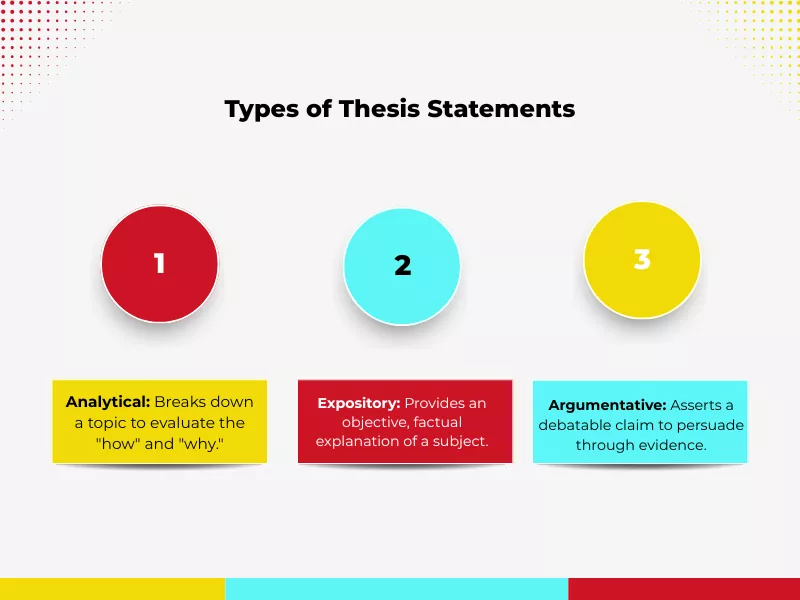
Identifying your essay goal is crucial when writing a paper. Each goal has its own type of statement to guide the reader. Each type has a different purpose, depending on your assignment.
1. Analytical
An analytical thesis breaks an issue into its core components. It offers a detailed analysis of the topic to explain an issue. The statement should reflect the interrelation of components. It assesses the “how” and “why” of a particular topic, rather than reporting facts.
2. Expository
The expository statement is informative. It defines a topic in an objective manner. This type of statement is a guide for the facts you will discuss. This is the most appropriate for descriptive, definitional, or chronological essays.
3. Argumentative
An argumentative thesis statement is a strong stance. It makes a claim that’s not a fact but rather a matter of debate. You need to explain, argue, and prove your claim in the text using evidence and reasoning.
This is ideal for writing about a controversial issue with various perspectives. It’s important to know how to write a claim in this kind of writing.
How to Write a Thesis Statement for an Essay?
Creating a solid focus starts with a basic structure. Follow a thesis statement formula for research paper assignments: Topic + Stance + Supporting Reasons = Thesis Statement.
This will help make your argument logical. Here are some clear and concise thesis statement tips:
- Determine the main subject of your paper before you begin writing.
- Review a guide with examples to understand how to word claims.
- Formulate a rough draft first and perfect it later as you gather data.
- Use your statement to promote a specific perspective or unique logic.
- Your statement should always provide a direct answer to a question.
- Explore how your ideas link back to this single central sentence.
- Aim to provide an interpretation of the facts rather than just listing them.
- This sentence must control the focus and tone of the rest of your essay.
Sometimes topics are assigned by teachers for the essay. In both scenarios, when the topic is assigned or not assigned, here’s a quick way to generate a thesis statement:
a. How Do You Write a Thesis Statement for a Research Paper When the Topic Is Assigned?
Every prompt can be turned into one core question. This helps you find the true purpose of your paper.
Take a close look at the assignment and reformulate it as a question. The answer to this question will be your thesis statement.
After you have this main point, it is easy to learn how to write an essay outline that fits. This step ensures that your entire project stays relevant to the instructions.
Example Process:
- Topic Assigned: Write an essay discussing how solar energy helps modern homeowners.
- Turned into a query: What are the primary benefits of installing solar panels on a home?
- Formulate an answer: Solar panels help homeowners by lowering monthly power bills and reducing a family’s carbon footprint.
The final answer is the key point of your text. It indicates what research you need to do, and what you need to consider. This method ensures that your writing always stays relevant to the original assignment.
b. How to Write a Thesis Statement When the Topic is not Assigned?
This can be done with a bit of research. First, consider a couple of topics of interest or related to the course. You need to narrow down from a general idea to a particular issue or question. If the topic is too wide, you will struggle to cover it deeply.
Select a topic where opinions vary so your writing is not dull. Let’s take up the example of how to write a thesis statement for an argumentative essay in the very next section:
Example: Thesis Statement for Argumentative Essay Step By Step
This requires a strategic approach. You must ensure your entire paper revolves around proving a specific point of view. Here are the steps:
- Choose a topic: Focus on something specific, like plastic bans or technology in schools. Look for popular or controversial debates in recent news.
- Establish your stance: Take a side that other people might oppose.
- Draft an assertion: Ensure your claim is debatable and requires proof to be accepted. Ensure enough evidence exists to build a solid case.
- Incorporate proof: Plan to use credible sources and textual evidence to build a strong case.
- Build your argument: You must analyze every fact to show how it helps persuade the reader.
- Provide backup: Always offer enough evidence to support the claim you make at the beginning.
21 Thesis Statement Examples for Your Inspiration (For Both UK and US Academics)
Learning how to write a proper thesis statement is often a tricky part of the writing process. Reviewing good thesis statement examples for university essays provides a helpful hint to start your draft. A common mistake is creating a sentence that is too broad. When a claim lacks focus, you often need to revise it to add specific evidence.
The following breakdown shows how to turn a weak idea into a sharp argument. This transition helps your reader understand your logic from the very first sentence.
Argumentative Thesis Statement Examples
These examples show how to take a clear position that others might refute. These focus on persuading the audience through a specific stance.
|
Topic |
Weak Example |
Strong (Argumentative) Example |
|
High School Sports |
High school sports are good for kids to play. |
Mandatory high school sports improve student mental health by teaching time management. |
|
Public Transport |
We should have more public buses in cities. |
Free city-wide public transport reduces urban traffic congestion and lowers carbon emissions. |
|
Tech in Schools |
Tablets are used in many classrooms today. |
Using tablets in elementary schools hinders fine motor skills and leads to screen addiction. |
|
Fast Fashion |
People buy a lot of cheap clothes now. |
Fast fashion promotes unfair labor practices and causes massive pollution in developing nations. |
|
Diet and Health |
Eating meat can be bad for the planet. |
Adopting a plant-based diet is the most effective way for individuals to lower their carbon footprint. |
Analytical Thesis Statement Examples for Essays
An analytical approach explores how to write a good thesis statement by breaking a topic into its parts. These samples analyze a specific subject deeply.
|
Topic |
Weak Example |
Strong (Analytical) Example |
|
Classic Literature |
Shakespeare writes about love in Romeo and Juliet. |
Shakespeare uses the “starcrossed” motif to argue that social conflict outweighs individual passion. |
|
Advertising |
Commercials make people want to buy things. |
Luxury perfume ads use specific lighting and minimalist music to associate brands with social status. |
|
Space Travel |
We have learned a lot from going to space. |
International space exploration promotes peace by forcing nations to share sensitive technology. |
|
Urban Architecture |
Tall buildings change how a city looks. |
Brutalist architecture reflects the desire for functional housing in post-war European cities. |
|
Historical Conflict |
Many things caused the French Revolution. |
High grain prices and heavy taxation of the Third Estate were the primary triggers for revolution. |
Expository Thesis Statement Examples
Expository claims offer a neutral path to how to write a strong thesis statement. They explain a concept clearly without being overly biased.
| Topic | Weak Example | Strong (Expository) Example |
| Honeybee Population | Honeybees are dying out in many places. | The decline in honeybee populations stems from pesticide use, habitat loss, and global warming. |
| Solar Energy | Solar power is becoming very common. | Residential solar systems work by converting sunlight into electricity via photovoltaic cells. |
| Coffee Consumption | A lot of people drink coffee every morning. | Daily caffeine consumption boosts focus by blocking adenosine receptors in the brain. |
| Internet History | The internet has changed since it started. | The shift to Web 2.0 allowed for user-generated content and the rise of interactive social media. |
| Local Government | City councils have many jobs to do. | City councils manage urban growth by passing local laws, setting budgets, and fixing infrastructure. |
Starting your paper with one of these clear models sets the tone for your work. Once you provide the evidence in your body paragraphs, choosing effective conclusion starters will help reinforce your original claim.
Example of Literary Analysis Thesis Statements
If you are wondering what a good thesis statement for a literary analysis is, remember that a successful claim focuses on how a specific literary device reveals a deeper theme.
Instead of just describing the plot, you must analyze the author’s hidden message.
|
Title |
Weak Example |
Strong (Literary) Example |
|
The Great Gatsby |
Gatsby loves Daisy and wants to be rich. |
Fitzgerald uses the green light to symbolize the unreachable nature of the American Dream. |
|
1984 |
George Orwell writes about a scary government. |
Orwell employs the “Thought Police” to argue that language is a primary tool for psychological control. |
Thesis Statement Examples of a Compare and Contrast Paper
This type of statement highlights specific similarities and differences between two subjects. It explains the significance of the relationship between them and how they interact.
|
Topic |
Weak Example |
Strong (Compare/Contrast) Example |
|
Governance |
Democracies and autocracies have many differences. |
Both systems aim for order, but democracy relies on participation while autocracy uses state coercion. |
|
Education |
Remote learning is different from sitting in a classroom. |
Both methods educate students, but remote learning provides flexibility while traditional classes build social skills. |
Narrative Essay Thesis Statement Examples
Many students ask how to write a thesis statement for a narrative essay? Unlike academic papers, a narrative thesis usually expresses a life lesson or a core insight from a personal experience.
|
Theme |
Weak Example |
Strong (Narrative) Example |
|
Failure |
I failed my driving test, and it was hard for me. |
Failing my first driving test taught me that patience and discipline are more valuable than speed. |
|
Service |
Helping at the local shelter was a good experience. |
Volunteering at the local shelter showed me how small acts of service can restore a community’s spirit. |
What Mistakes Should I Avoid When Writing a Thesis Statement?
- Stating a dictionary definition: Your opening should not start with “Webster defines…”
- Overcrowding with ideas: Do not try to solve five different problems in a single sentence.
- Using first-person pronouns: Phrases like “In my opinion” or “I think” make your argument feel weak.
- Being too aggressive: Use evidence to prove your point instead of using hostile or insulting language.
- Burying the sentence: Ensure your claim stays at the end of the first paragraph so it isn’t missed.
- Ignoring the prompt: Always check that your statement directly answers the question your teacher asked.
Need Help with Thesis Statement Writing? Assignments4u Can Help!
A weak thesis can destroy an entire paper before you finish the first page. One poorly phrased claim leads to confusing body paragraphs and low marks. At Assignments4u, we understand the pressure of balancing tight deadlines and strict grading rubrics.
Our take my online class experts specialize in creating professional claims for every level, from US college essays to UK dissertations. We cover every subject, ensuring your specific niche is handled with academic precision. Don’t risk your GPA on a “good enough” draft when you can have a perfect foundation.
Let us craft a clear, high-impact focus for your research or narrative assignments. Our support helps you submit with confidence and ensures your work meets institutional standards.
Conclusion
Mastering the thesis statement is one of the most effective ways to elevate your academic writing instantly. It transforms a vague collection of thoughts into a disciplined, persuasive argument. Do not settle for a wishy-washy opening that leaves your audience guessing. By using a clear formula and a narrow focus, you ensure every sentence in your paper serves a defined purpose. Start building stronger, more impactful essays today.
Frequently Asked Questions
Can a Thesis Statement be a Question?
A thesis statement should not be a question. Its main goal is to provide a firm claim or a definitive position for the reader to follow. While your research usually begins with a specific question, the final sentence in your introduction must be the solution.
Your statement serves as the actual answer to the question you investigated. This format ensures your paper takes a clear stance rather than leaving the core argument open for doubt.
What is the difference between a thesis statement for an opinion paper versus a research paper?
An opinion paper thesis focuses on your personal perspective and belief on a subject. A research paper thesis must be objective and based on a synthesis of existing facts and external data.
How do I revise a thesis statement after drafting my essay?
Read through your body paragraphs to see if your focus shifted during the writing process. Adjust your thesis to include the new points or arguments you actually ended up proving in your text.
Can a thesis statement include evidence or quotes?
No. A thesis statement should only be your unique claim or position. You should save specific evidence, statistics, and direct quotes for the body paragraphs to support your assertion.
How does a thesis statement evolve in a longer research paper?
In a short paper, the thesis remains a single direct point. In a long research project, the statement becomes more complex to allow for various sub-topics and multi-layered analysis.

Want To See My Profile — Check Now
- Figurative Language: Types, 60+ Examples, and How to Use Them - September 16, 2026
- A List of 100+ Policy Speech Topics for College Students - July 6, 2026
- How to Write a Thesis Statement (UK/US Guide + 21 Examples) - May 4, 2026


