
Have you ever said to yourself, ‘I will start my homework after I complete this episode of ‘What If?’ and then spent three hours going through all the theories behind the series? Well, if you have, you are not alone. Numerous students keep their homework and assignments aside, not because they have to watch a series, but because the deadline is not near.
While the situation is relatable, you must also understand that such procrastination can lead to last-minute stress and low grades. Therefore, the best way to avoid such a situation is by keeping all distractions away.
Wondering how to stop procrastinating on assignments? Are there more ways? Well, there is. Let’s explore them.
Key Takeaways
- Procrastination is driven by emotions (stress, anxiety), not laziness.
- Key causes: fear of failure, perfectionism, boring tasks, low confidence.
- Start small & break tasks into manageable steps.
- Set clear, realistic goals to avoid overwhelm.
- Manage time effectively with planning and prioritization.
- Minimize distractions to improve focus.
- Practice mindfulness & self-compassion to reduce avoidance.
- Accountability (friends/mentors) helps maintain consistency.
- Reward progress to stay motivated.
- Avoid all-nighters; they reduce performance.
Why Do Students Procrastinate on Assignments?
This is something you must know before learning about the ways to stop procrastinating on assignments. Research shows that 80-95% of students procrastinate on assignments to cope with negative emotions.
Here’s a look at the various psychological reasons for procrastination, in addition to that:
A. Fear of Failure and Evaluation Anxiety
Numerous students delay work to protect their self-esteem. By starting late, they can blame a poor grade on not having enough time, instead of a lack of ability. Can you believe that? Well, research says so. But, are you among those students who do this?
B. Perfectionism
The stress of producing flawless work can affect even the best student. There are instances where students wait for the perfect moment of inspiration. They often put a task on hold because they don’t feel they can meet their own unrealistic standards. Sounds strange, but if you think, you might find yourself in this category.
C. Tedious Tasks
In case a student finds an assignment difficult, boring, or irrelevant, they often keep it aside. It is a common psychology among students. They want to escape the unpleasant feelings and switch to immediate pleasure, like scrolling social media or watching a web series. They have the option to hire an online assignment help expert, though, to get the job done.
D. Self-Doubt and Low Self-Efficacy
One of the major reasons students procrastinate is their lack of confidence. They doubt their ability to complete the task, or they simply don’t know where to start. The take my online class experts have also talked about students who ask for help because they are completely clueless about where to start.
We think you can relate to any one of the above scenarios. Now, how do you avoid it and focus on your assignments? Don’t worry, we will walk you through a few of them.
How to Stop Procrastinating on Assignments: 9 Effective Strategies
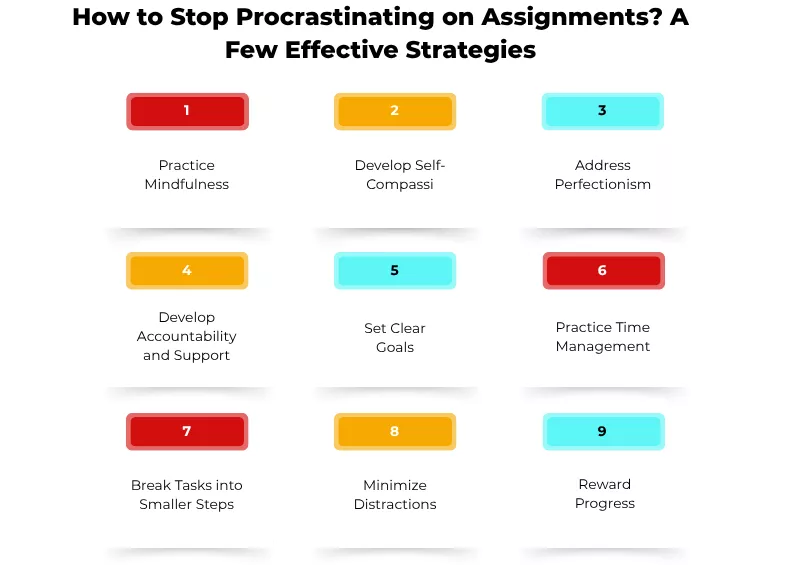
There are a few effective strategies from a psychological perspective to avoid procrastination. Let’s take you through them to help you with the problems:
A. Practice Mindfulness
Practising mindfulness is one of the effective strategies to improve your focus and avoid procrastination. It is about focusing on the present moment with acceptance and without judgment.
Mindfulness can be practised using techniques like meditation, body scans, and mindful observation. It helps reduce stress, improve focus, and emotional recognition. While this is an effective strategy, you need to start slow and increase daily.
B. Develop Self-Compassion
A major reason for procrastination among students is the fear of failure. Therefore, to avoid it, you must develop self-compassion. It is about treating yourself with the same kindness, care, and understanding that you would offer a good friend, especially during times of failure, suffering, or imperfection.
It is necessary to avoid harsh self-criticism when you face any failure. This fuels procrastination and negatively impacts self-esteem. The only way to avoid such situations is to be compassionate with yourself. Whenever you face such a situation, try doing these things to refocus and work on your assignments.
C. Address Perfectionism
The perfectionistic tendencies lead to procrastination among students. Instead of waiting for the perfect moment of inspiration, it is crucial to focus on a growth mindset and focus on learning and improvement.
You need to accept that imperfection is natural in the assignment writing process. It is wise to prioritize progress over perfection. That will help you avoid procrastination and focus on your assignments.
D. Develop Accountability and Support
Another effective strategy to avoid procrastination on assignments is to share your goals and progress with a trusted friend, colleague, or mentor. It is about sharing with someone who can provide encouragement, feedback, and accountability.
The process helps maintain motivation and commitment to goals. The interactive process helps you stay motivated and work on assignments.
E. Set Clear Goals
Don’t set unrealistic goals for yourself. Most students make the mistake of setting unrealistic goals, like completing an assignment within a day, and end up getting stressed. This is why experts suggest that students set clear and achievable goals.
Take your abilities and time constraints into consideration before setting goals for yourself. It will help you complete all your tasks on time without being stressed about them.
F. Practice Time Management
The best way to avoid procrastination is to practice time management. Mostly, students fail to keep up with the tasks and procrastinate because they lack the necessary time management skills. They do not create a schedule and struggle at the end. It is crucial to implement effective time management strategies for better results.
Start by prioritizing your tasks. If you feel one task is simpler than the other, complete that first and start working on the complicated tasks slowly and steadily to ensure you complete them on time. Break your day into parts, keeping everything in your schedule, from exam preparation, daily classes, assignments, to that analysis of the What If episode in it.
G. Break Tasks into Smaller Steps
It is crucial to break down larger tasks into smaller, more manageable steps or sub-tasks. The approach helps reduce the workload. This helps increase the likelihood of getting started, thus preventing procrastination.
H. Minimize Distractions
A great way to avoid procrastinating on assignments is to minimize distractions. Make sure to turn off notifications, use website blockers, and set boundaries with colleagues. The best way to go about it is by creating a dedicated workspace.
I. Reward Progress
Reward yourself with a slightly longer watch time or 30 minutes of a multiplayer game session with your friends when you achieve a goal. This will keep you motivated throughout and will not let you step away from doing assignments. As a consequence, it will also improve academic performance in colleges and universities.
Endnote:
Procrastination is a reason most students fail to score well or maintain their grades. It is important to understand the reason and find the right ways to avoid it. Take the steps to ensure you focus on your studies without hampering any other activity.
We know that some of you also work part-time, and it gets difficult to maintain everything. You have the option to hire experts to help you with the online courses and assignments. Take help when needed and put every strategy into practice to have a great learning experience.
Frequently Asked Questions
Is procrastination a sign of laziness or anxiety?
Mostly anxiety, not laziness. Research shows that 80–95% of students procrastinate as a way to cope with negative emotions. Avoidance feels easier in the moment than confronting a task that triggers stress or insecurity.
How do I break the cycle of academic procrastination?
A few approaches work well together:
- Practice mindfulness to stay present and reduce stress,
- Set clear and realistic goals,
- Break assignments into smaller steps so they feel less overwhelming, and
- Use time management to schedule tasks before deadlines
Building in accountability, telling a friend or mentor your goals, also helps break the avoidance loop.
How do I motivate myself to start an assignment I hate?
Three things help most:
First, minimize distractions
Second, start small; commit to just one tiny sub-task rather than the whole assignment; getting started is the hardest part
Third, reward yourself after progress; a short gaming session or an episode of your favourite show works as a genuine motivator, as long as it comes after the work, not before.
Can pulling all-nighters fix last-minute procrastination?
Mostly, it doesn’t. While all-nighters may help you submit on time, sleep deprivation impacts memory consolidation, critical thinking, and writing quality. You may complete the assignment, but the output and your health will suffer. Consistent scheduling is a better option.
Does procrastination get worse with more assignments on your plate?
Yes, it often does. When the workload feels overwhelming, the brain tends to shut down and avoid all tasks rather than prioritize them. This is called task paralysis. Ironically, having more to do can result in doing nothing; making early planning and task-batching essential habits for busy students.
Can the environment you study in affect procrastination?
Absolutely. Studying in a cluttered, noisy, or uncomfortable space increases mental fatigue and makes it easier to drift toward distractions. Research in environmental psychology suggests that a clean, well-lit, and designated study space signals to your brain that it is work mode, naturally reducing the urge to procrastinate before you even open a textbook.

Want To See My Profile — Check Now
- Figurative Language: Types, 60+ Examples, and How to Use Them - September 16, 2026
- A List of 100+ Policy Speech Topics for College Students - July 6, 2026
- How to Write a Thesis Statement (UK/US Guide + 21 Examples) - May 4, 2026


