
Summary - Mathematical sentences are the literature of mathematics. It depicts the relationship between two expressions with a relational symbol like the equal sign... Solving equations involves weaving algebraic thinking that significantly enhances logical and analytical skills. Students learn it at elementary school, and they solve complex equations in middle school math. And mathematical sentences get more complex as they progress at the degree level.
In this article, we’ll answer the question “What is a number sentence?” and go through everything you need to know about this aspect of elementary math. Additionally, teachers can utilize our examples of number sentences in math exercises to assess their student’s level of understanding of mathematics.
What is a number sentence?
Elementary school children learn to solve number sentences, a combination of numbers, and mathematical operations (symbols). They first learn sum, then subtraction, multiplication, and division, respectively. To find the solution, they are given simple numerical sentences, like two numerics, a plus sign, and an equal sign.
So, a number sentence is a grouping of numbers and symbols of two numbers. Questions frequently take the form of mathematical sentences, also called “sums” or “problems.” The simplest example of a number sentence is 2+2=4.
A mathematical sentence is a crucial part of math homework for elementary school students. And until college level, you will get at least one math sentence or equation in your assignments. Many schools and colleges give complex equations. You must master all the information and logic to solve those, or you may get Assignments Help to eradicate the stress.

What is an example of a number sentence?
Two groups of numbers known as a mathematical sentence consist of a mathematical operation (such as addition, subtraction, multiplication, or division) and an equal sign or any other sign that makes sense. The other signs we use mainly in inverse operations are inequality (≠), greater-than (>), less-than (<), greater than or equal to (≥), less than or equal to (≤), etc.
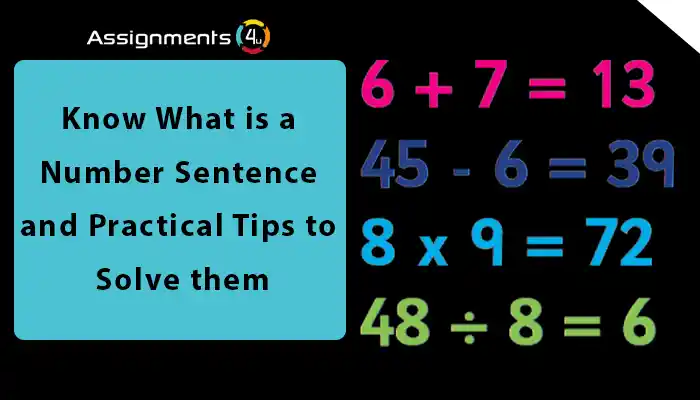
It also conveys a fact between two expressions, just like a written statement. For example, here are some mathematical sentences:
- Addition: 7 + 5 = 12
- Subtraction: 44 – 10 = 34
- Multiplication: 5 x 4 = 20
- Division: 35 ÷ 7 = 5
How do mathematical sentences improve mental math skills?

Children in the first grade usually start learning to write sentences using given numbers. To assist them in comprehending the value of numbers, they probably start by using items like counters, little toys, or other strategies that make learning school math fun.
- Students in 2nd grade learn to use the sum (+), subtract (-), and equality (=) to write mathematical statements within the multiplication tables.
- Students in 3rd grade learn to use multiplication tables to create and compute mathematical statements for multiplication and division. That includes two-digit numbers multiplied by one-digit numbers.
- Students in 5th grade should be able to make equivalence mathematical sentences using the terms factor, multiple, prime, square, and cube numbers (for example, 4 x 35 = 2 x 2 x 35; 3 x 270 = 3 x 3 x 9 x 10 = 92 x 10).

In this process, students