

The journey of a thousand miles begins with a single step, and for any college student, the academic journey of a research paper begins with a single, crucial decision: choosing a topic. The process of choosing a research topic can feel overwhelming, but it’s also an opportunity to explore your passions and contribute to your field. This step-by-step guide on how to choose a research topic covers everything, from brainstorming initial ideas to developing a robust framework for your study.
What Are the 5 Factors to be Considered in Choosing a Research Topic?
As you start to select your research topic, it’s important to assess its viability. Here are five crucial factors to consider to ensure you make the right choice.
1. Interest and Passion
Your genuine interest in the topic will be the fuel that gets you through the long hours of research and writing. Don’t choose a topic just because you think it will be easy or because it’s what your friend is doing. Align the topic with your interests.
For example, if you are into sports, then go for Sports Research Paper Topics.
2. Relevance and Significance
A good research topic should be relevant to your field of study and have some level of significance. Ask yourself:
- Why does this research matter?
- Who will benefit from this knowledge?
The impact of your study doesn’t have to be earth-shattering, but it should contribute to the academic conversation in a meaningful way.
3. Feasibility
This is a practical consideration that is often overlooked. Before you commit to a topic, you need to assess if you can realistically complete the research within your timeline and with the resources you have available. Consider:
- Access to data: Will you be able to find enough reliable data and sources to support your research?
- Time commitment: Be realistic about the scope of your project.
- Resources: Do you need special equipment, software, or funding?
4. Originality
Your research should aim to be original. This doesn’t mean you need to discover something completely new to science, but you should offer a fresh perspective or build upon existing knowledge in a unique way. Whether it’s through a novel methodological approach or a new way of analyzing existing data, originality is key.
5. Ethical Considerations
Finally, consider the ethical implications of your research. If your study involves human participants, you’ll need to ensure you can protect their privacy and well-being. If you are ever in doubt, consult your university’s ethics board or your advisor. It is crucial to be aware of and adhere to all ethical guidelines.
For a more detailed guide on topic development, check out this article on How to Develop Research Paper Topics.
What Are The Common Mistakes While Choosing a Research Topic?
Students need to avoid common mistakes during topic selection. There include:
| Category | Mistake | Why it Fails |
|---|---|---|
| Scope Issues | Too Broad | A broad topic lacks focus, leading to shallow or unfocused findings. |
| Too Narrow | A narrow topic may not provide enough material or data for meaningful analysis. | |
| Personal Factors | Lack of Genuine Interest | Choosing a topic to impress others rather than one you’re genuinely curious about can reduce motivation and engagement. |
| Unrealistic Topic | Selecting a topic that requires more time, money, or resources than are available can derail the project. | |
| Planning & Knowledge | Poor Advance Planning | Not spending enough time exploring topics can lead to missed opportunities and weaker outcomes. |
| Insufficient Knowledge | Starting with a topic you don’t understand well makes it hard to design research questions or methodology. | |
| Skipping the Literature Review | Ignoring existing studies may cause duplication of work and missing essential background information. | |
| Clarity & Feasibility | Vague Research Question | Without a clear, focused question, research can become scattered and lack direction. |
| Ignoring Practical Constraints | Overlooking time, cost, and resource limits can make the project unmanageable. |
What Is the Right Step-By-Step Action Plan for Choosing a Good Research Topic?
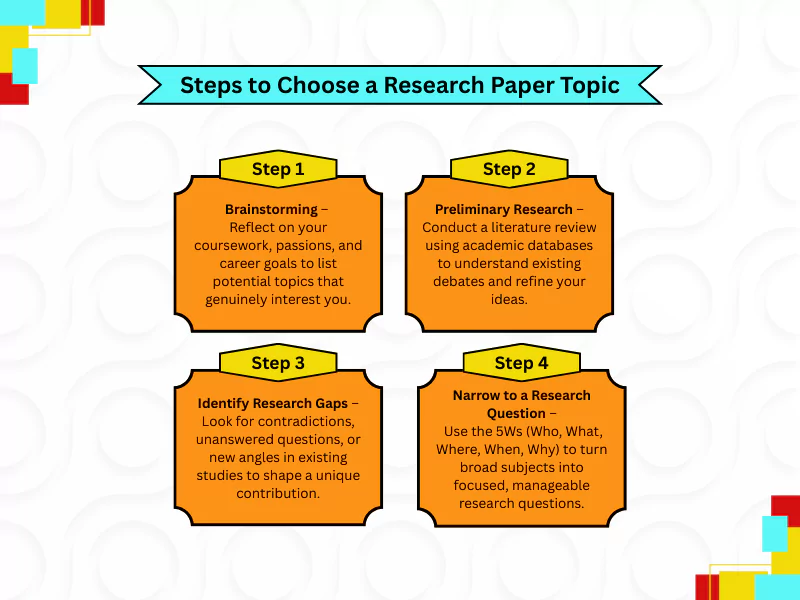
Now that you have understood the important consideration, it’s time to follow a practical action plan. Remember, finding the right research topic is a process of discovery. Here’s a breakdown of how to choose a topic for research:
Step 1: Brainstorming (Start with What You Know and Love)
The first step to choosing a research topic is to look inward. You’re going to be spending a lot of time with this subject, so it’s essential to select something that genuinely excites you. Start by:
- Reflecting on your coursework: Which lectures, readings, or class discussions sparked your curiosity?
- Considering your hobbies and passions: Can you connect your personal interests to your academic field?
- Thinking about your future career: Could your research project serve as a stepping stone to your desired profession?
Create a list of potential subjects. At this stage, no idea is too broad or too niche. Let your creativity flow.
Step 2: Conduct Preliminary Research and Literature Review
Once you have a few ideas, it’s time to see what’s already out there. A preliminary literature review will help you understand the existing conversations and debates within your field. This isn’t about reading everything ever written, but about getting a feel for the landscape.
Use your university’s database and academic journals to search for keywords related to your potential topics. As you review existing literature, you’ll start to see where the current research is focused and the relevance of the topic. This exploration can help you refine your own ideas.
Step 3: Identify and Address Research Gaps
At the time of choosing a good research topic, remember that an outstanding, high-quality research paper doesn’t just summarize existing knowledge; it adds something new. One of the best ways to do this is to address research gaps. These are areas that haven’t been fully explored in the existing literature. Look for:
- Contradictory findings: When different studies have conflicting results, that’s a gap.
- Unanswered questions: Do researchers consistently recommend further investigation into a specific area? That’s your cue.
- New angles: Can you apply an existing theory to a new context or population?
Once you identify a potential gap, your research will have a clear purpose. If you’re struggling to pinpoint these, you can always enlist a Research Paper Writing Service for guidance.
Step 4: From Broad Subject to Focused Research Question
To refine research topics further, you need to narrow your focus to a specific, manageable research question. These questions will guide your entire research process. To do this, use the “5Ws” framework:
- Who: Which population or group are you studying?
- What: What specific aspect of the topic are you interested in?
- Where: What is the geographical context of your research?
- When: What is the timeframe you’re examining?
- Why: What is the significance of this question?
By answering these, you can refine a broad idea into a focused question. For example, the broad topic is “climate change” and a clear, answerable, and manageable research question is “How has the decline in Arctic sea ice between 2000 and 2020 impacted the polar bear population in the Barents Sea region?”.
How Do I Narrow Down or Broaden My Research Topic Effectively?
It’s common for a topic to change as research progresses. If you find too much information, it’s time to narrow it down. Go back to your keywords and focus on a particular person, place, time period, or event. For example, instead of “postcolonial literature in India,” you could narrow it to “postcolonial dynamics of historical representation in Rushdie’s Midnight’s Children.”
Conversely, if you’re struggling to find sufficient reliable data, you might need to broaden your topic. Expand the concepts, time period, or groups of people you hope to study. For instance, if “women voting for Ross Perot in Poweshiek county” is too narrow, broaden it to “Iowa voters’ response to Ross Perot in the 1992 or 1996 election.” Consulting a librarian or professor can be very helpful if you suspect you’re overlooking sources.

Other Helpful Tips to Find a Research Topic
Sometimes, the best ideas don’t come from a textbook. If you are still struggling to find inspiration, here are some creative ways to find a research topic:
- Engage with current events and trends: Read reputable news sources, watch documentaries, and follow current events related to your field. Real-world problems are often ripe for academic investigation.
- Initial background reading: Use encyclopedias, specialized dictionaries, or even Wikipedia (as a starting point, not an end) to familiarize yourself with the basics of potential topics, identify key concepts, controversies, people, places, and jargon. This can also help you find additional sources through bibliographies.
- Talk to your professors and advisor: They are experts in their field and can offer valuable insight and direction.
- Attend academic conferences or webinars: Even virtual ones can expose you to the latest research and ongoing debates.
- Look at past student dissertations: Your university library likely has an archive of past theses and dissertations. These can be a great source of inspiration.
The key is to keep a flexible and inquisitive mind. You never know where you’ll find the inspiration for your next research project.
How to Develop a High-Quality Theoretical Framework?
Once you’ve settled on your topic, the next step is to build a theoretical framework. This framework outline is the research essay structure that will hold, formulate, and support your research. It’s the lens through which you will view your topic. Here are some crucial steps on how to develop one:
- Identify Key Concepts: Start by identifying the main concepts related to your topic and variables in your research question.
- Review Existing Theories: Explore the existing literature to find theories in the direction of your study and models that are relevant to your topic.
- Select the Best Fit: Choose the theory or theories that best explain the relationships between your key concepts. This will form the foundational reference of your framework.
- Articulate Your Framework: Clearly explain how the chosen theory will be applied in your research. You may need to create a diagram to illustrate the relationships between your variables. A strong theoretical framework will give your paper a solid academic grounding.
How to Choose a Dissertation or Research Topic for Different Academic Levels?
The expectations for your research project will vary significantly based on your academic level. Here’s how to tailor your approach.
- Choosing a Research Topic for Undergraduate Students: The primary goal is often to demonstrate a strong understanding of existing research. A focused case study or a comprehensive literature review on a specific aspect of a broader field is an excellent choice. The scope should be tightly controlled.
- Choosing a Research Topic for students pursuing master’s or honours: At this stage, students need to demonstrate more independence and make a modest but original contribution. This may involve collecting and analyzing your own data or developing a novel argument based on existing literature. Your analyses should be more advanced.
- Choosing a research topic for a PhD Scholar: The pinnacle of academic research, a PhD thesis, demands a significant and original contribution to your field. Your work must be grounded in a deep understanding of existing scholarship, identify a clear gap, and offer a substantial new insight. The topic selection process is longer and requires extensive consultation with your supervisory committee.
Discipline-Specific Strategies to Select a Research Topic
Every field has its own hot-button issues, methodologies, and classic debates. Here’s a detailed look at how to approach this in various fields, complete with unique topic ideas to spark your inspiration.
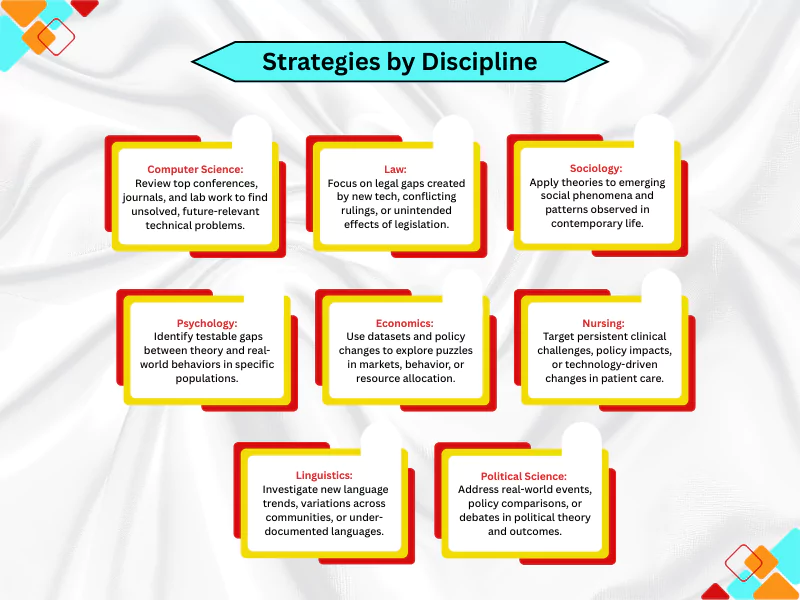
How to Choose a Research Topic for a PhD in Computer Science?
Computer science is a rapidly evolving field driven by innovation. A strong PhD topic should be at the forefront of this change. Here are some tips to choose a research topic for a PhD in Computer Science:
- Look at leading conference proceedings (like NeurIPS, ICML, or CHI)
- Read recent high-impact journal articles
- Follow the work of prominent research labs.
Your goal is to identify a problem that is not only unsolved but also technically challenging and relevant to future technological trends.
Here are some topic ideas:
- Federated Learning for Privacy-Preserving AI
- Bias and Fairness in Algorithmic Systems
- Quantum Computing’s Threat to Cryptography
- Energy-Efficient AI (Green AI)
- Explainable AI (XAI) for Medical Imaging
- The Security of the Internet of Things (IoT)
- Natural Language Processing (NLP) for Under-resourced Languages
How to Choose a Research Topic for a PhD in Law?
Legal research at the PhD level moves beyond analyzing what the law is to critiquing what it should be. A compelling topic addresses the complex interplay between law, society, and justice.
Here are some tips to choose a research topic for a PhD in Law:
- Look for areas where new technologies are outpacing existing regulations.
- Identify splits in judicial circuits or inconsistencies in case law.
- Examine the unintended consequences of recent legislation.
Your goal is to address a gap in legal doctrine or propose a new framework to resolve a contemporary legal challenge.
Here are some topic ideas for a PhD in Law:
- The Jurisprudence of Artificial Intelligence
- Data Sovereignty and Transnational Law
- Intellectual Property in the Metaverse
- Climate Change Litigation and Corporate Responsibility
- Biotechnology and Legal Ethics
- The Future of Digital Contracts on the Blockchain
- Access to Justice in the Digital Age
How to Choose a Research Topic in Sociology?
Sociology seeks to understand the structures and dynamics of social life. A great topic often emerges from observing a contemporary social phenomenon and applying a theoretical lens to understand it.
Here are some tips for choosing a research topic in sociology:
- Apply classic sociological theories to modern phenomena like online communities.
- Observe emerging social patterns in your daily life and ask “why?”
- Read ethnographic studies to see how research is conducted in the field.
Your goal is to use systematic investigation to provide a new insight into how social forces shape human experience.
Here are some topic ideas for Sociology:
- The Social Construction of Authenticity on Instagram
- The Gig Economy and Social Stratification
- Digital Communes: Governance in Online Communities
- Urban Revitalization vs. Gentrification
- The Role of Memes in Political Discourse
- ‘Cancel Culture’ as a Modern Social Sanction
How to Choose a Research Topic in Psychology?
Psychology is a vast field, ranging from neuroscience to social behavior. A strong topic often identifies a specific population or a puzzling phenomenon and asks a question that can be empirically tested.
To find a research topic in psychology
- Read the “future research” sections of recent meta-analyses or review articles.
- Identify a gap between a well-established theory and a new real-world behavior.
- Focus on a specific population that interests you (e.g., adolescents, athletes, remote workers).
Your goal is to formulate a topic that’s based on a specific, testable research question that can be investigated through experimental, correlational, or qualitative methods.
Here are some clear research topic ideas for Psychology:
- The Cognitive Impact of ‘Doomscrolling’
- Political Polarization and Cognitive Dissonance
- The ‘Gamification’ of Mental Health Apps
- Attachment Styles and Online Dating Behaviors
- The Psychology of Susceptibility to Misinformation
- Virtual Reality (VR) as a Therapeutic Tool for Phobias
- The Impostor Phenomenon in First-Generation College Students
How to Choose a Research Topic in Economics?
Economics is the study of scarcity and choice. A good topic identifies an interesting puzzle in human behavior, market dynamics, or policy effectiveness, using data to provide evidence. Here are some tips to choose a research topic in economics:
- Explore large public datasets (e.g., from the World Bank or BLS) for interesting patterns.
- Consider the economic consequences of a recent major policy change.
- Look for real-world situations where individuals or firms appear to be acting irrationally.
Here are some topic ideas:
- The Economics of Wage Determination in the Gig Economy
- Behavioral Nudges and Household Energy Consumption
- The Economic Impact of Student Loan Forgiveness
- Game Theory and Strategic Entry in Tech Markets
- Sector-Specific Impact of International Trade Tariffs
- The Economic Valuation of Urban Green Spaces
- Cryptocurrency’s Impact on Central Bank Monetary Policy
How to Choose a Research Topic in Nursing?
Nursing research is focused on evidence-based practice
- finding practical solutions to improve patient outcomes
- Enhance safety and support the well-being of nurses.
While choosing a good research topic in nursing, consider
- Identifying a persistent problem or inefficiency you’ve observed in a clinical setting.
- Reviewing leading nursing journals for recurring themes or calls for research.
- Examining the impact of new healthcare technologies or policies on patient care.
The goal should be conducting research that provides clear, actionable insights for the healthcare community.
Here are some topic ideas:
- Nurse Burnout and Patient-to-Staffing Ratios
- The Efficacy of Telehealth for Chronic Disease Management
- Developing Culturally Competent Communication Training
- The Impact of 12-Hour vs. 8-Hour Shifts on Medical Errors
- A Qualitative Study on End-of-Life Care
- Integrating Mental Health Screening in Primary Care
- Alarm Fatigue in Clinical Settings and Cognitive Load
How to Choose a Research Topic in Linguistics?
Linguistics is the scientific study of language. Your research can focus on anything from the abstract structure of sentences (syntax) to the way language is used in society (sociolinguistics) or changes over time (historical linguistics).
Here are some tips to choose a research topic in linguistics:
- Look for linguistic puzzles in everyday language, like new slang terms or speech patterns.
- Explore how language use varies across different social groups or online communities.
- Read literature on under-documented or endangered languages to find gaps in knowledge.
Your goal is to apply linguistic methodologies to describe a language phenomenon, test a theoretical hypothesis, or analyze the social function of language.
Here are some topic ideas:
- The Evolution of Internet Slang on TikTok and Its Linguistic Lifecycle
- Language and Identity: Code-Switching Practices in Bilingual Communities
- A Phonetic Study of Vocal Fry and Its Social Perceptions
- Language Revitalization through Mobile Applications for Endangered Languages
- The Syntax and Grammatical Functions of Emojis in Digital Communication
- The Pragmatics of Political Apologies and Their Discourse Strategies
- Tracking Linguistic Innovations on Social Media Using Computational Linguistics
How to Choose a Research Topic in Political Science?
Political science examines power, government, and political behavior. A strong research topic often addresses a real-world political problem, a major theoretical debate, or the impact of a significant event.
Here are some tips to choose a research topic in political science:
- Focus on a major real-world event and analyze its political causes or consequences.
- Compare how different countries or states handle the same policy problem.
- Identify a major theoretical debate in the literature and find a case study to test it.
Your goal is to use political theory and empirical evidence to explain a political outcome, evaluate a policy, or understand a power dynamic.
Here are some topic ideas:
- The Impact of Social Media Algorithms on Political Polarization
- The Geopolitics of Critical Minerals: Global Competition for Lithium and Cobalt
- State-Level Policy Innovation as a Response to Federal Gridlock
- The Securitization of Cyberspace: State Responses to Cyber-Attacks
- Foreign Aid and Democratic Development: Analyzing Governance Outcomes
- The Rise of Political Populism and the Use of Campaign Rhetoric
- Public Trust in the Supreme Court and the Effects of Controversial Rulings
How to Choose a Research Topic in Accounting?
Modern accounting research extends far beyond traditional bookkeeping and now includes data analytics, corporate governance, ethics, and sustainability.
Here are some tips to choose a research topic in accounting:
- Consider the challenges created by new financial regulations or standards (e.g., ESG).
- Analyze the impact of technological disruption from AI and blockchain on the profession.
- Read reports from professional bodies to identify current and future industry challenges.
Your goal is to analyze how accounting information is produced and used, evaluate regulations, or explore the behavioral and ethical dimensions of the profession.
Here are some topic ideas:
- The Financial Impact of ESG Reporting on Stock Market Performance
- Forensic Accounting in the Digital Age: Tracing Fraudulent Cryptocurrency Transactions
- The Effectiveness of the Sarbanes-Oxley Act: A Two-Decade Retrospective on Corporate Fraud
- Behavioral Accounting and the Influence of Cognitive Biases on Auditor Judgment
- The Role of Artificial Intelligence in Auditing and Its Effect on Audit Quality
- Tax Policy and Corporate Behavior: Evaluating the Effectiveness of State Tax Incentives
Conclusion
The process of selecting your research topic is the first and arguably most important step in producing high-quality research. It is a blend of personal passion and academic rigor. You need to understand that a well-chosen topic becomes a source of motivation, not a burden. By brainstorming creatively, conducting a thorough literature review, narrowing your focus, and systematically formulating your research problem, you set a clear course for success.
It’s essential to avoid common mistakes and remain flexible, as your ideas may evolve. If the process feels overwhelming, connecting with a professional assignment helper can provide the clarity needed to stay on track. The next step is to begin your investigation, knowing you have a solid foundation. If you need a final check before submission, our Checklist To Write A Research Paper Conclusion can be a valuable tool. This journey will be challenging, but a carefully selected topic will make it a truly rewarding academic exploration.
Frequently Asked Questions
What makes a good research topic?
A good research topic is interesting to you, matches assignment requirements, and can be supported with credible evidence.
How do I narrow down a broad research topic?
Focus on a specific person, event, place, or timeframe. For example, instead of postcolonial literature in India, refine your research topic to postcolonial themes in Salman Rushdie’s Midnight’s Children.
What if my research topic is too narrow?
Broaden your research topic by expanding the group, period, or context you study. For example, instead of women in Iowa voting for Ross Perot in 1992, try Iowa voters’ response to third-party candidates in the 1990s.
How do I turn a research topic into a research question?
Start with your idea and phrase it as a clear, focused question. Example: Research topic -> Frank Lloyd Wright -> Research question -> How has Frank Lloyd Wright influenced modern architecture?
How do I find sources for my research topic?
Brainstorm keywords related to your research topic (event, time, people, place), search library catalogs and databases, and review background sources like encyclopedias.
Why should I use reference sources before finalizing my research topic?
Reference sources give you an overview of the research topic, clarify terms, highlight key figures, and provide bibliographies for deeper study.
How do I track down citations for my research topic?
Identify the type of source (book, article, dissertation, etc.), then use library catalogs or databases to locate it or request it through interlibrary loan.
Related Blogs

Interesting Research Paper Topics for High Schoolers in 2025

Examples And Tips For Writing A Research Paper Outline

What Are The Top 8 Type Of Research Papers You Should Know?

Want To See My Profile — Check Now
- Best 200+ SAE Project Ideas for School Students - October 25, 2025
- How to Choose a Research Topic? Tips with Discipline-Specific Topic Ideas - September 17, 2025
- Time Management Tips for High School Students: A Complete Guide - September 9, 2025