

The journey of a thousand miles begins with a single step, and for any college student, the academic journey of a research paper begins with a single, crucial decision: choosing a topic. The process of choosing a research topic can feel overwhelming, but it’s also an opportunity to explore your passions and contribute to your field. This step-by-step guide on how to choose a research topic covers everything, from brainstorming initial ideas to developing a robust framework for your study.
What Are the 5 Factors to be Considered in Choosing a Research Topic?
As you start to select your research topic, it’s important to assess its viability. Here are five crucial factors to consider to ensure you make the right choice.
1. Interest and Passion
Your genuine interest in the topic will be the fuel that gets you through the long hours of research and writing. Don’t choose a topic just because you think it will be easy or because it’s what your friend is doing. Align the topic with your interests.
For example, if you are into sports, then go for Sports Research Paper Topics.
2. Relevance and Significance
A good research topic should be relevant to your field of study and have some level of significance. Ask yourself:
- Why does this research matter?
- Who will benefit from this knowledge?
The impact of your study doesn’t have to be earth-shattering, but it should contribute to the academic conversation in a meaningful way.
3. Feasibility
This is a practical consideration that is often overlooked. Before you commit to a topic, you need to assess if you can realistically complete the research within your timeline and with the resources you have available. Consider:
- Access to data: Will you be able to find enough reliable data and sources to support your research?
- Time commitment: Be realistic about the scope of your project.
- Resources: Do you need special equipment, software, or funding?
4. Originality
Your research should aim to be original. This doesn’t mean you need to discover something completely new to science, but you should offer a fresh perspective or build upon existing knowledge in a unique way. Whether it’s through a novel methodological approach or a new way of analyzing existing data, originality is key.
5. Ethical Considerations
Finally, consider the ethical implications of your research. If your study involves human participants, you’ll need to ensure you can protect their privacy and well-being. If you are ever in doubt, consult your university’s ethics board or your advisor. It is crucial to be aware of and adhere to all ethical guidelines.
For a more detailed guide on topic development, check out this article on How to Develop Research Paper Topics.
What Are The Common Mistakes While Choosing a Research Topic?
Students need to avoid common mistakes during topic selection. There include:
| Category | Mistake | Why it Fails |
|---|---|---|
| Scope Issues | Too Broad | A broad topic lacks focus, leading to shallow or unfocused findings. |
| Too Narrow | A narrow topic may not provide enough material or data for meaningful analysis. | |
| Personal Factors | Lack of Genuine Interest | Choosing a topic to impress others rather than one you’re genuinely curious about can reduce motivation and engagement. |
| Unrealistic Topic | Selecting a topic that requires more time, money, or resources than are available can derail the project. | |
| Planning & Knowledge | Poor Advance Planning | Not spending enough time exploring topics can lead to missed opportunities and weaker outcomes. |
| Insufficient Knowledge | Starting with a topic you don’t understand well makes it hard to design research questions or methodology. | |
| Skipping the Literature Review | Ignoring existing studies may cause duplication of work and missing essential background information. | |
| Clarity & Feasibility | Vague Research Question | Without a clear, focused question, research can become scattered and lack direction. |
| Ignoring Practical Constraints | Overlooking time, cost, and resource limits can make the project unmanageable. |
What Is the Right Step-By-Step Action Plan for Choosing a Good Research Topic?
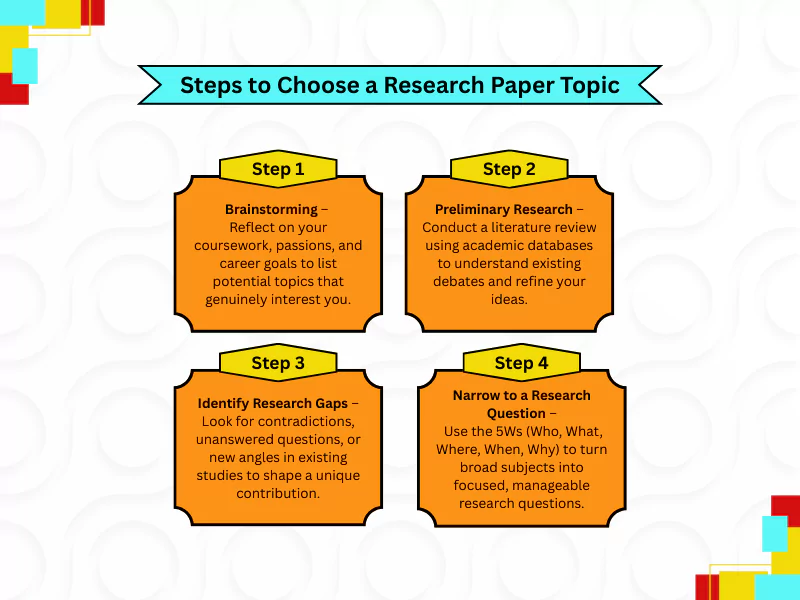
Now that you have understood the important consideration, it’s time to follow a practical action plan. Remember, finding the right research topic is a process of discovery. Here’s a breakdown of how to choose a topic for research:
Step 1: Brainstorming (Start with What You Know and Love)
The first step to choosing a research topic is to look inward. You’re going to be spending a lot of time with this subject, so it’s essential to select something that genuinely excites you. Start by:
- Reflecting on your coursework: Which lectures, readings, or class discussions sparked your curiosity?
- Considering your hobbies and passions: Can you connect your personal interests to your academic field? Browsing passion project ideas is a quick way to surface these connections.
- Thinking about your future career: Could your research project serve as a stepping