

Research papers must be properly cited to offer academic credibility to the reference sources and avoid plagiarism. There are generally three popular ways of citation: MLA, APA, and Chicago. Choosing the right one depends on your field of study. Each style has its own format for structuring in-text citations and the reference page. In this guide, we will explicitly discuss the MLA vs APA vs Chicago to help you understand each and choose the right one as per your academic discipline.
Key Takeaways on MLA vs APA vs Chicago
- Citation is the process of documenting sources in a research paper, and there are various citation formatting styles.
- Choosing among MLA vs APA vs Chicago for research papers depends on the field of study and academic discipline. APA is best for social science, MLA is best for Humanities, and Chicago is best for fine arts.
- While the difficulty level of APA is moderate, MLA is the simplest and easiest. On the other hand, Chicago is detailed yet offers flexibility by offering two citation styles.
- The Chicago Manual of Style offers two systems: Notes and Bibliography and Author-date.
- Chicago (for Scientific papers) and APA use author-date, and MLA use Author-page in-text citation. APA uses a comma between the author and date, while Chicago doesn’t. MLA also doesn’t use a comma between the author and the page.
- A title page is needed in APA and CMOS, while MLA doesn’t require it.
Overview of Academic Citation Formats: MLA vs APA vs Chicago
Before we jump into citation styles comparison, let’s discuss MLA, APA, and Chicago style in brief:
1. APA Style
The APA citation style originated in 1929 and was first used by a collaborative group of the American Psychological Association. APA uses in-text citations with the author’s last name and the date of publication.
2. MLA Style
Also known as MLA 9th Edition Citation, the first style sheet was introduced in 1951, compiled by William Riley Parker (a ~31-page document in PMLA) – the Executive Secretary of the Modern Language Association of America. This style also uses in-text citations by prominent usage of page numbers and focuses on authorship.
3. Chicago Style
Popularly known as the Chicago Manual of Style, it was originally introduced by the University of Chicago Press in 1906. The Chicago Citation Format features two systems:
- Author-Date: Uses parenthetical in-text citation like APA.
- Notes and Bibliography (footnotes/endnotes): Uses in-text superscript numbers that refer to footnotes or endnotes.
When to use MLA vs APA vs Chicago Citation Style?
For choosing the right citation style, take an idea from this table:
| Citation Style | Where to Use | Academic Levels | Why is it preferred? |
| APA |
Social sciences, including
|
|
|
| MLA |
Humanities, including
|
|
|
| Chicago |
|
|
|
Citation Styles Comparison: How Do MLA, APA, and Chicago Differ in Formatting?
Each style of citing sources in academic writing has different features and rules for how to format an essay with references. Let’s do a citation comparison of MLA, APA, and the Chicago Manual of Style:
1. Features of MLA Citation Style
The general formatting rules are:
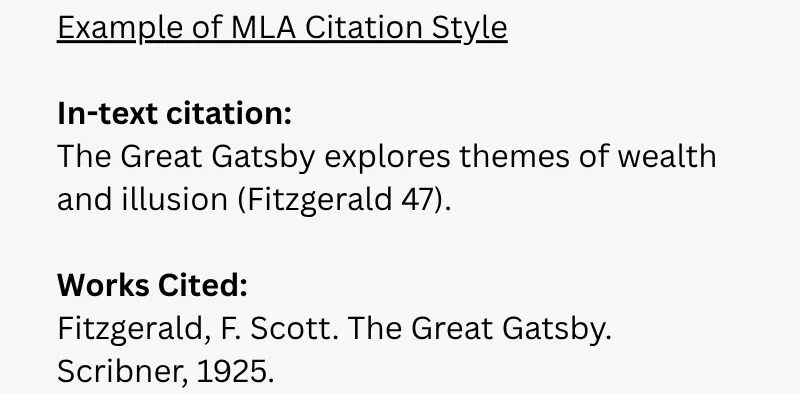
- A title page is not required in MLA style. Here, you need to mention the name of the author, the instructor’s course, and the date on the first page, before the title.
- For In-text Citations, an author-page format (Author’s last name + page number in parentheses; no comma between) is used. For example (Carter 47)
- In the work cited, Author last name comes first, then the title in italics, the publisher, year.
- The list of all the referenced sources is named “Works Cited”. It appears at the end of the paper.
- The start of the Works Cited entry must match the in-text name to ensure easy finding for the reader.
Recent Updates
The latest update, MLA 9th Edition (April 2021), recently expanded the guidelines. Some of them are:
- The Flexible 9-element System: The term “Publisher” doesn’t have to be literal always. It could even refer to a theater company that stages plays, for example.
- Citing Digital Sources: Online materials (e.g., social media posts, digital archives, websites, etc.) can be cited.
- Audio-Video Citations: If citing a video clip or an audio recording, timestamps (e.g., 03:22:12) can be included in the in-text parenthetical citations.
- Translation of Quotation: Updated guidance on correct identification if the writer translated a quotation (e.g., using “my trans.”) in parenthetical citation.
- Inclusive Language: Writers are extensively recommended to use unbiased, inclusive language regarding gender, race, and socioeconomic status.
- Use of Abbreviations: In the list of Works Cited, abbreviations for common terms like “translator”, “editor”, and “edited by” no longer exist.
2. Features of APA Citation Style
APA citation style for a poem follows a consistent set of formatting and referencing rules that make academic writing clear, organized, and easy to verify. Understanding these features will help you prepare research papers that meet university and publication standards.
The general formatting rules are:
- APA style requires a title page. It includes the title of the paper, the name of the author, the institutional affiliation, the course and number, the name of the instructor, and the due date. These all should be center-aligned and double-spaced.
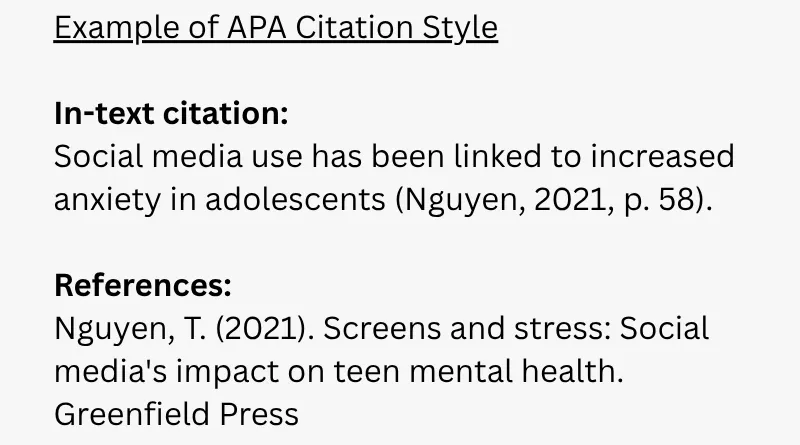
- This also uses the author-date format for in-text citation, but it uses a comma for separation. Page number is also included when the writer is directly quoting something. For example, (Carter, 2021, p. 67).
- The cited sources appear at the end of the paper. These are labelled as “references,” which are bolded at the top and centered. The list to cite a research paper in APA format is ordered alphabetically, and each entry is double-spaced and uses a hanging indent.
- In the reference list, the author’s name is mentioned using the inverted style (last name comes first). For titles and subtitles, only the first word is capitalised, and capitalisation is needed for proper nouns. To write a book title in an essay or journals, italics are used.
- The reference list must include all the sources cited in-text. Exceptions include personal communications (e.g., private conversations, emails), which might be cited within the text only.
Recent Updates
The latest APA 7th Edition was introduced in 2019 with some key updates:
- Different Guidelines for Professional and Student Papers: The 7th edition offers separate guidelines for professional and student papers with a sample paper for each.
- Running Head: For student papers, it is omitted entirely if the instructor has not specified it otherwise. On the other hand, for professional papers, it no longer includes the words “running head”; rather, only the shortened paper title is used.
- Flexible Fonts: Times New Roman 12pt was mandatory earlier. The recent edition now accepts: Georgia 11, Lucida Sans Unicode 10, and Calibri 11.
- Multiple Authors: Now up to 20 authors can be added in the reference list, and previously it was limited to 7. Also, for sources with three or more authors, “et al.” can be used after the shortened first author’s name. For example: (Smith et al., 2011)
- Publisher Location Dropped: In book references, the publisher’s city name is no longer required. Also, the e-book’s format mention is no longer needed.
- Digital Source and Multimedia Citation: Offers 114 reference examples on various digital source citations for audio-video, social media, and other multimedia materials.
- Bias-free Language: Addresses bias-free language guidelines for research participation, intersectionality, and socioeconomic status. Now, it accepts gender-neutral singular pronouns “they”
3. Features of the Chicago Manual of Style
The general formatting rules of the Chicago citation style are:
- A title page is generally recommended. It includes: paper title, name of the author, course and instructor name, and date. Each is mentioned on separate lines with centre alignment.
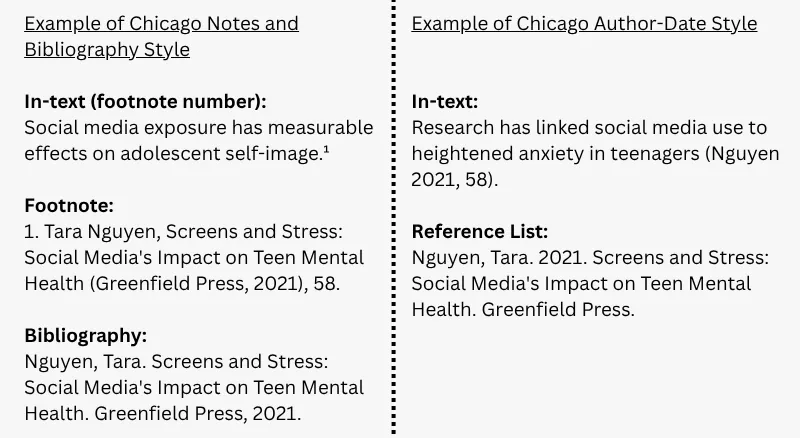
- For Notes and Bibliography (N&B), a superscript number is used, which is placed after the cited material within the text. This number corresponds to a numbered footnote or endnote, which offers complete source details.
- Similar to APA, the Author-date system features in-text citation using parentheses, which includes the last name of the author, the year of publication, and the page number.
- Both bibliography and reference list entries are in alphabetical order by author’s last name, and appear at the end of the paper on a separate page.
- The bibliography format is: Author’s last name first, followed by full first name, title in italics, publisher, and year.
- The Reference List in the Author-Date system follows the same format, with only the year appearing after the author’s name.
Recent Updates
The latest 18th edition of the Chicago citation style guide was published in September 2024 by the University of Chicago Press. Key updates are:
- Removal of Publisher Location: No need to mention the place of publication in citation and bibliography for book publishers.
- Easy page citation: Essays or Book Chapters with inclusive page ranges are no longer required in the bibliography. Only the specific page cited in the note is enough.
- Updated “Et al.” Limit: In a bibliography or reference entry, up to 6 authors can be listed. If more than six, “et al.” can be placed after mentioning the first 3 authors. Note or author-date citation allows listing for two authors. If the number exceeds, “et al.” is placed after the first author mentioned.
- Guidance on AI Citation: Fresh guidelines are added to cite AI-generated prose and images. Also, expanded advice is given on the connection between copyright and AI.
- Title Case Requirements: “Headline Style” is now formalized as “Title Case.” Within the title, capitalization is now needed for prepositions of five or more letters (e.g., about, without, throughout).
- Ibid. Usage: The 18th edition actively recommends using shortened notes instead of ibid when the previously cited source is being referred to.
- Expanded Field Coverage: While traditional focus was on non-fiction, now CMOS is covering fiction and other creative genres while giving wider attention to self-published authors.
- Inclusive language: Also, like recent updates of APA and MLA, CMOS is also encouraging bias-free language, considering the diversity and accessibility of the readers. This includes pronoun usage, new coverage of Indigenous languages, etc.
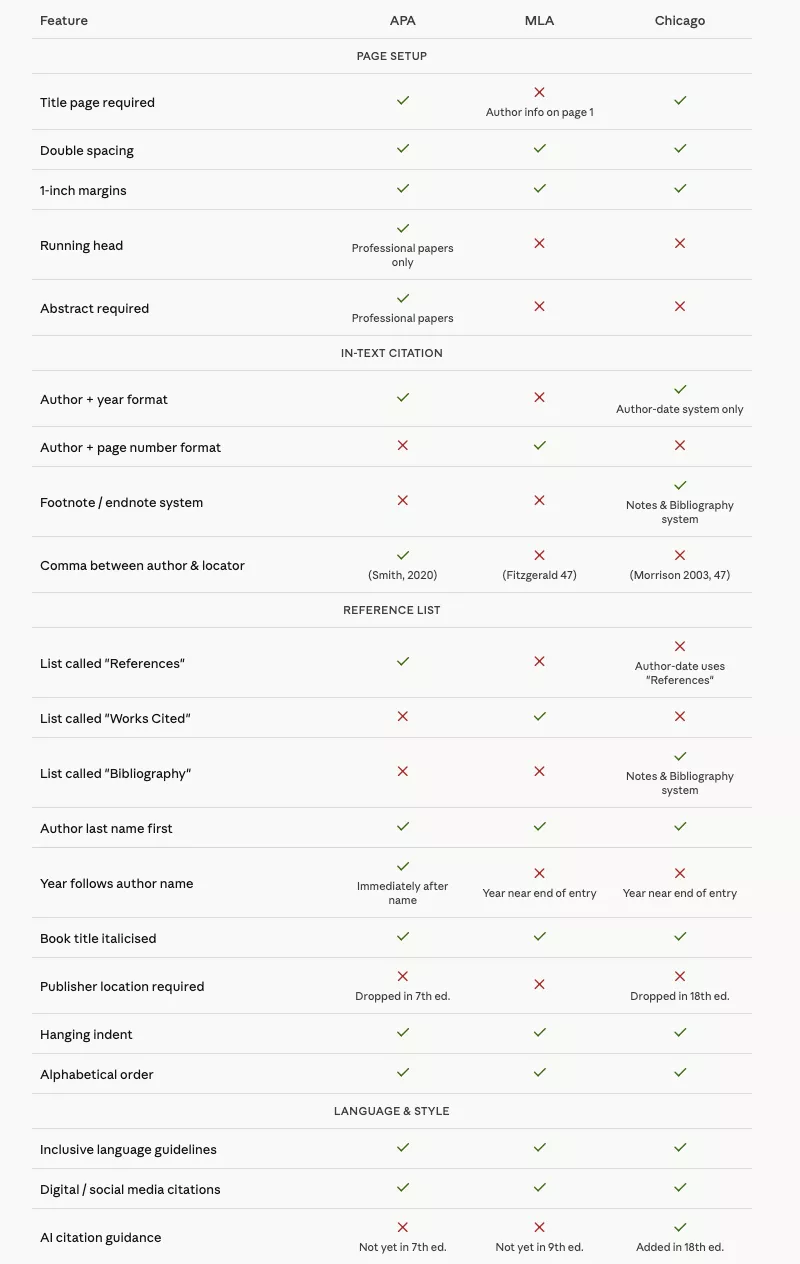
Check out this infographic table on the similarities and differences between APA, MLA, and Chicago style:
5 Tips to Choose the Right Citation Style
Now that you have understood the basics of the Chicago vs APA vs MLA format, here are tips to choose the right one:
- Read Your Course Syllabus: Your professor or department’s specific directions should always take precedence. They sometimes have definite preferences in spite of general field norms.
- Know Your Data Source Type: Chicago’s footnote system may be most useful for heavily archival papers or those using old historical records.
- Analyze the Focus of Research: If the date of the study is important (often in the sciences), use APA. Use MLA when the exact words of the author and the context of the literature are the main point.
- Choose the correct Journal: If you’re writing for publication, check the “Author Guidelines” section of your target journal for the styles they require.
- Think Reader Experience: If you want to have a clean, text-heavy page and not be distracted by the parenthetical citations, then use the Chicago style.
5 Mistakes to Avoid While Choosing Between MLA, APA, and Chicago
The style of the citation is just half the job; accuracy is the other half. Make sure to steer clear of these common mistakes:
- Mixing Up is Not Allowed: Never combine guidelines from older and newer editions (e.g., APA 6th guidelines in an APA 7th paper).
- Excessive use of Automated Generators: Digital instruments are not always the most nuanced; check your MLA vs APA vs Chicago reference page format manually.
- Avoiding consistent “Et al.” Usage: The rules for using “Et al. . . .” differ between the two styles; using MLA guidelines for “Et al. . . .” in an APA paper will result in a grade penalty.
- Failure to follow Instructor Modifications: If the instructor has requested MLA style papers but requires a separate title page, then you must provide one. Follow specific class “house rules”.
- Poor Punctuation Placement: Do not write periods and commas incorrectly in relation to parentheses or superscript numbers, since there are significant differences among the three styles. If you’re unsure about the differences between citation styles, review the MLA punctuation guidelines and compare them with APA and Chicago formatting.
Need Help with Academic Writing with Proper Citation Style?
Finding it difficult to manage multiple MLA vs APA vs Chicago in-text citations? With the specific requirements for margins, font, and MLA vs APA vs Chicago reference page format styles, it can be difficult to master them all.
Assignments4u provides expert research paper writing services to guarantee that your papers are technically flawless. We have experts who are skilled in different fields of study and provide you with papers that are accurately formatted, which will help you avoid plagiarism and gain a higher grade.
Contact Assignments4u today to get the assignment help you need on your path to success!
More Sources for MLA, APA, and Chicago
- For MLA Format Guide: Purdue OWL and University of Nevada (9th Edition)
- For APA Format Guide: Southern New Hampshire University Library, and University of Alberta (7th Edition)
- For CMOS Guide: The official Chicago Manual of Style guide.
Conclusion
Hopefully, the comparison of MLA, APA, and Chicago referencing styles in this guide has been helpful for you! Although MLA is a strong choice in the humanities, and APA is a good choice in the social sciences, Chicago offers depth for historical analysis. The final decision should depend on your field of study, the needs of your institution, and the type of research data you need. Citing sources is not only important for avoiding plagiarism, but it also establishes your academic credibility.
Frequently Asked Questions
When should you use Chicago style instead of APA?
When a paper is about history or fine arts, use the Chicago style, or if the document needs a lot of footnotes.
Does MLA or APA require a title page?
All papers must have a formal title page in APA format. Unless specified by an instructor, an MLA does not need a separate title page.
What is the most commonly used citation style?
MLA is the most frequent style choice at the high school and introductory college level; APA is used more often in research and professional scientific publications throughout the world.
Is Chicago style the same as Turabian?
These are almost the same. Turabian is a simplified form of the Chicago style for students who are writing research papers, while the Chicago style is for professional publications.
Does APA use footnotes or in-text citations?
APA mainly employs the ‘parenthetical in-text citation’ system (Author, Year). Avoid using footnotes except for additional content and copyright permissions.
Which citation style is best for research papers?
There is no specific “best citation style” for a research paper. It entirely depends on the academic field and the type of project you are working on. For example, if it is heavily based on history and religion, go for the Chicago Manual of Style.
How to cite the book MLA vs APA vs Chicago?
- MLA: Author Last, First. Title. Publisher, Year.
- APA: Author Last, F. M. (Year). Title. Publisher.
- Chicago: Author Last, First. Title. City: Publisher, Year. Note: In the 18th Edition, City is removed.

Want To See My Profile — Check Now
- How to Write a Book Title in an Essay: Citation Rules and Mistakes to Avoid - September 28, 2026
- Transition Words for Essays: 100+ Examples by Function - September 10, 2026
- AMA Style In Text Citations Explained With Examples - August 29, 2026


