
Worried about a misplaced period or an unnecessary comma in your academic writing? These small punctuation mistakes can make your citations inconsistent and can affect the overall presentation of your paper.
Whether you are quoting a source, adding an in-text citation, or creating a Works Cited page, understanding MLA punctuation rules keeps your citations clean and consistent. Even small punctuation mistakes can result in incorrect citations or lost formatting marks in graded assignments.
In this blog, we will cover all punctuation rules for citing in MLA, the common mistakes to avoid, and the punctuation checklist to follow before completing the work. You’ll also find practical examples and a quick-reference cheat sheet, so you can confidently apply MLA punctuation guidelines in every assignment.
Key Takeaways – MLA Punctuation Essentials
- Punctuation in MLA format rules ensure your citations, quotations, and Works Cited entries follow the MLA 9th edition (2021).
- Place the period after a regular in-text citation, but before the citation in a block quote.
- In most MLA in-text citations, the author’s last name and page number appear without a comma.
- Use quotation marks, ellipses, and brackets correctly to preserve the meaning and accuracy of quoted material.
- Review your paper with a final MLA punctuation checklist to catch common errors before submission.
What Are MLA Punctuation Rules?
MLA punctuation rules are a set of guidelines developed by the Modern Language Association (MLA). They prescribe specific ways of using periods, commas, quotation marks, colons, semicolons, parentheses, ellipsis, brackets, and other punctuation elements. These are mainly applicable while writing essays, research papers, in-text citations, and the Works Cited page.
Correct punctuation helps you organize your sources and integrate them smoothly. While punctuation is an important part of MLA style, it should be applied consistently with the rules of the MLA 9th edition citation format.
Additionally, correct punctuation in essays and research papers helps ensure your citations follow MLA requirements.
Misplaced punctuation, such as putting a period before an in-text citation or adding a comma between the author’s name and the page number in parentheses, makes your paper look unprofessional.
These rules apply throughout your paper, including:
- MLA in-text citations and parenthetical references
- Direct quotations and block quotes
- Works Cited entries
- Titles of books, articles, and other sources
- Lists, abbreviations, and general academic writing
Punctuation Rules for Quotations in MLA Format: A Quick Overview
MLA style punctuation plays a key role in formatting quotations correctly. Whether you’re using short quotations, block quotes, or in-text citations, following the proper punctuation rules helps ensure clarity, accuracy, and compliance with MLA guidelines.
MLA Period and Comma Rules
Period and comma placement in MLA citations are among the most frequently used marks in MLA style. Understanding these rules helps you avoid the most common mistakes in your paper and improves the overall quality of writing.
Period Placement in MLA
When using an in-text citation in short quotations, the period comes after the parenthetical citation.
Correct:
“Academic writing requires careful proofreading” (Brown 42).
Incorrect:
“Academic writing requires careful proofreading.” (Brown 42)
MLA Comma Rules
One of the most crucial MLA comma rules is that no comma is used between the author’s last name and the page number.
Correct:
(Smith 28)
Incorrect:
(Smith, 28)
Use commas normally after signal phrases.
Example:
According to Smith, “Clear punctuation improves readability” (28).
Quick Tips
- Never use a comma between the author’s name and page number.
- Use commas after introductory phrases and in lists as part of standard grammar.
- In the Works Cited page, periods and commas separate the different elements of each citation.
MLA Quotation Punctuation Rules
Quotations are a common part of academic writing, and using the correct MLA quotation punctuation rules ensures they are properly integrated into your paper. MLA specifies where to place periods, commas, question marks, and quotation marks when citing quoted material.
Correct punctuation is only part of using quotations effectively. Learning how to integrate textual evidence can help you introduce, explain, and cite quotations naturally in your academic writing.
Periods and Commas with Quotations
In MLA style, when a quotation is followed by a parenthetical citation, the period comes after the citation, not inside the quotation marks.
Correct:
“Writing is a process of revision” (Smith 24).
Incorrect:
“Writing is a process of revision.” (Smith 24)
If there is no citation, periods and commas remain inside the closing quotation marks in standard American English.
Question Marks and Exclamation Points
Question marks and exclamation points depend on whether they belong to the quoted material or the sentence as a whole.
Question is part of the quotation:
She asked, “Have you finished your essay?”
Question is part of your sentence:
Did the author really write “punctuation matters” (Brown 31)?
Quotations within Quotations
Use double quotation marks for the main quotation and single quotation marks for a quotation within it.
Example:
“The instructor said, ‘Always proofread your citations,’ before ending the class” (Taylor 18).
MLA In-Text Citation Punctuation Rules
Following MLA in-text citation punctuation rules helps ensure your sources are cited correctly and consistently. MLA uses the author’s last name and page number in parentheses without commas or publication years.
The rules explained below are based on the principles outlined in the MLA Handbook (9th edition), the official guide to MLA style.
Where Does the Period Go in MLA In-Text Citations?
Understanding where the period belongs in an in-text citation helps ensure your citations follow MLA guidelines accurately. The period is always placed after the parenthetical citation.
Correct:
“Proper citation improves credibility” (Johnson 56).
Incorrect:
“Proper citation improves credibility.” (Johnson 56)
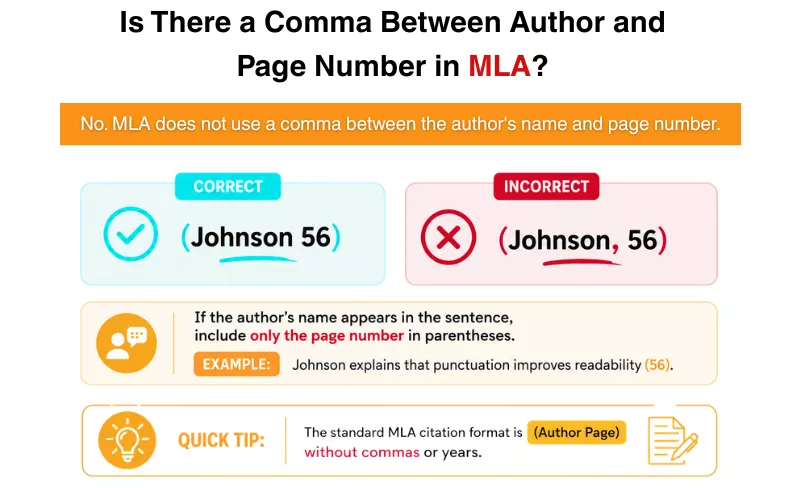
Is There a Comma Between Author and Page Number in MLA?
No, the MLA does not use a comma between the author’s name and page number.
Although MLA primarily uses parenthetical citations, understanding when to use footnotes and endnotes can be helpful when your instructor requests supplementary notes or explanations.
How to Punctuate Block Quotes in MLA
Block quotes follow different punctuation rules than short quotations. They are used for quotations longer than four lines of prose or three lines of poetry. Knowing when to use block quotes and where to place the citation and final period will help you format longer quotations correctly in MLA style.
MLA Block Quote Rules
- Introduce the quotation with a colon.
- Begin the quote on a new line and indent it half an inch (0.5″) from the left margin.
- Do not use quotation marks.
- Place the period before the parenthetical citation.
Example:
Smith explains the importance of punctuation:Proper punctuation helps readers to easily understand the intended meaning of a sentence. It differentiates ideas, clarifies relationships between clauses, and enhances overall readability of academic writing. Consistent punctuation ensures that quotations and citations follow the required style guidelines, making research papers easier to read and verify. (45)
How to Use Ellipses and Brackets in MLA Quotations
Ellipses and brackets allow you to edit quotations without changing the author’s intended meaning. Knowing how to use ellipses in MLA quotations helps keep your writing concise while maintaining accuracy.
Using Ellipses (…)
Use an ellipsis to show that words have been omitted from a quotation.
Example:
“Effective writing. . . requires careful editing” (Brown 32).
Only omit words that do not change the original meaning of the quotation.
Using Brackets [ ]
Use brackets to add your own words, clarify information, or replace pronouns within a quotation.
Example:
“[Students] should review their citations before submission” (Taylor 14).
All Punctuation Rules for Citing in MLA

Using the correct punctuation is essential when creating MLA citations. From in-text citations to the Works Cited page, every punctuation mark has a specific purpose. Following all MLA citation rules helps ensure your references are consistent, accurate, and easy for readers to locate.
You must remember that punctuation requirements vary across citation styles. Knowing the difference between MLA, APA, and Chicago makes it easier to follow the correct formatting rules for your assignment.
In-Text Citations
MLA in-text citations use the author’s last name and page number enclosed in parentheses.
Example:
(Smith 42)
Key Rules:
- Do not use a comma between the author’s name and page number.
- Do not include the publication year.
Correct:
“Research strengthens academic writing” (Smith 42).
Books
When citing a book in the Works Cited page, periods separate the major elements, while the book title is italicized.
Example:
Smith, John. Academic Writing Today. Oxford UP, 2023.
Key Rules:
- Place a period after the author’s name.
- Italicize the book title.
- Separate the publisher and publication year with a comma.
- End the citation with a period.
Journal Articles
Journal articles require a combination of quotation marks, italics, commas, and periods.
Example:
Carter, Lisa. “Effective Citation Practices.” Journal of Academic Writing, vol. 15, no. 2, 2024, pp. 45–60.
Key Rules:
- Enclose the article title in quotation marks.
- Italicize the journal title.
- Use commas to separate the volume, issue, year, and page numbers.
- End the citation with a period.
Websites
When citing online sources, punctuation separates each citation element, and the URL is placed at the end.
Example:
Brown, Emily. “MLA Citation Guide.” Writing Center, 15 Jan. 2025, www.example.com/mla-guide.
Key Rules:
- Place the webpage title in quotation marks.
- Italicize the website name.
- Separate the publication date and URL with a comma.
Poems
When quoting poetry, follow MLA conventions and preserve the original line breaks. If you’re quoting poetry in detail, it’s also useful to understand how to cite a poem in MLA, including titles, line numbers, and anthology citations.
Example:
Frost, Robert. “The Road Not Taken.” Mountain Interval, Henry Holt and Company, 1916, pp. 9–10.
Key Rules:
- Place the poem title in quotation marks.
- Italicize the book or collection title.
- Preserve line breaks when quoting poetry in your paper.
- Use a forward slash (/) to indicate line breaks in short quotations.
MLA Punctuation Rules for Works Cited Page: Common Mistakes to Avoid
MLA punctuation rules can be easy to overlook, but even small errors can affect the accuracy of your citations. Follow this chart to compare correct and incorrect MLA punctuation, helping you identify and avoid common citation and formatting mistakes.
| Punctuation Mark | MLA Rule | Correct Example | Incorrect Example |
| Period (.) | Place the period after the parenthetical citation. | “Example text” (Smith 24). | “Example text.” (Smith 24) |
| Comma (,) | Do not use a comma between the author’s name and page number. | (Smith 24) | (Smith, 24) |
| Quotation Marks (” “) | Use double quotation marks for short quotations and article titles. | “Article Title” | Article Title |
| Single Quotation Marks (‘ ‘) | Use single quotation marks for a quote within a quote. | “She said, ‘Proofread your citations.'” | “She said, “Proofread your citations.”” |
| Colon (:) | Use a colon before introducing a block quote. | Smith states: | Smith states, |
| Semicolon (;) | Separate multiple citations with a semicolon. | (Smith 24; Brown 18) | (Smith 24, Brown 18) |
| Ellipsis (…) | Show omitted words in a quotation. | “Writing … requires revision” (Jones 12). | “Writing requires revision” (when words have been omitted) |
| Brackets [ ] | Add clarification or replace words in a quotation. | “[Students] should revise their work” (Taylor 8). | “Students should revise their work” (when clarification is required) |
| Question Mark (?) | Place it inside quotation marks only if it belongs to the quoted material. | She asked, “Have you finished?” | She asked, “Have you finished”? |
| Parentheses ( ) | Use for MLA in-text citations. | (Brown 45) | Brown (45) |
| Forward Slash (/) | Indicate line breaks in short poetry quotations. | “Two roads diverged in a yellow wood, / And sorry I could not travel both“ | “Two roads diverged … And sorry I could not travel both” |
MLA Punctuation Checklist Before You Submit
Before you submit your essay or research paper, take a few minutes to review your punctuation. This quick checklist will help you identify common formatting errors and ensure your citations follow the MLA punctuation guidelines.
The MLA punctuation checklist includes:
- Place the period after the parenthetical in-text citation, not before it.
- Do not use a comma between the author’s last name and page number in MLA citations.
- Use double quotation marks for short quotations and single quotation marks for quotes within quotes.
- Introduce block quotes with a colon, indent them correctly, and omit quotation marks.
- Use ellipses (. . .) only to indicate omitted words without changing the original meaning.
- Use brackets [ ] only when adding clarifications or minor grammatical changes to a quotation.
- Check that book and journal titles are italicized, while article, chapter, and webpage titles are enclosed in quotation marks.
- Ensure your Works Cited entries have the correct placement of periods, commas, and italics.
- Use semicolons to separate multiple citations within a single parenthetical reference, when applicable.
- Review your paper for consistent punctuation throughout the text and reference entries.
Final Tip: A quick proofread focused solely on punctuation can help you catch formatting mistakes, improve readability, and resolve the most common punctuation errors before submission.
Conclusion: Get Your MLA Punctuation Right Every Time
Mastering punctuation in MLA citations is essential for creating clear, credible, and professionally formatted academic papers.
From placing periods and commas correctly to formatting quotations, in-text citations, and Works Cited entries, paying attention to these small details can make a significant difference in the quality of your writing.
By following the guidelines and checklist in this guide, you can avoid common mistakes and ensure your work aligns with the MLA 9th edition (2021) standard.
If you’re working on a complex assignment, explore our academic support services for help with citations and formatting. All materials are provided for reference and study purposes.
Frequently Asked Questions
Does MLA require punctuation after a URL in the Works Cited page?
Yes. MLA 9th requires a period after the URL. Some instructors prefer omitting it; check your assignment brief, but MLA’s own rule is to include it.
Should punctuation be italicized with book or journal titles in MLA?
No. Italicize only the title itself. Punctuation marks, such as commas and periods, are generally not italicized unless they are part of the original title.
How do you punctuate a citation with multiple authors in MLA?
For two authors, use and between their last names: (Smith and Brown 24). For three or more authors, cite the first author’s last name followed by et al.: (Smith et al. 24).
Can you use punctuation to shorten a quotation in MLA?
Yes. MLA allows the use of ellipses to omit unnecessary words, provided the omission does not change the author’s original meaning. Any clarification you add should be enclosed in brackets.
How should you punctuate citations for sources without page numbers?
If a source, such as a webpage, does not include page numbers, cite only the author’s last name. Do not add page numbers or paragraph numbers unless the source explicitly provides them.
Does MLA punctuation differ for digital and print sources?
The punctuation rules remain the same for both. The main difference is that online sources often include additional elements such as URLs or DOIs, while print sources usually end with publication information.
How do you punctuate abbreviations such as vol., no., and pp. in MLA?
MLA abbreviations take a period: vol., no., pp., ed., trans. Exceptions are all-caps abbreviations like UP (University Press) and DOI, which take none.
Example:
vol. 12, no. 3, pp. 45–58.
Why is consistent punctuation important in MLA style?
Consistent punctuation makes your citations easier to read, helps readers locate your sources, and ensures your paper follows MLA formatting standards. It also demonstrates attention to detail and academic professionalism.

Want To See My Profile — Check Now
- How to Avoid Plagiarism? Top 10 Rules for Students - August 18, 2026
- MLA Punctuation Rules Every Student Must Know - July 31, 2026
- How to Cite a Research Paper in APA Format? - July 17, 2026


