
The Modern Language Association, popularly known as MLA, is a citation style that is often used in the humanities, where essays on literature, philosophy, or language rely on a shared system of order.
The MLA 9th edition citation format serves as a comprehensive update of its 8th edition. The edition functions both as a citation manual and a complete textbook for writing and research. Here, we will take you through the details of the citation format, including the rules, examples, and templates for a proper understanding.
Key Takeaways: All about MLA Citation Format 9th Edition
- MLA 9th edition is mainly used for humanities subjects.
- It follows standard rules for font, spacing, margins, and headers.
- Citations include core elements like author, title, publisher, and date.
- In-text citations use the author-page format, e.g., (King 245).
- The Works Cited page must be alphabetized.
- MLA provides special rules for digital sources and sources without page numbers.
What Are the General MLA Citation Format Requirements?
The first step to proper citation lies in getting the setup right. This citation style is designed to make papers uniform to ensure you focus on writing, instead of the layout. The following are things you need to check:
A. Font and text
The recommended font and text are Times New Roman, size 12, if your university has not specified anything else. Italics should be used only for longer works, like books, journals, films, etc., or when you want to emphasize a specific thing. Bold or underlining for titles is never used. The 9th edition allows any font size between 11 and 13, but it needs to be consistent throughout the paper.
B. Margins and Alignments
The format recommends using one-inch margins on all sides. The text is aligned to the left, while the right margin stays uneven. Use one space after punctuation, unless your professor instructs otherwise.
C. Spacing
The entire paper is recommended to be double-spaced, and that includes block quotations, notes, and the works cited page. Also, it is necessary to avoid extra spaces between and/or sections.
D. Indents
The format recommendations are to indent the first line of each paragraph. Use the Tab key to maintain the indent.
E. Page Header
A header is there on the upper right-hand corner of every page and carries the last name of the student and the page number. It generally appears one-half inch from the top of the page and is aligned with the right margin.
While these will help you maintain a clean layout, working on a 10-page assignment following these guidelines can be stressful. This is why students often seek assignment help from qualified experts to ensure everything is on track.
Moving on, we will take you through the MLA 9th edition core elements guide.
What Are the Core Components of the MLA 9th Edition Citation Format?
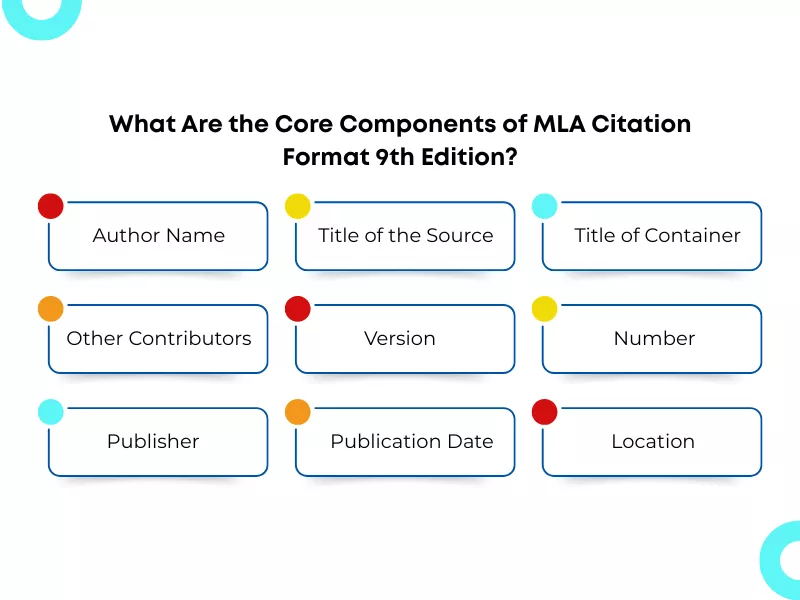
It is necessary to know about the core components before going any further. While most students know why is academic research important, many are unaware of the need to cite sources and the things to consider while working on them.
Since citation is all about getting the components cited correctly, you need to understand what needs to be cited and how:
A. Author Name
The first component of the MLA format is the name of the author. You need to put the surname first, separate it by a comma, and list the first name, and if there are any initials after that. (Example. Eliot, Thomas, S.)
B. Title of the Source
The MLA style requires you to cite sources properly. If you have used information from a short work, put the title in quotation marks. In case of larger works, like books, television shows, and websites, use italics for citing them. If the source title is unknown, replace it in the MLA works cited page with a brief description without using any quotes or italics.
C. Title of Container
The MLA citation style guide states that the container, the larger vessel in which the source sits, must be cited properly. The name should be italicized and can contain more than one container, if necessary.
D. Other Contributors
There are other contributors, like editors, translators, or directors. For the MLA format, you need to use only the most relevant contributors and not all of them. Before the name of each contributor, specify his or her role to add relevance.
E. Version
The MLA handbook states that it is necessary to add the specific edition, version, or revision of the source. You need to put this part of the citation in lower case.
F. Number
This component refers to the sources that appear in a sequence. If you are using TV seasons or episodes, issues, and volumes, you need to number them properly.
G. Publisher
If the type of source you used has multiple publishers, you must use them as part of your work-cited entry. Separate each of the publishers with a slash.
H. Publication Date
The date here depends on the type of source you have used. In case there’s more than one publication date, you need to cite the date of publication of the one you have used and nothing else. MLA 9 follows the day month year format for dates with months abbreviated.
I. Location
This again depends on the type of source. Here, you can list any of the following, depending on the type:
- Printed source – Page number
- Online source – URL
- DVD – Disk number
- Object – Place it is held
- Performance – City and/or venue
That will help you understand the different elements that you must include in the works cited list. You must also know that the MLA style does not need a separate title page unless your instructor asks you to add one specifically.
However, when it comes to digital sources, like ebooks with no page numbers, students often look forward to pay someone to take my online class because they don’t have the time to master the formatting hurdles.
How to Cite Sources Using the MLA Style in the 9th Edition?
- In-text citations – These are brief MLA parenthetical citations that you need to place immediately after the information you used. The basic format is the author’s last name followed by the page number.
- One author – Cooper, 4
- Two authors – Cooper and Johnson, 4
- Three or more authors – Cooper et al. 4
- No author – Use a shortened version of the title in quotes (“Impact” 12)
- The works cited entry – The entry needs to be on a separate page at the end of your document. It is recommended that you use a hanging indent for every line after the first.
- Book – Last name, first name. Title of book. Publisher, year.
- Journal article (from a database) – Author. “Title of article”. Journal name, vol., no., year, pp. Database name, DOI or URL
- Website page – Author. “Title of page.”Title of website, Date of publication, URL
Here are a few fully-worked MLA format citation examples for a better understanding:
MLA In-Text Citation Rules
→ Single Author
The manipulation of trust is central to how predatory characters operate in fiction (King, 245).
→ Two Authors
Investigators often rely on their instinct along with the evidence (Patterson and Paetro, 89).
→ Three or More Authors (MLA Citation Format for Multiple Authors)
Long-term memory is shaped most by emotional experience (Myers et al. 312).
→ No Author
Anxiety rates among teenagers have risen sharply along with social media use (“Impact” 12).
→ Same Author, Multiple Works
Totalitarian control relies on the manipulation of language (1984) and the distortion of historical memory (Animal Farm 23).
→ Direct Quote
King argues that predators depend fundamentally on their victims’ goodwill, as the trust of the innocent is the liar’s most useful tool (245).
→ Paraphrase
Those who deceive others rely fundamentally on the goodwill of the people they target (King 245).
MLA Works Cited Format with Examples
→ Single-author book
King, Stephen. Needful Things. Viking Press, 1991
→ Two authors
Patterson, James, and Maxine Paetro. The 21st Midnight. Little, Brown and Company, 2023
→ Three or more authors
Myers, David, et al. Psychology: Tenth Edition. Worth Publishers, 2013.
→ Journal article
Sharma, Priya. “Digital Anxiety and Adolescent Behavior.” Journal of Youth Psychology, vol. 18, no. 3, 2022, pp. 45-61. JSTOR https://doi.org/10.1037/yps0000123.
→ Website article
Ramirez, Carlos. “How Social Media Rewires Teenage Brains.” The Atlantic, 14 Mar. 2023 www.theatlantic.com/health/social-media-teen-brains.
→ No author
“The Impact of Social Media on Teen Mental Health.” Psychology Today, 5 Jan. 2024, www.psychologytoday.com/social-media-teen-mental-health.
- YouTube video
TED. “How Social Media Makes Us Unsocial.” YouTube, 12 Feb. 2022, www.youtube.com/watch?v=example123.
→ Podcast episode
Koenig, Sarah. “The Alibi.” Serial, season 1, episode 1, WBEZ Chicago, 3 Oct. 2014, www.serialpodcast.org/season-one/1/the-alibi.
It sounds confusing, without a doubt, but once you start doing it, you will be able to understand and implement these correctly. Also, you can use a free MLA citation generator to get things done faster. Further, you can go through the APA citation guide to understand how the citations differ from one another.
How to Format the Works Cited Page in MLA 9th Edition?
- Page title
- References listed in alphabetical order
- Double spacing
Before you start working on your research paper, dissertation, or essay, consider visiting the MLA style center to understand the correct ways to cite sources and also to practice how to do it. You can also talk to experts providing research paper writing services to get the necessary assistance.
How to Handle Sources with No Page Numbers in the 9th Edition?
The 9th edition of the MLA handbook provides clear guidance on the correct ways to handle sources with no page numbers. Websites, ebooks, and audiobooks are common work citation MLA format examples where page numbers do not exist, and this is how you can cite them in the MLA 9th ed.:
- Websites and online articles – If you don’t find any page numbers, add the last name of the author to create in-text citations.
- Ebooks with location numbers – You will come across ebooks that use location numbers instead of page numbers. The ninth edition of the MLA handbook advises using against using these since they vary by device. Instead, use the author’s name only.
- Works with numbered paragraphs – Use ‘par.’ or ‘pars.’ if your source numbers its paragraphs.
- Works with section headings – Use a shortened version of the heading if the source has title sections but no numbers.
That clears all the doubts with citations and works cited entries for these sources.
Final Thoughts,
The 9th edition has changed a few things while keeping the basics intact. Students working on research papers, dissertations, or any other academic papers must be aware of the guidelines. Check the instructor guidelines, go through the citation format to ensure you write and submit a perfect assignment.
Frequently Asked Questions
Do you need a URL in MLA 9th edition citations?
Yes, in the case of MLA 9th edition citations, you can include a URL while citing online sources, like websites, articles, or social media posts, to help readers locate the post. This is in the case that the citation information is not enough to help readers find the source easily.
How do you cite an AI tool like ChatGPT in MLA format?
To cite an AI tool like ChatGPT in MLA format, you need to use the prompt, “the title, followed by the tool name, version name, publisher, date, and URL”. You must treat the AI as the container, not the author.
What is the difference between MLA 8th and 9th edition?
The core nine components of a citation remain the same across both editions. The 9th edition added a new chapter on inclusive language, expanded guidance on citing digital sources, and transformed the handbook from a citation-only manual into a full writing and research guide.
How is MLA format different from APA or Chicago style?
MLA is mostly used in humanities, while APA is standard for social sciences, and Chicago is used in history and some humanities subjects. The MLA style uses the author-page format, while the APA uses the author-date format, and the Chicago uses footnotes or endnotes.
How do you format a research paper in MLA style?
To format a research paper in MLA style, you need to use standardized margins, fonts, line spacing, and page numbering. You need to make sure that all text is double-spaced and uses a standard 12-point font with 1-inch margins on all sides.
How do you cite a book in MLA format?
To cite a book in the MLA 9th edition citation format, it is necessary to create a full citation for your Works Cited page and a brief parenthetical citation for your in-text citation. The citation format can be as follows:
- One author – Last name, first name. Title of book. Publisher, Year.
- Two authors – Last name, first name of first author, and first name last name of second author. Title of book. Publisher, Year.
- Three or more authors – Last name, first name of first author, et al. Title of book. Publisher, Year.
- E-books and online books – Last name, first name. Title of book. E-book ed., Publisher, Year.

