
Have you ever read a sentence that painted a picture in your mind and made you pause to think twice? This is the power of non-literal language.
Mastering non-literal devices can enable writers to achieve greater control over the emotional tone of their writing. In addition to aesthetic function, non-literal devices dictate the speed and intensity with which a reader can process the narrative and connect with the author’s distinct voice.
Whether you are writing a creative story, analyzing poetry, or writing a persuasive essay, these tools can be of great help. In this blog, we will discuss figurative language, its uses, main forms of the language, and examples. We will also explore less common types of figurative language and how to use them in your writing.
Key Takeaways: The Guide to Non-Literal Language
- Go beyond plain definitions to create a vivid, memorable impression and evoke emotional depth.
- Literal language is factual and direct, making it ideal for academic and scientific writing, whereas figurative language is imaginative and expressive and is better suited for poetry and creative fiction.
- Essential non-literal tools include similes, metaphors, personification, hyperbole, idioms, and irony.
- Sound and structural devices (like anaphora, assonance, and chiasmus) build rhythm and emphasis rather than non-literal visual imagery.
- Spot figurative devices effortlessly by testing for literal impossibility, identifying descriptive triggers, evaluating context, and naming the specific trope.
- Move beyond simply naming devices in literary analysis by following the Identify → Quote → Explain → Analyze → Link format.
What Is Figurative Language?
Figurative language refers to words or phrasing that differ from their usual or literal meaning. Writers use a range of non-literal devices to explain an idea, paint a sensory picture, or evoke responses in the reader, such as emotions or symbolic meaning.
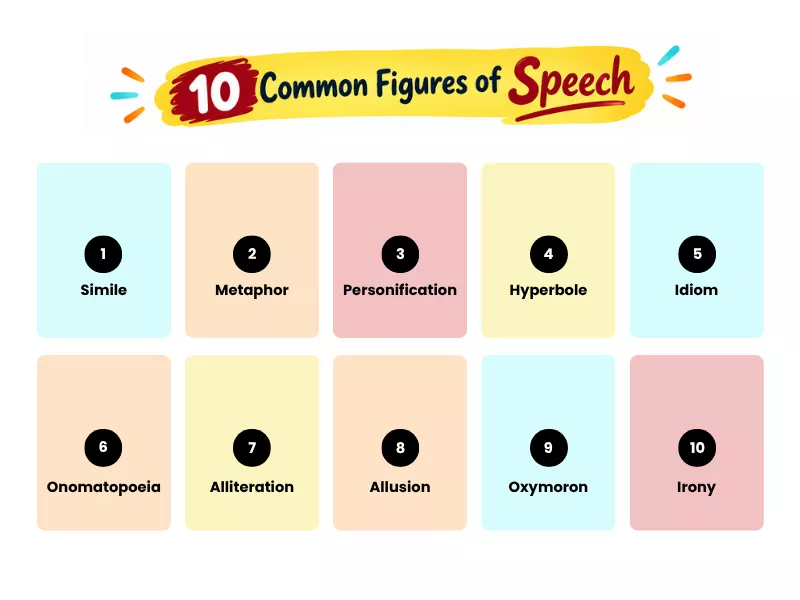
What Are the 10 Types of Figurative Language?
These 10 fundamental devices are among the most common tools used across creative writing, literature, poetry, and everyday communication to add depth and visual clarity to prose.
1. Simile
A simile makes an indirect comparison using like or as. These create vivid visuals by linking the unknown to the familiar.
Look for these words: like, as, or resembles.
Figurative Language Examples:
- Her smile was as bright as the morning sun.
- The news hit him like a freight train.
- The city lights were like scattered diamonds in the dark.
- The conference room was as silent as a graveyard after the argument.
- He is as unyielding as an anvil when a decision needs to be made.
- She bolted through the corridor like a sprinter off the blocks.
2. Metaphor
A metaphor makes a direct comparison by stating one thing is another. Metaphors are creative ways to paint vivid word pictures and convey emotions or symbolic meanings.
Look for an “A is B” type of statement, where one thing is stated to be another.
However, using too many metaphors or mixing up contrasting imagery in your papers can make your arguments unclear. You can reach out to professional assignment writing help and polish your stylistic devices so that they emphasize your thesis statement.
Examples:
- Time is a thief that steals our memories.
- The hallway was a battlefield during the passing period.
- His heart was a block of stone following years of disappointment.
- His voice was gravel scraping across the microphone.
- Life is a roller coaster of ups and downs.
- Knowledge is the key to unlocking doors.
3. Personification
Personification describes an animal, object, or idea as if it were human. It makes writing more vivid by linking the subject to human characteristics.
Look for human characteristics in non-human objects or animals.
Personification examples:
- The wind whispered through the pine trees.
- The old car engine groaned before starting.
- Opportunity knocked on her door.
- The sun greeted the day with a smile.
- The alarm clock screamed at six o’clock.
- Shadows danced across the wall.
4. Hyperbole
Hyperbole uses deliberate overstatement or extreme exaggeration to emphasize a point. When paired with other forms of emotive language, it heightens the intensity of a scene.
Look for statements or claims that could not possibly be accurate.
Hyperbole examples:
- I have told you a million times to clean your room!
- This leather backpack weighs a ton when it is full of books!
- I am so hungry I could eat a horse!
- She cried a river of tears following the novel’s ending.
- He was so tired he could sleep for a century.
- The checkout line at the store lasted forever.
5. Idiom
An idiom is a type of figurative language whose meaning differs from the literal meaning of its individual words. They add flavor and familiarity to the writing.
Look for non-literal expressions that you hear people say in real life.
Idiom examples in literature:
- It is time to bite the bullet and send in the application.
- Don’t let the cat out of the bag about the surprise.
- Learning the new program was a piece of cake.
- She stayed home from work because she was under the weather.
- Let us call it a day and resume tomorrow.
- You hit the nail on the head with your statement.
6. Onomatopoeia
Onomatopoeia is a literary device in which sound words imitate real sounds. They trigger a person’s sense of hearing and heighten the imagery for the reader.
Say the word out loud to hear the sound it imitates.
Examples:
- The clock ticked in the study room.
- Thick bacon sizzled inside the iron skillet.
- Dry leaves crunched under my hiking boots.
- Big ocean waves crashed against the rocks.
- A bumblebee buzzed by her ear.
- The front door slammed shut with a loud bang.
7. Alliteration
Alliteration is the repetition of the same initial consonant sound at the beginning of consecutive or closely related words. It adds rhythm and sound to the writing.
Listen for repeated sounds at the beginning of words.
Examples:
- Peter Piper picked a peck of pickled peppers.
- Soft sea breezes soothed the traveler.
- Big blue balloons bounced by the barn door.
- Waves washed over the worn wooden wharf.
- Silver streaks of rain slid down the glass sill.
- Five fierce felines fought over the food.
8. Allusion
An allusion is a reference an author makes to something well known. The allusion could refer to a person, a literary or historical work, mythology, or something else familiar. These devices add depth to the work by suggesting a possible connection to the referenced work or person.
Look for capitalized names or references to well-known people or stories.
Examples:
- Math equations were his Achilles’ heel.
- She had a Midas touch with money.
- Dark chocolate was her Kryptonite on a diet.
- Don’t be such a Scrooge about the holiday!
- Opening the questionable file had unleashed a Pandora’s box of problems.
- He was acting like a Romeo buying her flowers.
9. Oxymoron
A figure of speech in which two opposite words are placed together. They might be used for emphasis or to express contradictory ideas.
Look for two opposite words used together.
Examples:
- There was a deafening silence after the announcement.
- It was an open secret that the CEO planned to retire.
- She ordered a plate of jumbo shrimp for lunch.
- The comedian made a serious joke.
- The office was organized chaos before the deadline.
- The farewell was a bittersweet moment with happy and sad emotions.
10. Irony
Irony occurs when a sharp contrast exists between the intended meaning and what is stated, or between what is expected to happen and the actual outcome.
Look for differences, such as when the message or outcome is the opposite or unexpected.
Verbal Irony (Stating the opposite of what is actually meant):
- Saying “What lovely weather!” during a torrential downpour.
- Literature: “For Brutus is an honourable man.” — Mark Antony, Julius Caesar (Act 3, Scene 2).
Situational Irony (When the actual outcome directly contradicts expectations):
- A local fire station burning down because of an unattended candle.
- A tow truck breaking down and needing to be towed away.
Dramatic Irony (When the audience knows a critical secret that characters do not):
- In Romeo and Juliet, the audience knows Juliet is merely asleep, but Romeo believes she is dead.
- A horror movie character hiding in the exact closet where the viewer just saw the villain step inside.
Figurative Language vs. Literary Devices vs. Rhetorical Devices
Figurative language is a part of a bigger group of writing techniques. While all three overlap, they are not identical and serve slightly different purposes in writing.
| Category | What Makes It Different | Examples |
| Figurative Language | Uses words beyond their literal meaning to create comparisons, images, or emphasis. | Simile, metaphor, hyperbole, personification, idiom |
| Literary Devices | Broader techniques used to develop meaning, themes, structure, or literary effect. | Symbolism, imagery, foreshadowing, irony, motif |
| Rhetorical Devices | Focuses on persuading, emphasizing, or influencing an audience. | Rhetorical questions, repetition, parallelism, anaphora |
Note: Irony functions as both figurative language (specifically verbal irony, which uses non-literal statements) and a broader literary device (such as situational or dramatic irony used to build structural narrative themes).
Commonly Confused Figurative Language Devices
Some figurative language devices are similar to each other, making it easy to confuse their differences. Understanding the differences between them can help you identify them better.
Simile vs. Metaphor
Both devices compare two things, but they do so differently. Here is the difference between simile and metaphor with examples:
- Simile: Makes a comparison using words such as “like” or “as.”
- Metaphor: Makes a direct comparison without using “like” or “as.”
- Simile: “Her smile was like sunshine.”
- Metaphor: “Her smile was sunshine.”
Metaphor vs. Personification
A metaphor states that one thing is another, while personification gives human characteristics to something non-human.
- Metaphor: “The hospital ward was a beehive of activity.”
- Personification: “The hospital ward hummed with tension as night fell.”
The first creates a comparison. The second gives the walls a human ability.
Hyperbole vs. Metaphor
A hyperbole makes something seem much greater, smaller, better, or worse than it really is. A metaphor describes one thing in terms of another.
- Hyperbole: “I have told you a million times.”
- Metaphor: “His words were weapons.”
Idiom vs. Metaphor
An idiom is known as an established expression whose meaning differs from the literal meaning of its individual words, whereas a metaphor simply compares two things.
- Idiom: “Break a leg.”
This traditionally means “good luck.”
- Metaphor: “The exam was a mountain.”
This compares the difficulty of the exam to a mountain.
Irony vs. Sarcasm
Irony occurs when there is a contrast between expectation and reality, or when the literal meaning of words differs from the intended message.
Sarcasm is a sharp, cutting form of verbal irony that is typically directed at a specific person or situation to mock, ridicule, or express contempt.
- Irony: A fire station catching fire (situational irony).
- Sarcasm: Telling someone who just dropped a stack of plates, “Oh, brilliant job!” (verbal irony used mockingly).
Alliteration vs. Onomatopoeia
These devices are based on sound, but they are used differently.
- Alliteration: Repeats the same initial consonant sound in nearby words.
- Onomatopoeia: Uses a word that imitates or resembles a real sound.
- Alliteration: “Peter picked a pile of papers.”
- Onomatopoeia: “The door went bang.”
Oxymoron vs. Paradox
Both can involve apparent contradiction, but they operate at different levels.
- Oxymoron: Combines contradictory or opposing words in a short phrase.
- Paradox: Presents an apparently contradictory statement or idea that may reveal a deeper meaning.
- Oxymoron: “Deafening silence.”
- Paradox: “The only constant is change.”
An oxymoron is usually a compact combination of opposing terms, while a paradox can express a larger or more complex idea.
How to Identify Figurative Language: A Step-by-Step Method
Learning how to identify figurative language in a poem or story becomes easier when you know what to look for. Instead of just looking for words such as “like” or “as,” take a look at the whole sentence and its meaning.
Step 1: Read the Sentence Literally
First, ask what the sentence would mean if you interpreted every word literally.
For example:
“The classroom was a zoo.”
A classroom cannot literally be a zoo, so it is likely that the writer is using figurative language.
Step 2: Look for Unusual Comparisons or Descriptions
Look for language that sounds exaggerated, imaginative, contradictory, or unusual.
These include:
- Direct comparisons
- Comparisons using “like” or “as”
- Exaggerated statements
- Human characteristics given to objects or animals
- Expressions that do not make sense literally
- Words that imitate sounds
- Unexpected combinations of words
Step 3: Identify the Figurative Language Device
Once you have noticed unusual language, you need to identify which device the author is using.
For example:
- “Her voice was like music.”
- The phrase compares her voice to music using “like,” making it a simile.
- “The autumn leaves danced across the pavement.”
- The wind is given a human ability—whispering—making this personification.
Step 4: Consider the Context
The context of the sentence can help you to understand its meaning.
A phrase can have a different effect depending on the situation, speaker, tone, or subject being discussed. Make sure not to identify a device based on a single word only.
Step 5: Explain the Effect
Identifying a device is only the beginning. Ask yourself what the figurative language helps the reader to:
- Imagine
- Feel
- Understand
- Emphasize
- Visualize
- Notice about a character, setting, theme, or idea
For example:
“The classroom was a zoo.”
The metaphor does more than compare the classroom to a zoo. It suggests that the classroom is noisy, crowded, chaotic, or difficult to control.
A Quick Identification Formula
When you are unsure, use this process:
Literal meaning → Unusual language → Device → Context → Effect
This approach helps you go beyond naming the figurative language and understand why the writer uses it.
Practice identifying these non-literal devices in different passages so you feel confident during open-ended reading assessments. If test preparation feels overwhelming or you need expert assistance handling your upcoming tests, you can hire a qualified tutor to take my exam and secure the grades you need.
How to Analyze Figurative Language in an Essay
When studying how to use figurative language in an essay and how to analyze it, simply naming the device is not enough. A good analysis should explain what the writer has done, what the language means, and why it is effective.
A useful approach is:
Identify → Quote → Explain → Analyze → Link
1. Identify the Device
Start by naming the technique.
The writer uses a metaphor to describe the city.
2. Include a Short Quotation
Use a relevant quotation as evidence.
The city is described as “a jungle.”
Keep the quotation focused on the words you are analyzing.
3. Explain the Meaning
Explain what the figurative expression means in context.
The metaphor compares the city to a jungle, suggesting that it is crowded, chaotic, and difficult to navigate.
4. Analyze the Effect
To explain what is the effect of figurative language in writing, go further by demonstrating what the comparison makes the reader think, feel, or imagine.
The comparison creates an image of an unpredictable and potentially dangerous environment. It also makes the city seem overwhelming to the speaker.
5. Link It to the Bigger Idea
Make sure to connect your analysis to something else, such as the writer’s purpose, theme, character, or setting.
This reinforces the writer’s negative portrayal of urban life and highlights the speaker’s discomfort with the city.
Example of a Complete Analysis
The writer uses a metaphor when describing the city as “a jungle.” By comparing it directly to a jungle, they are suggesting that it is crowded, chaotic, and difficult to navigate. The image of the environment makes the reader think of an unpredictable and potentially dangerous environment, helping them understand the speaker’s negative attitude toward urban life.
A single paragraph shows the method, but seeing how analysis runs through an entire paper makes it easier to apply in your own assignments. Reviewing complete English samples, such as literary and rhetorical analysis essays, shows how writers introduce devices, support them with quotations, and connect them to a larger argument.
8 Advanced Devices Worth Knowing
Beyond common devices such as similes and metaphors, writers can use less familiar forms of figurative language and broader English techniques to create emphasis, contrast, rhythm, and deeper meaning. It is crucial to note that although such figures of speech as anaphora, assonance, and chiasmus are rhetorical and sound devices rather than figurative language proper, they are commonly taught alongside it.
1. Synecdoche
Synecdoche is a figure of speech in which a part of something represents the whole, or the whole represents a part. It lets writers refer to a larger person, object, or group through one recognizable part.
Examples:
- Check out my new wheels sitting in the driveway. (“Wheels” represents the entire car.)
- We need all hands on deck to finish the project. (“Hands” represents the people needed to help.)
2. Metonymy
Metonymy replaces the name of something with a closely associated person, place, object, or concept. It creates concise associations by using a familiar symbol or related term instead of directly naming the subject.
Examples:
- The pen is mightier than the sword. (“Pen” represents writing or diplomacy.)
- Hollywood continues to produce successful films. (“Hollywood” represents the American film industry.)
Quick distinction: Synecdoche uses a part-whole relationship, while metonymy uses something closely associated with the subject.
3. Litotes
Litotes is a form of understatement that expresses an idea by negating its opposite. It can soften a statement, create subtle emphasis, or convey modesty and irony.
Examples:
- The presentation was not bad at all. (It was quite good.)
- Winning the championship was no small feat. (It was a major achievement.)
4. Paradox
A paradox is a seemingly contradictory statement or situation that reveals a deeper truth when considered carefully. Paradoxes challenge ordinary assumptions and encourage readers to consider an idea from a different perspective.
Examples:
- The only constant in life is change.
- The more you learn, the more you realize how little you know.
5. Anthropomorphism
Anthropomorphism gives animals, objects, or other non-human entities human abilities, behaviors, personalities, or motivations. It makes non-human characters behave like people, making stories more engaging and relatable.
Examples:
- The rabbit adjusted his necktie before entering the meeting.
- The owl offered wise advice to the other animals.
Quick distinction: Personification gives human qualities to something for figurative effect, while anthropomorphism often portrays a non-human character as actually behaving like a human.
6. Anaphora
Anaphora is the deliberate repetition of a word or phrase at the beginning of successive clauses, sentences, or lines. It builds rhythm, emphasis, emotional momentum, and persuasive force.
Examples:
- Every day we learn. Every day we grow. Every day we improve.
- Never give up. Never give in. Never stop trying.
7. Assonance
Assonance is the repetition of similar vowel sounds in nearby words. It creates rhythm, musicality, mood, and memorable sound patterns in poetry and literary prose.
Examples:
- The low road rolled slowly toward the coast. (Repeated long “o” sound.)
- Try to light the fire inside your mind. (Repeated long “i” sound.)
8. Chiasmus
Chiasmus is a rhetorical structure in which words, ideas, or grammatical elements are repeated in reverse order in two related phrases. It creates balance and memorable contrasts by reversing the structure of an earlier phrase.
Examples:
- “Ask not what your country can do for you—ask what you can do for your country.” — John F. Kennedy, 1961 Inaugural Address
- Never let a fool kiss you, or a kiss fool you.
How to Use Figurative Language in Your Writing

Using figurative language effectively is about precision, not decoration. When applied intentionally, literary devices clarify complex themes and immerse readers in your prose; when overused, they clutter your narrative and confuse your core message.
Serve Purpose Over Decoration
While using figurative language in poetry creates visual rhythm, you should never insert a metaphor or simile into prose just to sound poetic. Like all effective creative writing techniques, every figurative device should actively serve a specific storytelling function—such as deepening characterization, establishing atmosphere, or simplifying an abstract concept.
Anchor Comparisons in Shared Reality
A comparative device rarely lands if the reader cannot relate to the secondary object. Ensure your comparisons draw parallels to recognizable experiences, similar to popular examples of figurative language in songs, so the visual image lands instantly with the reader.
Maintain Consistency in Extended Metaphors
When using an extended metaphor across multiple paragraphs or an entire scene, keep your imagery aligned within the same conceptual family (e.g., nautical terms, weather patterns, or architectural elements). Mixing imagery disrupts the reader’s visual immersion.
Avoid Clichés and Dead Metaphors
A dead metaphor is a figure of speech that has lost its imaginative, visual impact through long, repeated use to the point where listeners treat it as literal language (e.g., “falling in love,” “time is running out,” or the “legs” of a table).
Learning these creative writing techniques takes time and consistent practice. If tight deadlines or a crowded schedule are making it difficult to keep up with your literature assignments, you can pay someone to take my online class and ensure every paper meets high academic standards.
Figurative vs. Literal Language: Key Differences
The main difference between literal and figurative language is mainly about precision and depth. Literal language works as a direct reporting tool, explaining what it means through strict dictionary definitions.
Figurative language, on the other hand, works as an artistic tool, using sound patterns and non-literal comparisons to make descriptive writing more engaging.
Understanding this distinction across both prose vs verse keeps your writing clear when delivering precise facts and engaging when building imaginative narratives.
| Feature | Literal Language | Figurative Language |
| Primary Purpose | To inform, describe facts, or give direct instructions clearly. | To evoke emotion, build visual imagery, or emphasize an idea. |
| Interpretation | Straightforward; meant to be taken at exact face value. | Non-literal; requires contextual or symbolic interpretation. |
| Common Use Cases | Academic research, technical manuals, journalism, legal papers. | Creative writing, poetry, persuasive essays, narrative fiction. |
| Tone & Style | Precise, objective, and denotative. | Expressive, evocative, and connotative. |
Direct Comparisons in Context
- Literal: The temperature dropped significantly, and the lake froze solid overnight.
- Figurative (Personification): Winter seized the lake in an icy grip, locking the water in silence overnight.
- Literal: She was extremely stressed and had many tasks to complete before the deadline.
- Figurative (Hyperbole): She was buried under a mountain of paperwork with a million deadlines looming.
- Literal: The stars were bright and clearly visible from the top of the hill.
- Figurative (Simile): The stars glinted like fresh dew on a velvet blanket.
Wrapping Up: Bring Your Writing to Life
Mastering figurative language can transform plain, literal text into immersive, unforgettable prose. Whether you are using similes and metaphors to build striking visual imagery, employing hyperbole for dramatic emphasis, or leveraging less common devices like synecdoche and metonymy to add rhetorical depth, these techniques give your writing a distinct narrative voice.
By applying non-literal language intentionally—focusing on purpose over decoration and avoiding worn-out clichés—you can create prose that connects deeply with your readers and leaves a lasting impact.
Ready to take your academic writing to the next level? Get Your Free Quote Today or reach out to our PhD experts at Assignments4U for 100% original assignment support!
Frequently Asked Questions
How do I spot figurative language when annotating a text for English class?
You can look for descriptive phrases, which have meanings beyond what they literally say, or phrases that use non-literal comparisons or personify objects/people. By looking at the text before and after, you can understand if the author means what they say or if they are using a deeper, more meaningful form of communication.
What should I write when an assignment asks me to explain the effect of figurative language?
Identify what device is being used, what it actually means, and why the author might have used it. Explain how it helps to create imagery and/or mood within the piece and how it relates to the overall message or theme of the author.
How do I analyze figurative language in a poem without just summarizing it?
Look at the messages that the author is trying to convey rather than simply summarizing the plot one line at a time. Discuss why the author chose to use certain devices rather than simply describe what is happening in the poem.
How do I write a literary analysis paragraph about figurative language?
Like any other literary analysis, you should include a claim, evidence, and explanation. State your argument about what the author intended with the specific quote, include the quote itself with the figurative language, identify the specific device being used, and explain how the use of that device supports your claim.
How can I avoid confusing similar figurative language devices in an English assignment?
Remember the specific structure for each device. Similes use specific words to compare things, which is different from metaphors that directly state that something is something else, personification that personifies objects/people, and hyperbole that uses extreme exaggeration.
How do I use figurative language without making my creative writing sound forced?
Only use non-literal language when necessary, so that it adds to the imagery that you want to create vs. simply using it to fill up space. The less cliché and more unique and impactful the usage is, the better.
Should I use figurative language in an academic essay or keep the writing literal?
It is safer to stick to literal language in essays in order to prevent misinterpretations of meaning. In some cases, figurative language could help explain a few abstract ideas that are hard to discuss without it, but overusing it in research papers could actually hurt your arguments.
How can I tell whether a figurative-language interpretation is actually supported by the text?
Look at the larger context of the text, and analyze the characters and plots in relation to each other. This way you can support your ideas even if they aren’t explicitly stated by the author.
Is imagery always considered figurative language?
No, because there is literal imagery as well, such as when the author talks about real things that happen around characters. Figurative imagery is created through similes or metaphors, while literal imagery describes events around the characters, not using any forms of comparison.
What's a simple way to explain hyperbole and understatement to a middle schooler?
No, because there is literal imagery as well, such as when the author talks about real things that happen around the characters. Figurative imagery is created through similes or metaphors, while literal imagery describes events around the characters, not using any forms of comparison.

Want To See My Profile — Check Now
- Figurative Language: Types, 60+ Examples, and How to Use Them - September 16, 2026
- A List of 100+ Policy Speech Topics for College Students - July 6, 2026
- How to Write a Thesis Statement (UK/US Guide + 21 Examples) - May 4, 2026


