
What comes to your mind when you hear ‘policy speech?’ A speech about a policy, a speech to discuss a policy, or a speech to influence someone about a policy? While all of these are correct, when it comes to policy speech assignments in schools, colleges, or universities, look at it as a way to persuade someone to believe in what you are saying.
Sounds confusing? Let’s make things simpler for you. Remember, President Obama’s 2015 America’s College Promise Speech? That is a great example of policy speech. The President provided a concrete solution to a problem with an implementation plan, which are the elements of a good policy speech.
With that understanding, let’s move on and know more about such speeches and take you through a list of 100+ unique policy speech topics to help you prepare for the next speech.
Key Takeaways: What This Guide Covers
- Learn how to choose a good policy speech topic
- Choose from 100+ topic ideas from multiple subjects
- Understand the importance of research and persuasive arguments
- The guide recommends selecting current, specific, and engaging topics
- Tips to help students prepare proper policy speeches
What Is a Policy Speech?
While we have already given you an idea about what these speeches are, let’s formally explain them for a better understanding. A policy speech is something that argues for a specific action, change, or solution. In these speeches, the speaker does not just explain an issue; they move forward and recommend what can be done about it.
In case of policy debate speech topics, you need to take a side and present your views strongly so that the audience agrees with your points.
So, if you are asked to deliver such speeches, you will have to focus on a lot of things before you zero in on a topic. How do you do that? Don’t worry, we don’t just leave a statement; we share recommendations to help you achieve your goals. Further, you can always hire an assignment help expert to help you write the speech.
Policy Speech Ideas for Students
We have a policy persuasive speech topics list to help save your time. Find the topic that interests you and start preparing your speech.
Easy Policy Speech Topics for College Students
- Should the government provide a universal basic income?
- Should companies provide permanent remote opportunities to workers?
- Should menstruation leave be mandatory in business for women’s wellness?
- Should companies start paid internships for all candidates?
- Should overwork be paid in companies?
- Should financial literacy be taught in schools as basic knowledge?
- Should the government start more scholarship programs for students?
- Should literacy in the stock market be mandatory for the general public?
- Should companies be responsible for cleaning local areas to maintain the environmental factor of corporate social responsibility?
- Should businesses generate more eco-friendly products for customers?
- Should influencers promote products or brands without testing in the marketplace?
- Should companies provide a certain amount to the worker after retirement?
- Should companies provide basic AI training to employees?
- Should the government fund vocational training rather than universities?
- Should workers disconnect from the workplace after office hours?
- Should the government provide free medicines to people for better health?
- Should the government increase taxes on tobacco and other substances?
- Should the government offer free transportation for women?
- Should employees take legal actions for gender pay gaps against companies?
- Should companies provide utilities (laptops and wi-fi) for employees during remote work?
You could hire a research paper writing expert to help you find information and draft a speech that gets the audience’s attention.
Policy Speech Topics on Politics

- Should the United States join all international climate agreements?
- Should NATO’s commitment be diminished?
- Should Election Day become a national holiday?
- Should the jurisdiction of the Supreme Court be expanded, one Supreme Court for all?
- Should facial recognition technology be stopped?
- Should Washington, D.C., become a state?
- Should there be maximum age limits for presidents?
- Should hate speech obtain protection under the First Amendment?
- Should TikTok need to be banned in the United States?
- Should undocumented immigrants obtain a pathway to citizenship?
- Should birthright citizenship be reconsidered?
- Should laws on gun ownership become stricter?
- Should universal background verification be mandatory?
- Should the death penalty laws be abolished?
- Should private prisons be banned?
- Should prisons concentrate on rehabilitation or punishment?
- Should marijuana be legalized across the world?
- Should physician-assisted suicide be legal?
- Should critical race theory be taught in public schools?
- Should billionaires pay a wealth tax?
Controversial Policy Speech Topics on Technology

- What is the likelihood that humans will be replaced by AI in customer service?
- Can facial recognition technology be used to protect privacy or safeguard public safety?
- Do you think governments should control the development of artificial intelligence?
- Is social media more of a negative or positive for society?
- Do you think the government should allow self-driving vehicles to be used on its roads?
- Do you agree with businesses using and selling your personal information?
- What does the future hold for cryptocurrencies?
- Should schools prohibit the use of AI tools such as ChatGPT for academic purposes?
- Does remote working technology enhance productivity or diminish collaboration?
- Is it ethical to pay a hacker to make a security vulnerability discovery?
- Will quantum computing be more of a blessing or a cybersecurity danger?
- Do governments need to force tech companies to grant backdoors for the police?
- Will the metaverse become an essential part of digital interactions, or is it just a passing trend or a hyped-up concept?
- Do robots replace humans in the medical and elder care sector?
- Do wearable health gadgets enhance healthcare or infringe on privacy?
- Do you think it is possible for deepfake technology to be used for entertainment purposes only?
- Do you think the Internet of Things (IoT) is creating more convenience or more cyber risks?
- Is there a need for new laws or regulations to prevent the spread of misinformation on technology platforms?
- Will cashless electronic payments benefit and harm members of society equally?
- Would it be desirable to widely adopt brain-computer interface technology even in the face of ethical concerns?
Good Policy Speech Topics on Education
- The impact of gamified learning platforms on intrinsic motivation among disengaged boys in lower secondary English, a mixed-methods study.
- Adoption of local environmental information in STEM education influences scientific self-efficacy and future career goals for students in rural areas
- Exploring the role of teacher-led book clubs in reducing early career burnout and fostering professional resilience in urban primary schools.
- A critical review of policies for parents in special education and their impact on family-school relationships.
- The unintended consequences of zero-tolerance attendance policies on the social-emotional well-being of students from low-income households.
- Investigation of the effectiveness of peer-to-peer writing workshops for improving the writing skills of EAL learners aged 11-14 in narrative writing.
- Flexible seating arrangements influence collaborative problem-solving skills and classroom discourse in middle school mathematics classes.
- A comparative investigation of the long-term retention of scientific concepts in secondary biology learning through inquiry-based learning versus textbook-based learning.
- Effect of school garden programs on nutrition knowledge and attitudes towards environmental stewardship among early childhood education (ECE) providers.
- Exploring the challenges to culturally responsive pedagogy that are perceived by experienced teachers in school contexts that are predominantly monocultural in nature.
- The relationship between headteacher transformational leadership styles and staff retention rates in challenging inner-city academy schools.
- Ethnographic study of the influence of digital portfolios on their students’ image of themselves and self-regulation in their final-year art and design coursework.
- Evaluation of the effectiveness of training in trauma-informed practice on teacher confidence and student behavior in alternative provision settings.
- Effects of structured physical activity break on sustained attention in upper primary school children.
- Analysis of the representation of gender in recently published KS3 state-funded comprehensive history textbooks using a discourse approach.
- Investigating the effectiveness of Virtual reality simulations for empathy and perspective-taking ability in Secondary Humanities.
- The Impact of ability grouping on academic self-concept and peer relationships of top-achieving students in mixed ability comprehensive schools.
- The initial training experience of early career teachers’ experience of its usefulness for them to effectively manage neurodiverse learners in mainstream classrooms.
- Longitudinal investigation of the growth of critical thinking skills in lower secondary education, using a program of philosophy for children.
- Exploring the effects of the digital divide on how economically disadvantaged coastal communities engage in and complete homework.
You can also go through a few motivational speech topics if you are assigned that task.
Policy Speech Topics Related to Environmental Issues
- What are the economic, sanitary, and environmental trade-offs of banning single-use plastics, and what role do biodegradable alternatives play?
- Is climate change primarily caused by human activities?
- Should fossil fuels be phased out completely?
- Are electric vehicles truly environmentally friendly?
- Should governments ban gasoline-powered vehicles?
- What are the safety, cost, and waste management considerations of expanding nuclear power as a low-carbon energy source?
- Is solar energy the best renewable energy source?
- Should renewable energy replace fossil fuels entirely?
- What are the economic benefits of offshore oil extraction weighed against the potential environmental risks to marine ecosystems?
- Is wind energy worth its environmental costs?
- Should governments subsidize renewable energy?
- Should carbon taxes be imposed on businesses?
- Are pesticides causing more harm than good?
- Should hydropower dams continue to be built?
- To what extent should governments mandate the early retirement of coal-fired power plants in favor of renewable energy sources?
- Should carbon capture technology receive more funding?
- How can the international community effectively enforce carbon emission targets, and what are the appropriate consequences for nations that fail to meet them?
- Is an outright ban on single-use plastic bags more environmentally and economically effective than implementing widespread recycling and taxation programs?
- Should developed countries pay more for climate action than developing countries?
- Should climate change denial be addressed through government policy?
Interesting Policy Speech Topics for High School
- If people have a right to be forgotten, can they request that Google and other search engines/websites remove information that they consider “errors” and/or “personal data”?
- Should there be a fixed age for using social media to ensure the mental well-being of our youth?
- Should law enforcement refrain from facial recognition and biometric tracking in public places due to privacy concerns?
- Should the companies that offer people algorithms for filtering have a legal duty to remove these algorithms if they are designing materials for consumers that are polarizing in nature?
- Should AI models be allowed to be trained on copyrighted artistic works, literature and music without paying any royalties to the original authors/creators?
- Access to health care should be a right, and the government should be responsible for it, or should it be a commodity, and the free market should be responsible for it?
- Should cities establish supervised drug-use sites, with legal authorities required to help prevent overdose deaths and infectious disease transmission?
- Is it the government’s right to mandate a vaccination for a public health issue or is it infringing on autonomy?
- Should parents be free to use a gene editing technology (CRISPR) to select or alter a trait from a gene of an unborn child?
- If governments classify “mental health days” as legally protected paid leave, will it continue to be at the employer’s discretion?
- If affirmative action is no longer allowed in higher education, why should affirmative action be continued in any private sectors affirmative action program for the sake of having diverse workforces?
- Do you think the key question for the prison system is “what is most important, is to deter criminals or should the system change and become a fully Scandinavian system of rehabilitation and re-entry?”
- Would it be appropriate to get rid of cash bail for nonviolent crimes to stop large populations from sitting in jail awaiting trial?
- If medically affirming care for transsexuals were to be available for minors that is, for people aged below 18, should it be one that is legally binding and enforceable? What’s the age at which a minor should be able to make a legally informed decision about medical gender affirming (transitions) care without parental consent?
- Should there be financial reparations paid to descendants of enslaved people or those with a highly marginalized situation in order to help to narrow or erode generational wealth gaps?
- Does “cancel culture” provide a powerful means of social accountability or, does it smother free speech and block real personal development?
- When school voucher programs enable low-income families to exit failing schools, then how are they taking public funding away from public schools?
- If school boards can remove mature content titles (including sexual orientation and systemic racism) from their libraries, can they remove them if they don’t agree with the content?
- In the present climate of parental burden regarding childcare, does it make sense for public elementary and secondary schools in grades K – 12 to adopt a year-round, four-day school week to curb the burnout among teachers and administrative costs?
- Shouldn’t public policy fund trade schools as an alternative to traditional four-year colleges, rather than funding only four-year institutions?
Adding on to these, we have a list of impromptu speech topics to help you in case you are asked to deliver an impromptu speech.
How Do You Choose a Policy Speech Topic?
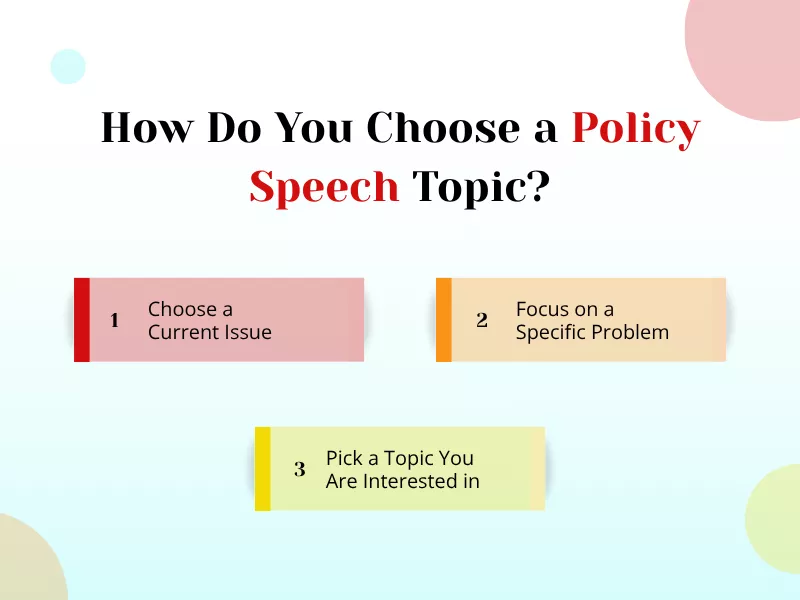
When you look for choosing a topic from a list of persuasive policy speech topics, you need to take into consideration a lot of things. Here’s what you need to take into consideration:
A. Choose a Current Issue
You must look for a topic that is relevant in the present. It is necessary to understand that the audience you will be addressing will not be interested in knowing about topics from the past. They are more interested in knowing about your perspective on a current topic. This will work in the case of choosing informative speech topics as well. You will be interested in knowing more and sharing with the audience if you are passionate about talking on the topic.
B. Focus on a Specific Problem
Do not choose a broad topic that covers a lot of information. It is wise to choose one that focuses on a specific issue. This helps keep the speech to the point and also makes research easier for students.
C. Pick a Topic You Are Interested in
You will not like to speak on a topic you have no interest in. Students often make the mistake of choosing a complex topic, thinking that it would help them stand out, only to waste hours researching and preparing a speech that’s below average. This is why it is important to choose a topic you are interested in. You can also go through a few policy speech examples to prepare accordingly.
Consult a take my online class expert to understand what your instructor expects from you and work on your speech accordingly.
Final Thoughts,
Finding a policy speech topic is difficult if you don’t understand the term properly. Further, you need to look at a lot of aspects before zeroing in on any one topic. Understand your audience well, find a topic you are interested in sharing your views on, and prepare your speech accordingly.
Get help when needed. If you struggle to prepare your speech or find the right topic, talk to your instructor or an expert to get the necessary assistance.
Frequently Asked Questions
Why are policy speech topics important?
Policy speech topics encourage critical thinking, persuasive communication, and problem-solving by requiring speakers to analyze issues and recommend effective policy changes.
Can policy speech topics be controversial?
Yes. Many policy speech topics involve controversial issues such as gun control, immigration, climate change, healthcare reform, and internet privacy, making them suitable for persuasive discussions.
What makes a strong policy speech?
A strong policy speech identifies a clear problem, presents credible evidence, proposes a realistic solution, and explains why the proposed policy would be effective.
Are policy speech topics suitable for students?
Yes. Policy speech topics are commonly assigned in high school and college because they help students develop research, public speaking, and analytical skills.
How long should a policy speech be?
The length depends on the assignment, but most classroom policy speeches are between 5 and 10 minutes, allowing enough time to explain the issue, support arguments, and present recommendations.

Want To See My Profile — Check Now
- 15 Logical Fallacies Examples You Need to Know (With Real-Life Cases) - August 19, 2026
- 100+ Passion Project Ideas for High School Students – Let Your Creativity Flow! - July 11, 2026
- A List of 100+ Policy Speech Topics for College Students - July 6, 2026


