
Logical fallacies can be stated as flawed methods of reasoning that invalidate an argument because the reasoning used to conclude is incorrect. Logical fallacies are also highly convincing due to the fact that they rely on emotions and assumptions (Ifan, 2022).
These forms of fallacies are significantly common in daily conversations, advertisements, politics, social media platforms, as well as within academic processes.
In certain situations, these fallacies are also used intentionally depending on the purpose of their use. This study presents the concept of logical fallacies, their importance in everyday life, common logical fallacies examples, reasons for their occurrence, and ways to avoid them.
Key Takeaways: Logical Fallacy Explained
- A logical fallacy is an error in the reasoning that links evidence to a conclusion; not necessarily an error in the conclusion itself.
- Logical fallacies persuade because they lean on emotion, popularity, and mental shortcuts instead of evidence.
- Appeal to popularity, hasty generalization, and false dilemma are among the most common logical fallacies in everyday life.
- Most fallacies are committed accidentally; some are deployed deliberately in advertising, politics, and debate.
- Naming a fallacy critiques the argument, not the person, and the conclusion may still turn out to be true.
- Critical thinking habits are the most reliable defense: pause on strong emotional reactions, separate claim from evidence, and ask what else could explain the result.
What Is a Logical Fallacy?
First, let’s learn the Logical Fallacy definition.
As per Friedman & Kaganovskiy (2025), a logical fallacy can be stated as a form of faulty reasoning that leads to invalid or deceptive conclusions. Even though the fallacy does not completely invalidate a perception, it simply indicates that the way this conclusion was reached was incorrect. Logical fallacies also appear within oral and written arguments, such as when writing an argumentative essay, which leads to undermining the credibility of an argument (Ifan, 2022).
Why Logical Fallacies Matter in Everyday Life?
Decision-making is heavily influenced by logical fallacies in advertising, politics, social media, as well as in general day-to-day conversations and activities. Each person thereby needs to be involved in decision-making based on textual evidence or any other type due to the fact that it helps to see the potential flaws in arguments.
15 Types of Logical Fallacies: Common Logical Fallacies Examples
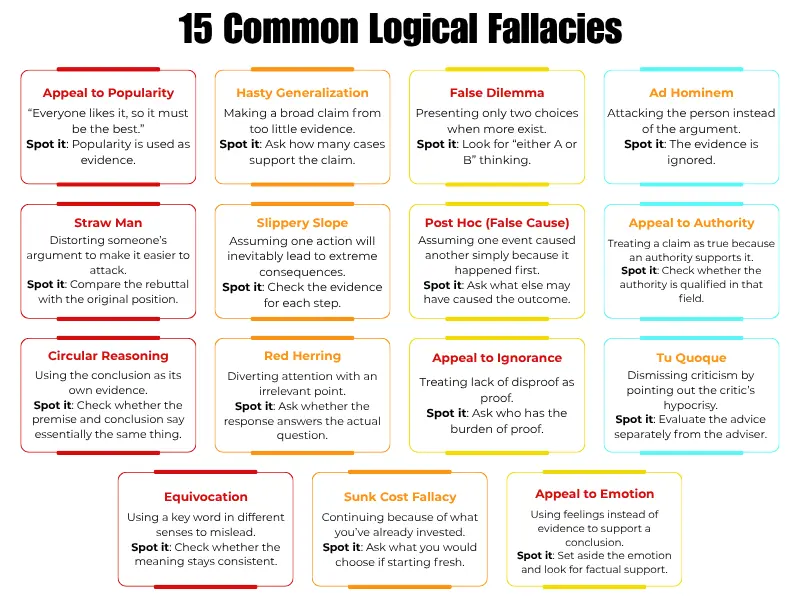
1. Appeal to Popularity (Bandwagon Fallacy)
An example fallacy can include the following statement as presented below:
“This restaurant is the best; even celebrities come to eat here.” – A local person talking about a restaurant.
The above statement showcases the fallacy that due to the reason that celebrities come to the restaurant to eat, the restaurant is the best. Celebrities may come to the restaurant for various reasons like proximity and popularity instead of food quality. Therefore, it can be stated that even though the restaurant may be popular, it does not indicate that it is the best restaurant. Such a statement can be stated as an Appeal to Popularity or a Bandwagon Fallacy.
How to spot it: Look for “everyone,” “most people,” “trending,” or celebrity presence standing in for evidence.
2. Hasty Generalization
Similarly, another example could include the following statement:
“All online shopping websites are unreliable.” – A person who had negative experiences with online shopping.
In this case, the person has experienced a negative situation and has come to a conclusion that online shopping websites are unreliable. However, as per Yaman & Köksal (2023), online shopping has generally been found to be reliable. The conclusion is made on one experience instead of enough evidence in a literature review and, therefore, is a Hasty Generalization fallacy.
How to spot it: Ask how many cases the claim rests on, and whether those cases were selected or simply the ones the speaker happened to encounter.
3. False Dilemma (Either/Or Fallacy)
“If you do not agree with uniforms, then you do not care about discipline.” – Spoken by authorities during a debate.
In the course of a debate, not wearing a uniform does not indicate that the person does not care about discipline. An individual must learn how to think critically and practice quantitative reasoning in order to prevent themselves from committing logical fallacies in arguments and decision-making.
How to spot it: Whenever a choice is framed as “either A or B,” list a third and fourth option before responding.
4. Ad Hominem (Attacking the Person)
Rejecting a claim by attacking the character, motive, or circumstances of the person making it rather than the claim itself.
“You cannot take her climate research seriously — she flies to conferences every month.” – A commenter responding to a published study.
The travel habits of a researcher have no bearing on whether her data and methodology hold up. The evidence either survives scrutiny or it does not, independently of who presents it. Attacking the speaker feels decisive in a conversation, but it leaves the original claim completely untested.
How to spot it: Check whether the response engages the evidence at all, or only the person delivering it.
5. Straw Man
Misrepresenting an opponent’s position as a weaker or more extreme version, then refuting that distorted version instead.
“You want later school start times? So you think teenagers should just sleep all day and skip class.” – A parent in a school board meeting.
The original position was a modest schedule shift. Recasting it as “sleep all day” creates an easy target that nobody actually argued for. The distorted version is defeated, the real argument is untouched, and the audience is left believing the issue has been settled.
How to spot it: Restate the opposing view in its strongest fair form first — if the rebuttal no longer works, it was aimed at a straw man.
6. Slippery Slope
Claiming that one step will inevitably trigger a chain of increasingly serious consequences, without evidence for the links in that chain.
“If we allow students to retake one exam, soon nobody will study and the entire grading system will collapse.” – An instructor opposing a resit policy.
Each step in that sequence needs its own supporting evidence. A single retake policy does not automatically produce the final outcome, and the argument works only because the endpoint sounds alarming enough that nobody checks the steps in between.
How to spot it: Number the steps from A to Z and ask what evidence supports each individual transition.
7. Post Hoc (False Cause)
Assuming that because one event followed another, the first event caused the second.
“I started using this study app in March, and my GPA rose that semester, so the app raised my GPA.” – A student recommending a product.
Sequence is not causation. The improvement may reflect an easier course load, a different instructor, more revision time, or simple regression to the mean. Testing a cause-and-effect claim requires ruling out confounders and considering whether the causal arrow could run the other way.
How to spot it: Ask what else changed during the same period, and whether the effect appears without the supposed cause.
8. Appeal to Authority
Accepting a claim as true purely because an authority figure endorses it, especially outside their field of expertise.
“A Nobel Prize-winning physicist says this diet reverses aging, so it must work.” – A supplement advertisement.
Expertise is domain-specific. A physicist’s credentials carry no weight in nutrition science, and even a genuinely relevant expert can be an outlier against broader consensus. Legitimate appeals to expertise point to a body of evidence; fallacious ones point only to a name.
How to spot it: Ask whether the authority is qualified in this specific subject, and whether other experts agree.
9. Circular Reasoning (Begging the Question)
Using the conclusion as one of the premises, so the argument assumes what it is meant to prove.
“This textbook is the most accurate because it contains no errors, and it contains no errors because it is the most accurate.” – A publisher’s marketing copy.
The premise and the conclusion are the same statement wearing different words. Nothing independent has been offered, so the argument cannot move a reader who does not already agree. This kind of self-confirming logic is common in slogans and mission statements.
How to spot it: Strip the sentence to its premise and conclusion — if they say the same thing, the reasoning is circular.
10. Red Herring
Introducing an irrelevant point to divert attention from the actual question under discussion.
“Why are we debating library funding when the parking situation on campus is so much worse?” – A student council member during a budget discussion.
Parking may well be a genuine problem, but it does not answer the funding question. The diversion works because the new topic is emotionally engaging enough that the audience follows it and never returns to the original issue.
How to spot it: Ask whether the response actually answers the question that was asked.
11. Appeal to Ignorance
Treating the absence of evidence against a claim as proof that the claim is true, or vice versa.
“No study has proven this teaching method does not work, so it works.” – A vendor pitching classroom software.
Absence of disproof is not proof. Countless untested claims remain unrefuted simply because nobody has studied them. The burden of proof sits with the person making the positive claim, not with those declining to accept it.
How to spot it: Ask who carries the burden of proof, and whether the claim has ever been tested at all.
12. Tu Quoque (Appeal to Hypocrisy)
Deflecting criticism by pointing out that the critic is guilty of the same fault.
“You are telling me to stop procrastinating, but you submitted your own thesis late.” – A student responding to a supervisor.
The supervisor’s record does not change whether the advice is sound. A hypocritical messenger can still deliver an accurate message, and the fallacy works by shifting the conversation from the substance of the criticism to the standing of the person offering it.
How to spot it: Separate the advice from the adviser and evaluate each on its own.
13. Equivocation
Using the same word in two different senses within one argument to create a misleading conclusion.
“The theory of evolution is only a theory, so it is just a guess.” – A blog post on science education.
“Theory” in everyday speech means a hunch; in science it means a well-substantiated explanation supported by extensive evidence. The argument only works if the reader fails to notice that the meaning shifted between the premise and the conclusion. Precise definitions are a basic requirement of clear academic coursework writing.
How to spot it: Define each key term once and check that it holds the same meaning throughout the argument.
14.Sunk Cost Fallacy
Continuing a course of action because of resources already invested, rather than because of its expected future value.
“I have already spent two years on this major, so switching now would waste everything.” – A junior considering a change of program.
Time already spent cannot be recovered by either choice, so it should not enter the decision. The only relevant comparison is between the future outcomes of staying and switching. The invested effort feels like a reason, but functions as an anchor.
How to spot it: Ask what you would choose today if you were starting fresh with no prior investment.
15. Appeal to Emotion
Substituting an emotional reaction — fear, pity, pride, or outrage — for evidence in support of a conclusion.
“If you truly cared about your children’s future, you would support this policy.” – A campaign advertisement.
Caring about children is not evidence that this particular policy achieves anything for them. Emotionally loaded language narrows attention and makes disagreement feel like a moral failure rather than an evidential dispute, which is precisely why it is so effective in political and advertising copy.
How to spot it: Notice the emotional pull first, then ask what factual support remains once the feeling is set aside.
Need support applying these principles to your own coursework? Explore our assignment help services.
Why Do People Fall for Logical Fallacies?
There are a wide range of reasons for logical fallacies to occur. As per Friedman (2023), people have a natural tendency to use mental shortcuts when analyzing any information instead of looking at the evidence.
Therefore, it can be stated that they accept the argument as it sounds persuasive. Additionally, as per Dennison (2024), emotions are also significant in contributing to logical fallacies, as people may sometimes consider emotional truths as logical evidence.
Cognitive Load:
Simple-sounding reasoning such as a neat slogan, a dramatic anecdote, or an either/or choice is easier to process than data, uncertainty, and nuanced causal explanations.
Mental Shortcuts:
We routinely use quick heuristics for decision-making, which might lead to errors such as treating correlation as proof of causation or generalizing from a few vivid examples.
Confirmation Bias:
People tend to accept, notice, and remember arguments that align and reinforce their beliefs and thoughts.
Persuasive Framing:
Fallacies often slip into the framing of a persuasive speech topic and pass as valid reasoning. For example, a slippery-slope claim turns a possible chain of consequences into an allegedly inevitable one.
Social Proof And Authority:
When a respected expert, celebrity, friend group, or large crowd endorses claims, we tend to accept them as truth without any evidence.
Emotion Overrides Scrutiny:
Emotive language like fear, anger, identity, hope, and outrage narrow attention and make an emotionally satisfying explanation more persuasive than a qualified one.
How to Avoid Logical Fallacies in Your Own Thinking
As per Nippold (2024), critical thinking skills are essential to understand logical fallacies. They also help to dissect logical fallacies based on what is stated by other people. It is an approach that will ensure that emotions and assumptions do not affect the individual.
The knowledge will help the individual realize the weakness in the argument and the lack of evidence.
Before committing to a belief, decision, or argument, ask:
- Pause when an argument produces a strong emotional reaction.
- Separate the claim, the evidence, and the step connecting them.
- Ask: “What else could explain this?” especially for cause-and-effect claims.
- Look for missing alternatives, unstated assumptions, and selective evidence.
- Steelman the opposing view: state it in its strongest fair form before rejecting it. This directly counters straw-man reasoning.
- Remember that how to identify logical fallacies critiques an argument, not necessarily the conclusion. A conclusion might still be true, but it needs better support.
Need help turning this into a stronger academic argument? Our English assignment help and philosophy assignment help experts work with logic and reasoning briefs every day.
What Is the Most Common Logical Fallacy, and Are They Always Intentional?
The examples of logical fallacies that are widely spread are appeal to popularity and hasty generalization.
These types of logical fallacies are frequently used in daily communication. Logical fallacies may be committed without even noticing, and because of emotions, assumptions, and absence of knowledge (Win, 2026).
There are many fallacies in the world, but some of the popular fallacies include hasty generalization, which is caused by concluding something based on one’s own personal experience.
Sometimes logical fallacies can be implemented purposefully, but most often logical fallacies happen accidentally.
Conclusion
Frequently Asked Questions
What's the difference between a logical fallacy vs cognitive bias?
Logical fallacies can be stated as an error in reasoning, whereas the definition of cognitive bias is the tendencies that greatly influence people’s thinking process and decision-making process (Friedman & Kaganovskiy, 2025).
How do you politely point out a logical fallacy in a conversation?
A logical fallacy should be pointed out by using polite questions and proving a point using evidence rather than criticizing the person who brought it up.
Can a logical fallacy make an argument's conclusion still be true?
The conclusion might be correct despite the flawed logic where 2+2 equals 5 applied to get to the right result. However, it is not always the case, as the construct on which the decision is based is wrong by itself.
What's the easiest way to spot a logical fallacy in an ad or headline?
The reason why logical fallacies can be easily identified is that they usually have emotional, popularity, and authority appeals in them.
How many types of logical fallacies are there?
There is no fixed number. Aristotle catalogued thirteen; modern logic reference lists well over a hundred using formal vs informal fallacies.
Split between formal fallacies that break an argument’s structure and informal fallacies that fail on relevance or content. The 15 types of logical fallacies above cover those you are most likely to encounter in conversation, advertising, political discourse, and academic writing.
- 15 Logical Fallacies Examples You Need to Know (With Real-Life Cases) - August 19, 2026
- How to Avoid Plagiarism? Top 10 Rules for Students - August 18, 2026
- A List of 100+ Policy Speech Topics for College Students - July 6, 2026
