
Let’s be honest — nothing exposes your true character faster than the moment someone says, “Hey, why don’t you say a few words?” and suddenly your vocabulary files vanish into thin air. You’re not alone. Roughly 75% of humans — yes, even the smart ones — fear public speaking more than death itself. (So technically, people would rather die than talk. Inspiring, right?)
But here’s the twist: in a world obsessed with “quick thinkers” and “natural leaders,” the ability to sound intelligent under pressure isn’t a luxury — it’s survival. That’s where impromptu speaking steps in. It’s not about being unprepared; it’s about being prepared to be unprepared.
So, whether you’re a student trying to impress your debate club, a professional stuck in a surprise Q&A, or just tired of saying “uhm” like it’s your middle name — this guide is your cheat sheet to mastering the ultimate skill: talking smart, fast, and fearless.
Buckle up — by the end, we’ll break down exactly what an impromptu speech is, why it’s a secret weapon in public speaking, and how you can ace it with practical tips, 300+ Impromptu topic ideas, and proven frameworks. Ready to turn those “uh-oh” moments into “wow” moments, then Learn how to deliver one so smooth that people will think you swallowed a TED Talk.
What Is an Impromptu Speech [With Examples]?
An impromptu speech is a type of speech delivered without prior preparation or rehearsal. The speaker is given a topic on the spot and expected to organize their thoughts quickly and speak coherently for a few minutes. According to Harvard Business Review, over 70% of professionals believe that strong impromptu communication is the real mark of leadership. Translation: your ability to wing it — gracefully — might just outshine your entire résumé.
It’s commonly used in classrooms, debate clubs, interviews, and public speaking contests to test a person’s ability to think fast, stay calm under pressure, and communicate effectively.
Unlike a prepared or memorized speech, impromptu speaking relies on your ability to structure your ideas quickly — often using simple formats like the PREP method (Point, Reason, Example, Point) or the Past–Present–Future method.
How Does Impromptu Public Speaking Help You?
That’s a strong foundation! Here is the content, distilled and structured for maximum impact and visual clarity in an infographic:
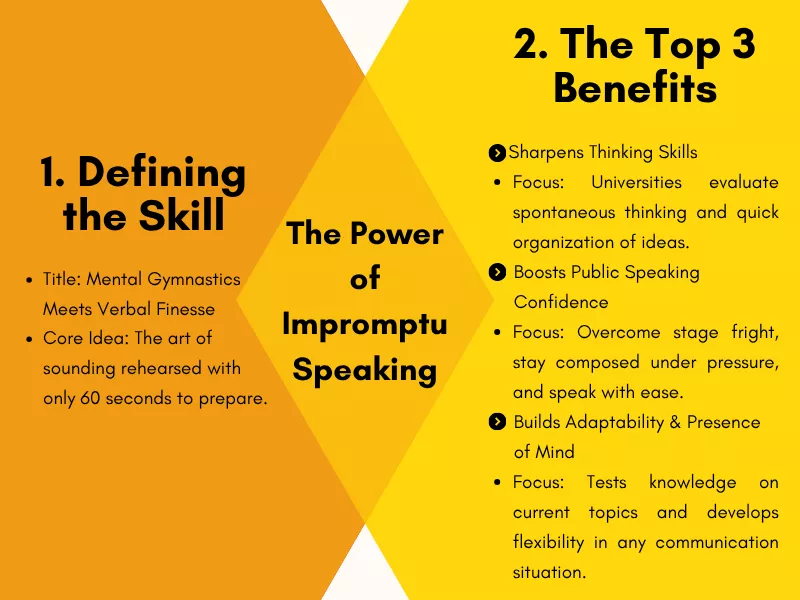
According to a friend of mine, impromptu speaking loosely translates to your mental gymnastics meets verbal finesse — the art of sounding like you’ve rehearsed for hours when you’ve had exactly 60 seconds to think.
- Sharpens Your Thinking Skills: Universities and schools evaluate your spontaneous thinking and articulation skills. They check how quickly you can organize ideas and how you can deliver your speech.
- Boosts Confidence in Public Speaking: An impromptu speech improves your confidence in public speaking. Evidently, most public speaking courses include impromptu speeches so you can overcome stage fright, stay composed under pressure, and speak with ease.
- Builds Adaptability and Presence of Mind: Impromptu speeches are a great way to test your knowledge on general or current topics and to develop adaptability in communication situations.
But here’s the deal: Impromptu speech does not mean you have to be unprepared! That’s why we have prepared topic ideas so you can spend more time preparing your speech rather than finding one.
20 Random Impromptu Questions
- If you could live anywhere in the world, where would it be and why?
- What would you do if you woke up one morning and could read minds?
- Do social media platforms bring people closer or drive them apart?
- What’s one invention you couldn’t live without?
- If time travel were possible, would you go to the past or the future?
- What does success mean to you?
- If you could change one rule in your school or workplace, what would it be?
- Is honesty always the best policy?
- What’s the most important lesson life has taught you so far?
- Should everyone be required to learn a second language?
- What would you do if you suddenly became famous overnight?
- Which is more important: intelligence or kindness?
- If you had one superpower, what would it be and how would you use it?
- What makes a person truly happy?
- Would you rather be rich and unknown or poor and famous?
- How would you spend a million dollars if you had to use it in one week?
- What’s the biggest challenge facing young people today?
- If animals could talk, what do you think your pet would say about you?
- Should technology be limited to protect human creativity?
- What’s something you think everyone should try at least once in their life?
20 Good Impromptu Speech Topics for High School
- The power of positive thinking
- Why school uniforms should (or shouldn’t) be mandatory
- How social media influences teenagers
- The importance of time management
- Why failure is the key to success
- Should students be allowed to grade their teachers?
- The role of sports in developing character
- How music affects your mood
- The impact of peer pressure on decision-making
- Should community service be a graduation requirement?
- Why reading books still matters in a digital world
- How to balance academics and personal life
- Should the voting age be lowered to 16?
- The pros and cons of online learning
- The importance of financial literacy for teens
- How kindness can change the world
- Should high school students have part-time jobs?
- What makes a great leader?
- How to overcome procrastination
- Why self-confidence is your greatest skill
20 Funny Impromptu Speech Topics for Middle School
- If teachers disappeared for a day
- The worst excuse I ever gave for not doing homework
- If pets ruled the world
- Why pizza should be declared a national treasure
- How to survive a zombie apocalypse at school
- My secret superpower that nobody knows about
- The most embarrassing moment of my life
- Why aliens would never visit Earth twice
- If I were the principal for a day
- How to convince your parents to buy you a puppy
- What if Wi-Fi stopped working for a week?
- My dream invention that would make life easier
- Why Mondays should be canceled
- How to become a billionaire without doing any work
- The most annoying sound in the world
- If homework could talk, what would it say?
- Why chocolate milk should come out of water fountains
- My life as a superhero sidekick
- How to win an argument with your sibling
- What would happen if everyone could fly?
20 Persuasive Impromptu Speech Topics for College
- College education should be free for all students
- The drinking age should be lowered (or raised)
- Social media does more harm than good
- Why internships should be paid
- Online classes are the future of education
- The government should prioritize mental health programs
- Voting should be mandatory
- Artificial intelligence will create more jobs than it destroys
- College athletes should be paid
- Climate change is the biggest threat to humanity
- Why students should take a gap year before college
- Cancel culture is toxic to free speech
- Electric cars are the future of transportation
- Should student loans be forgiven?
- The influence of celebrities on young people
- Why financial education should be taught in every college
- Technology has made us more connected but less personal
- Why everyone should volunteer at least once
- The importance of emotional intelligence in leadership
- College grading systems should focus more on learning than testing
20 Impromptu Speech Topics for Public Speaking
- The art of staying calm under pressure
- How first impressions shape relationships
- Why communication is the key to success
- The role of humor in public speaking
- How to turn fear into confidence
- The impact of body language on audience engagement
- Why storytelling makes speeches memorable
- How to handle mistakes while speaking on stage
- The power of using pauses in a speech
- How to connect emotionally with your audience
- The importance of preparation — even for impromptu speaking
- Why every leader should be a good listener
- How to persuade without being pushy
- The difference between speaking and communicating
- How to grab attention in the first 30 seconds
- The importance of authenticity in public speaking
- How to make boring topics sound exciting
- Why great speakers are also great thinkers
- The balance between humor and professionalism
- How to end a speech with impact
20 Excellent Speech and Debate Impromptu Topics
- Should freedom of speech have limits?
- Is technology making us smarter or lazier?
- Can money really buy happiness?
- Is artificial intelligence a threat or a blessing?
- Should voting be a right or a responsibility?
- Is censorship ever justified?
- Should social media companies regulate misinformation?
- Are humans responsible for climate change?
- Should schools ban junk food?
- Is homework still necessary in modern education?
- Do grades define intelligence?
- Should animal testing be banned completely?
- Is the internet making people less social?
- Should college athletes be treated as professionals?
- Does fame always lead to happiness?
- Is war ever justified?
- Should everyone serve in the military for a year?
- Are online friendships as real as in-person ones?
- Should the government control how people use their data?
- Is competition necessary for personal growth?
180 Impromptu Topics by Duration
45-30 Second Topics
(Short, sharp, and spontaneous — focus on clarity and one strong idea.)
- My favorite time of the day
- The best advice I’ve ever received
- Why laughter is contagious
- One thing I can’t live without
- The most surprising thing about me
45-1 Minute Topics
(Ideal for quick reasoning — use the PREP method: Point, Reason, Example, Point.)
- Why kindness is never wasted
- The importance of saying “thank you”
- One small habit that changed my life
- Why music can heal your mood
- How technology makes life easier — or harder
45-2 Minute Topics
(Allows room for examples or a short story — aim for an intro, body, and conclusion.)
- Why failure is the best teacher
- What makes a true friend
- The role of creativity in everyday life
- Why everyone should try public speaking
- How social media shapes our opinions
45-5 Minutes Topics
(Best for competitions or longer exercises — structure with 2–3 main points.)
- The impact of technology on human relationships
- How to overcome fear and build confidence
- Education vs. experience: What matters more?
- The importance of mental health awareness
- How small actions can make a big difference in society
As for the rest, click on the link below and download the list. But that’s not all, a surprise is waiting for you in it!
Struggling to pick a topic because of so many options? Well, fret not! We will help you with that, too. Check out the tips below to choose a topic like a professional!
Also, check out some unique motivational speech topics.
Tips to Choose Impromptu Speech Topics for Your Next Public Speaking

Understand Your Audience
While choosing Demonstration Speech Ideas or impromptu topics, you must be very careful about your audience. Therefore, know your audience’s interests, age group, or background. The more relevant your theme, the more engaged your listeners will be.
Pick a Relatable or Personal Theme
Well, how to know if a theme is relevant, you may ask? It’s simple: select something you can personally connect with or have an opinion about. It’s always better to choose a topic close to your heart because it keeps your speech natural and authentic.
Keep It Simple and Focused
But wait, don’t go for complex or controversial Policy Speech Topics. Your preparation time is limited; thus, a clear, straightforward topic is easier to develop. Furthermore, it keeps your message strong and improves your public speaking skills.
Limit Your Scope Based on Time
Your quick thinking skills are essential since impromptu speeches are short. But there’s another essential thing: focusing on one main idea instead of covering too much — depth matters more than breadth.
Identify Your Core Message
Last but never least, before you start, decide what takeaway you want the audience to remember. Every point you make should support that single message.
With that in mind, let’s focus on building your public speaking skills because we kid not, your tone can actually set you apart, and these strategies can even turn an introvert into the biggest manipulator [maybe better than your President!]
Strategies to Become the Best Impromptu Speaker

Embrace the Challenge
While delivering your Special Occasion Speech Topics or Impromptu speech, the very first lesson that you should focus on is taking this as an opportunity, not a test! Because it’s not! The more you face unprepared moments with confidence, the stronger your speaking instincts become.
Use a Clear Structure
Now, before you flow into the River Nile with your thoughts, organize your speech with a quick structure like Introduction–Body–Conclusion or the PREP method (Point, Reason, Example, Point) to stay logical and engaging. It won’t make your Impromptu speeches any less than those of Persuasive Speech Topics!
Use Frameworks That Work
Now, how should you highlight your main points? Well, simply rely on simple mental frameworks such as Past–Present–Future or Problem–Solution–Impact to develop ideas quickly and stay on track. Just as life, your last-minute speech is all about simplicity that touches the heart and brain together!
Active Listening
Pay close attention to prompts, audience reactions, or questions, even during your competition [and real life]. Active listening helps you tailor your message and respond naturally in real time, and also pick up points to set your debate on!
Time Management
Practice quick thinking and pacing your ideas so your speech fits within the time limit. A well-timed delivery shows control on subject, clarity, and confidence, which you might lack but must not show!
Now you have an added benefit —what about something more? Well, even after choosing a topic, most students struggle to make a good lasting impression! Why? Well, because even a thought-provoking topic requires a strong speech technique. Which brings us to our next section: How To Write A Speech Outline!
Impromptu Speaking Speech Outline

Basic 3-Point Structure
A simple and effective format to keep your speech organized:
- Introduction: State your topic and grab attention.
- Body: Share 2–3 key points with examples or reasoning.
- Conclusion: Summarize and leave a lasting message.
The PREP Method (Proven Formula)
Use the Point–Reason–Example–Point structure to sound logical and confident:
- Point: State your opinion or argument.
- Reason: Explain why you believe it.
- Example: Share a real-life story or fact.
- Point (Restate): Reinforce your main idea strongly.
The Past–Present–Future Framework
This method helps create a smooth, time-based flow:
- Past: Start by describing how things used to be.
- Present: Explain the current situation or changes.
- Future: Predict what’s ahead or give a closing insight.
The Problem–Solution Framework
Perfect for persuasive or issue-based topics:
- Problem: Identify and explain the challenge.
- Solution: Offer practical or creative fixes.
- Result: Highlight the positive impact or outcome.
Time Allocation Example
A 3-minute impromptu speech can be divided like this:
- Introduction: 30 seconds
- Body: 2 minutes
- Conclusion: 30 seconds
This keeps your delivery balanced and focused.
Pro Tip
Before you speak, take 5–10 seconds to organize your thoughts. Jot down keywords or mentally outline your structure — it can make your impromptu delivery sound planned and professional.
But did you know that about 34% students make common mistakes while speaking in front of an audience? Be it known or unknown, you must capture your audience’s heart and mind! Thus, let’s learn the mistakes you should never make. Because at times knowing what you shouldn’t do is equally important.
Common Mistakes to Avoid to Capture the Audience

Starting Without a Clear Point: We understand you might not have much time to prepare, but jumping into your speech without a clear main idea isn’t a smart move. It can easily confuse your audience (not capture their attention). Always decide your key message before you begin.
Speaking Too Fast or Too Slow: Rushing makes you sound nervous, while speaking too slowly can bore your audience. Therefore, give your audience a couple of minutes (not really) to grab the idea! Maintain a natural yet neutral and confident pace.
Ignoring Body Language: Your posture, gestures, and facial expressions speak as loudly as your words in real-world scenarios. Maintain eye contact and use open, confident movements.
A bonus for you all: When selecting an Impromptu Speech Topic, always remember it’s not a monologue — it’s communication. Engage your audience with relatable examples, questions, or brief humor to keep them involved.
Now, the most essential part: a short but scary story. Your topic covers it all, your speech outline is perfect, but when it was your chance to finally present your thoughts, you blankly stare at your audience — and BAM! You lose it all! Well, don’t fret! We told you it’s going to be a useful blog, right? So, let’s move to our last section, speaking practice for Impromptu speeches!
How to Practice Impromptu Speaking?
Pick Random Topics Daily: Choose a random topic — from current events to simple ideas like “happiness” or “technology” — and speak for 1–2 minutes. This builds spontaneity and topic adaptability.
Use Speech Frameworks: Practice structuring your thoughts using methods like PREP, Past–Present–Future, or Problem–Solution. Frameworks give your ideas instant flow and clarity.
Time Yourself: Record short speeches with a timer. Managing your time trains you to stay within limits while delivering a complete and clear message.
Record and Review: Before you receive feedback, give your feedback! Record your practice sessions to notice pacing, tone, and body language. Reviewing your videos helps you spot habits and track improvement.
Practice with Friends or Groups: Join debate clubs, public speaking groups, or online sessions. Getting feedback from others helps you refine delivery and boost confidence.
Reflect and Improve: After every speech, ask yourself — What went well? What can I improve? Self-evaluation is the key to long-term growth. after this line To become a more confident impromptu speaker, it helps to stay curious about the world around you. Familiarizing yourself with common informative speech topics gives you a foundation of general knowledge that you can draw upon whenever you are asked to speak without any formal preparation time.
Conclusion: Bidding Adieu!
Just as this, your impromptu speech must leave a lasting impression. From today, you don’t need to spend hours exploring topics; all you need to do is use your creativity and our expertise to transition your audience! Remember, impromptu speaking is not about perfection — it’s about confidence, clarity, and connection. With practice, structure, and a dash of creativity, you can turn any on-the-spot topic into a compelling speech that resonates with your audience. So take a deep breath, trust your instincts, and let your words leave a memorable impact every time!
Frequently Asked Questions
Why Does Using Personal Experience Help in Impromptu Speaking?
Using personal experience makes impromptu speaking more authentic and relatable. It helps you connect emotionally with your audience, recall ideas quickly, and sound natural instead of rehearsed. Real stories strengthen credibility and make your message more memorable.
In What Types of Settings Are Impromptu Speeches Commonly Used?
Impromptu speeches are common in classrooms, interviews, meetings, debates, social events, and panel discussions—any situation requiring spontaneous, unprepared responses.
What Is the Prep and Speaking Time Range for an Impromptu Speech?
Prep time for an impromptu speech typically ranges from 1–3 minutes, with a speaking time of 3–5 minutes, depending on the event or competition rules.
What Is Active Listening and Why Is It Key in Debates or Impromptu Talks?
Active listening means fully focusing on and understanding others’ points before responding. It’s crucial in debates or impromptu talks because it enables relevant, logical rebuttals and keeps communication clear and engaging.
What Are the Two Primary Goals or Functions an Impromptu Speech Can Serve?
Impromptu speeches serve two main purposes: to inform by sharing knowledge or insights, and to persuade by influencing opinions or decisions through logical, quick reasoning.
Related Blogs

Tips to Deliver an Extemporaneous Speech That Impresses Audiences

Tips For Crafting A Commemorative Speech That Will Astound Everyone

Effective Tips To Deliver A Memorable Retirement Speech
Fill Your Details

Want To See My Profile — Check Now
- 15 Logical Fallacies Examples You Need to Know (With Real-Life Cases) - August 19, 2026
- 100+ Passion Project Ideas for High School Students – Let Your Creativity Flow! - July 11, 2026
- A List of 100+ Policy Speech Topics for College Students - July 6, 2026


