
Writing a reaction paper can feel a bit confusing because you have to do more than just summarize a book, article, or movie. You need to explain your response, provide necessary details, and show why you reacted that way. Without a clear structure, a personal response can easily turn into a summary or a collection of opinions.
A strong reaction paper connects your response with the source’s ideas. From choosing a focused reaction and developing a thesis to organizing your analysis and writing a strong conclusion, every stage matters.
In this guide, we will walk you through how to write a reaction paper step by step, with practical examples and the academic standards to follow. You’ll also find practical tips for turning your thoughts into a well-structured paper.
Key Takeaways: Quick Guide to Reaction Papers
- Understand the purpose and structure of a reaction paper.
- Develop a clear thesis based on your response to the source.
- Support your reactions with specific evidence and analysis.
- Follow a clear reaction paper outline from introduction to conclusion.
- Avoid excessive summary, unsupported opinions, and plagiarism.
- Review your paper for clarity, formatting, and academic requirements before submitting.
What Is a Reaction Paper?
A reaction paper is an academic response to an article, book, movie, lecture, or other source. Rather than simply summarizing what the source says, you describe your response to its ideas and why you reacted that way.
A complete reaction paper combines a summary with personal response, analysis, and evidence from the source.
Your reaction should go beyond statements such as “I liked the article” or “I disagreed with the author.”
Explain what influenced your response, which ideas stood out, and whether the source changed, challenged, or supported your perspective. Specific examples, quotations, or details from the source can make your analysis more convincing.
Generally, a reaction paper includes an introduction, brief summary, reaction and analysis, supporting evidence, and conclusion. The exact requirements may vary by instructor, so always follow the assignment guidelines for length, formatting, and citation style.
Reaction Paper Format and Structure
A clear reaction paper structure helps you present your response logically and keep the focus on analysis rather than summary. If you’re also unsure how to format an assignment, understanding the basic organization of academic writing can help you structure your reaction paper more effectively.
While requirements can vary by instructor, most reaction papers follow three main parts: an introduction, body paragraphs, and a conclusion.
Reaction Paper Introduction
Start by identifying the source you are responding to, including its title, author, and type of work.
Briefly introduce its main topic or argument, then state your overall reaction. End with a clear thesis statement that tells the reader what you think about the source and why.
A simple formula: Source + context + main reaction + thesis
Body Paragraphs
The body is where you develop and support your reaction. Begin with a summary of the source’s relevant ideas, then focus on your response to them. Explain what you agree or disagree with, what surprised you, or how the source challenged your perspective.
Support important points with specific examples, quotations, or evidence from the source, and explain how each piece of evidence connects to your reaction. Avoid spending most of the body simply retelling the source.
Conclusion
The conclusion brings your response together without introducing a completely new argument.
Briefly restate your main reaction, reflect on the source’s significance, and leave the reader with your final insight.
A strong conclusion should answer one key question: What did you take away from the source, and why?
Reaction Paper Outline: A Simple Template
A reaction paper outline gives you a clear plan before you start drafting. It helps you separate the source’s main ideas from your own response and ensures each paragraph supports your central reaction. If you need help to write an essay outline, you can use the same approach to organize your ideas before drafting.
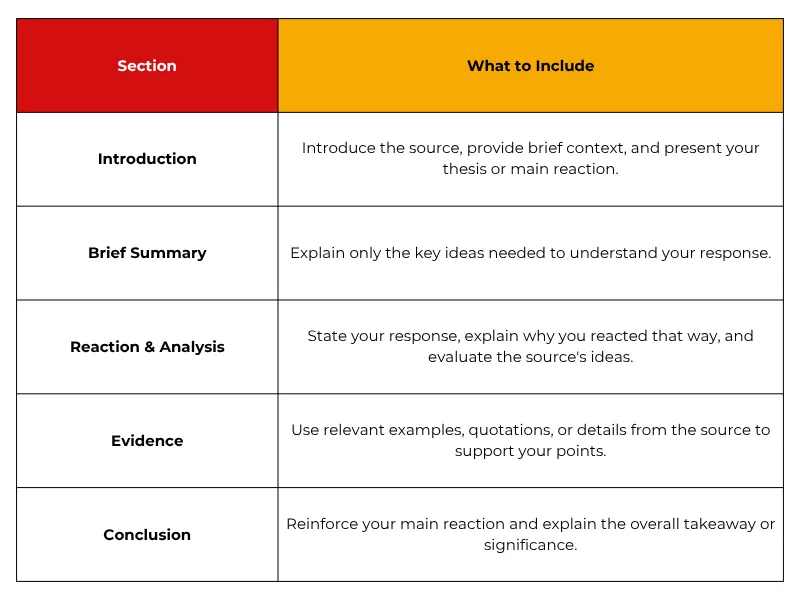
How to Use an Outline Template Effectively for a Reaction Paper?
Start by writing your main reaction or thesis at the top of the outline. Then add the key points you want to discuss under each section.
For every reaction, note the reason and supporting evidence you’ll use. This keeps your paper focused and prevents the body from becoming a lengthy summary.
You can also create a reaction paper outline using digital tools such as word processors or note-taking apps. Use headings for each section, add bullet points for ideas and evidence, and rearrange them as your argument develops.
The tool can organize your ideas, but your analysis and response should come from your own engagement with the source.
How to Write a Reaction Paper Step by Step?
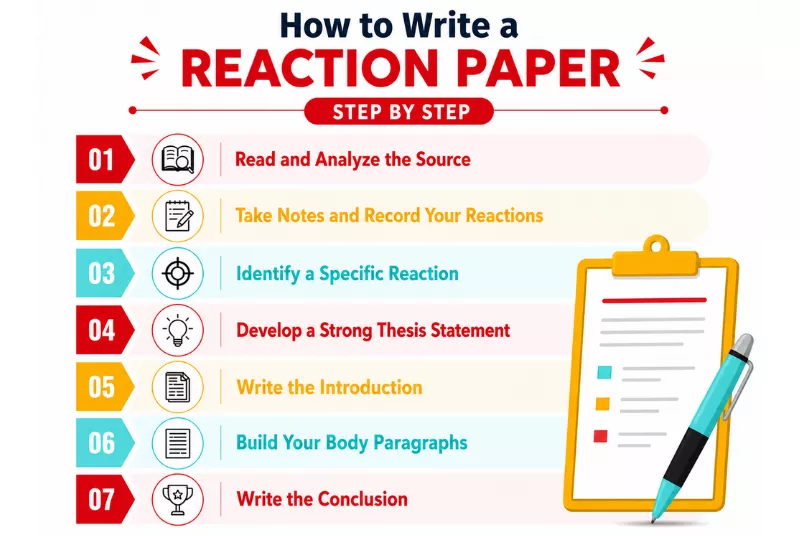
Knowing the reaction paper structure is helpful, but the real challenge is turning your thoughts into a focused response. Effective reaction papers go beyond summary to include personal response and analysis, a distinction also covered in the UMGC guide to reaction papers.
Follow the steps below to move from understanding the source to a clear, well-supported paper.
1. Read and Analyze the Source
Read the article, book, or other assigned material carefully before forming your response. Identify the author’s main argument, important ideas, evidence, and points that stand out to you. For a movie, pay attention to themes, characters, and significant scenes.
2. Take Notes and Record Your Reactions
Note what you agree or disagree with, what you find interesting, what you question, or what you find surprising. Record specific examples or quotations that support these reactions. You can use digital note-taking tools to organize your ideas and source details as you work.
3. Identify a Specific Type of Reaction
A reaction paper can express different types of responses, such as agreement, disagreement, surprise, appreciation, criticism, or personal reflection. Choose one or two reactions that best reflect your response to the source and explain what caused them. Use critical thinking to examine the source and develop a well-reasoned response. A focused reaction gives your paper a clear direction.
4. Develop a Strong Thesis Statement
Turn your main reaction into a clear thesis. State what you think about the source and briefly indicate why. A strong thesis gives your paper a central argument that each body paragraph can develop.
5. Write the Introduction
Start with the source’s title, author, and relevant context. Briefly introduce the central idea, then lead into your reaction and thesis. Keep the background concise so you can focus on your analysis.
6. Build Your Body Paragraphs
Develop each reaction with a clear point, relevant evidence, and your analysis. A useful pattern is:
Point → Evidence → Reaction → Analysis
Explain not only what the source says, but also why the evidence supports your response. Avoid turning the body into a detailed summary of the source.
7. Write the Conclusion
Bring your main response together and reinforce the insight developed throughout the paper. Briefly explain what you learned, how the source affected your thinking, or why its ideas matter. Avoid introducing a new argument in the final paragraph.
If you have difficulty writing a reaction paper or following all the required steps, you can get professional assignment help to improve the quality of your work.
How to Write a Reaction Paper about a Movie, Book, or Article?

The approach changes slightly depending on the type of source you are responding to. Focus on the elements that matter most to the work, while keeping your response centered on your reaction and analysis rather than retelling the entire source.
How to Write a Movie Reaction Paper?
Start by identifying the movie title, director, and central theme or message. Briefly describe the plot only where necessary to provide context. Then focus on your response to elements such as the characters, themes, performances, visuals, or important scenes.
Use specific scenes to support your reaction. Instead of saying that a character was convincing, explain which scene influenced your view and why.
Discuss whether the movie challenged your expectations, communicated its message effectively, or changed your perspective.
For example:
After watching The Truman Show, I was most interested in how the film explores freedom and control. Truman’s gradual realization that his entire life has been staged made me question how much control people have over their own choices. His decision to leave despite the fear of the unknown stood out to me because it showed his willingness to choose freedom over comfort. Overall, the movie made me think differently about privacy, independence, and the importance of making our own decisions.
How to Write a Reaction Paper about a Book?
Begin with the book title, author, and central theme or argument. Give only a brief overview of the relevant content before moving into your response.
You can react to the author’s ideas, characters, themes, writing style, or significant passages. Support your points with specific details or quotations from the book, then explain how those details shaped your response. Focus on interpreting the material rather than simply describing the plot.
For example:
After reading The Great Gatsby by F. Scott Fitzgerald, I was most struck by Gatsby’s desire to recreate the past. His pursuit of wealth and status made me question whether ambition can become harmful when driven by unrealistic expectations. The novel also made me reflect on how social status can influence people’s views of success and relationships.
How to Write a Reaction Paper about an Article?
Identify the article title, author, publication, and main argument. Briefly explain the author’s main claim before responding to it.
Consider whether the argument is convincing, which evidence stands out, and whether you agree or disagree with the author’s conclusions. Use specific claims or evidence from the article to support your response, and explain why they influenced your thinking.
For any source, the basic approach remains the same: briefly explain the source, state your reaction, support it with evidence, and analyze why that evidence matters.
Reaction Paper Examples
Examples can help you see how a reaction paper moves from summary to personal response and analysis. Instead of copying a sample, use the examples below to understand how each part contributes to the overall argument.
Reaction Paper Example about an Article
Sample Article: The Impact of Social Media on College Students
Summary: The article examines how frequent social media use can affect students’ concentration and academic habits.
Reaction: I found the author’s argument convincing because the discussion connects social media use with difficulties in maintaining focus. However, I think the article could have considered how social platforms can also support academic collaboration.
Analysis: This contrast makes the argument more balanced. While excessive use can create distractions, students may also use social media to exchange resources, discuss coursework, and communicate with classmates.
Notice that the example does more than state an opinion. It identifies a reaction, provides reasoning, and evaluates the source’s argument.
Reaction Paper Introduction and Conclusion Examples
Introduction example:
In The Impact of Social Media on College Students, the author explores how social media can influence students’ academic habits and concentration.
The article presents a convincing discussion of the challenges caused by excessive use, although it gives less attention to the educational benefits of these platforms. Overall, the article highlights an important issue for students navigating academic and digital life.
Conclusion example:
Overall, the article offers a convincing perspective on the effects of excessive social media use on students’ academic focus. While its discussion could include more benefits of responsible use, it encouraged me to reconsider how digital habits affect concentration and study routines.
The introduction establishes the source and thesis, while the conclusion reinforces the main reaction without introducing a new argument.
How to Write a Reaction Paper with Multiple Sources?
When a reaction paper requires more than one source, avoid writing a separate summary of each one. Instead, develop one central reaction and use the sources to support, challenge, or add context to it.
Start by identifying a common theme or disagreement between the sources. Then compare their ideas and explain how each one influences your response. Use evidence from each source where relevant and cite each source correctly.
A useful structure is:
Main reaction → Source 1 evidence → Source 2 evidence → Comparison → Analysis
For example, if two articles discuss social media and academic performance, you could explain how their different findings influenced your overall view rather than summarizing both articles separately.
Academic Standards, AI, and Plagiarism
A reaction paper should reflect your own understanding and response to the assigned source. Apply the same originality and evidence standards to any external resource you consult. Guides, examples, and reference materials are intended to support your own writing, and you must follow your institution’s academic integrity policy on what may be used and how it must be acknowledged.
Writing and editing tools can help you organize ideas or improve clarity, but they should not replace your analysis. Always follow your instructor’s requirements for AI use, citations, and academic integrity.
If you need help maintaining academic standards and avoiding plagiarism in your work, professional assignment writing services can provide relevant support.
Can I Use AI Tools to Write a Reaction Paper?

Yes, AI tools can assist with parts of the writing process, but your reaction, analysis, and interpretation should be your own. You can use AI to brainstorm questions, organize an outline, identify unclear sentences, or check grammar.
However, even where AI use is permitted, most institutions require you to disclose it and never present AI-generated text as your own work.
Before using an AI tool, check your course policy. Also, verify any facts, quotations, or citations it provides because AI tools can produce inaccurate information.
How to Avoid Plagiarism When Writing a Reaction Paper?
Plagiarism happens when you use another person’s words or ideas without proper acknowledgment. To avoid it:
- Write your reaction and analysis in your own words.
- Use quotation marks for direct quotations.
- Cite borrowed ideas, facts, and paraphrased information.
- Keep track of your sources while taking notes.
- Don’t copy material from online examples or other students’ papers.
- Review your citations before submitting.
Your personal response should remain the focus of the paper, while source material should be used to support your analysis.
What Are the Best Grammar-Checking Tools for Academic Writing?
Grammar-checking tools can help identify spelling, punctuation, sentence structure, and readability issues. They are useful for reviewing a finished draft, but they should not replace your own editing.
Some useful options include:
- Grammarly: Provides real-time feedback on grammar, spelling, punctuation, and clarity. It works across browsers, desktop apps, and Microsoft Word.
- ProWritingAid: Offers grammar, spelling, punctuation, readability, and style checks. Its reports can help identify sentence-structure problems and repetitive wording.
- LanguageTool: Checks grammar, spelling, punctuation, and style and supports numerous languages. It also works with tools such as Google Docs and Microsoft Word.
When using any grammar checker, review its suggestions instead of accepting every change automatically. Make sure the final wording still reflects your intended meaning and follows your instructor’s academic writing requirements.
Are There Any Online Platforms Offering Free Citation Generation?
Yes. Free citation generators such as MyBib, ZoteroBib, and the Scribbr Citation Generator create references for books, articles, websites, and other sources at no cost. Citation Machine offers similar functionality, though it is ad-supported and prompts you toward paid upgrades.
These tools give you a starting point, not a finished reference. Generated citations can contain errors or missing fields, so always check each one against the required style guide and the original source before adding it to your paper, and particularly when your assignment specifies MLA, APA, or Chicago.
Take the Next Step With Your Reaction Paper!
Writing a strong reaction paper is about more than sharing your opinion. A focused thesis and logical reaction paper structure can help you turn your thoughts into a clear academic argument.
Before submitting, review your paper for clarity, evidence, citations, formatting, and originality.
If you’re still unsure how to write a reaction paper, use the outline and examples in this guide as a starting point, then adapt them to your assignment requirements.
Need extra support with your academic writing? Explore Assignments4U’s academic writing guides and study resources to help you approach your assignments with greater clarity and confidence.
Frequently Asked Questions
Can a reaction paper include personal experiences?
Yes. Personal experiences can strengthen your response when they directly connect to the source’s ideas. Keep them relevant and explain how the experience shaped your reaction rather than turning the paper into a personal narrative.
How much of a reaction paper should be summary?
Keep the summary brief and include only the information needed to understand your response. The main focus should remain on your reaction, analysis, and supporting evidence.
Can I disagree with the author in a reaction paper?
Yes. A reaction paper can include agreement, disagreement, or a combination of both. If you disagree, explain your reasoning and support your position with specific evidence from the source.
What makes a reaction paper different from a critical essay?
A reaction paper emphasizes your response to a specific source, while a critical essay generally focuses more heavily on evaluating or analyzing an argument, text, or issue. A reaction paper can include critical analysis, but personal response is usually more prominent.
Can I write a reaction paper without using direct quotations?
Yes. You can paraphrase relevant ideas and cite the source instead of using direct quotations. Choose quotations only when the original wording adds value to your analysis.
How can I make my reaction paper sound more academic?
Use specific claims, relevant evidence, and clear reasoning instead of relying on broad statements such as “This was interesting.”Keep your language precise, connect each point to your thesis, and maintain a balance between personal response and analysis.
Can AI check whether my reaction paper is good?
AI tools can help identify unclear sentences, organizational issues, or grammar problems, but they cannot reliably determine whether your interpretation is academically appropriate. Your instructor’s requirements and your own judgment should guide the final draft.
Can I use a reaction paper template for my assignment?
Yes, a template can help you organize your ideas, but you should adapt it to your assignment requirements. Your source, thesis, analysis, evidence, and overall response should be original to your paper.
How do I find reliable sources to support my reaction paper?
Start with your assigned source, your institution’s library, and reputable academic databases. Choose sources that are relevant to your topic and, when required, peer-reviewed. Always verify the author’s credentials, publication, and date before relying on a source.
What should I do if my reaction paper has a strict word limit?
Prioritize your strongest reaction and the evidence that supports it. Keep the source summary concise, remove repetitive explanations, and make sure each paragraph contributes directly to your thesis.
Should I get feedback on my reaction paper before submitting it?
Feedback can help identify unclear arguments, weak transitions, grammar issues, or unsupported claims. If possible, ask a peer, your instructor, a writing center tutor, or a qualified editor to review the draft while keeping the final analysis and response your own.

Want To See My Profile — Check Now
- How to Write a Book Title in an Essay: Citation Rules and Mistakes to Avoid - September 28, 2026
- Transition Words for Essays: 100+ Examples by Function - September 10, 2026
- AMA Style In Text Citations Explained With Examples - August 29, 2026


