
Educational institutions enforce academic integrity rules strictly when checking student submissions, whether it’s a high school essay, a college dissertation, or a PhD thesis. Plagiarism is a serious form of academic misconduct, and professors treat it as non-negotiable. Therefore, students must be aware of three things to stay safe:
- What is plagiarism?
- What causes plagiarism? Or, what counts as plagiarism?
- How to avoid plagiarism?
In this article, we will discuss everything in detail so that you can submit your assignments without worrying about getting flagged.
Key Takeaways on Avoiding Plagiarism
- Plagiarism is one of the most serious forms of academic misconduct and often results in assignment rejection or failing a semester.
- Paraphrasing without attributing the source is considered plagiarism.
- Contextual citations with proper reference lists help avoid plagiarism to a great extent.
- Accidental plagiarism and unintentional collusion often carry the same penalties as deliberate cheating.
What Is Plagiarism? Types, Causes & Consequences
When you use someone else’s work without proper attribution, that is plagiarism. Plagiarism can be both intentional and unintentional.
| Feature | Intentional Plagiarism | Accidental Plagiarism |
| Definition | Using someone else’s work as your own without giving any credit | Accidentally misusing sources |
| Cause |
|
|
| Core Action |
|
|
| Penalties |
|
Often carries identical penalties regardless of the mistake |
How to Avoid Plagiarism in Writing? 10 Simple Rules!
Here are some simple plagiarism prevention tips for students:
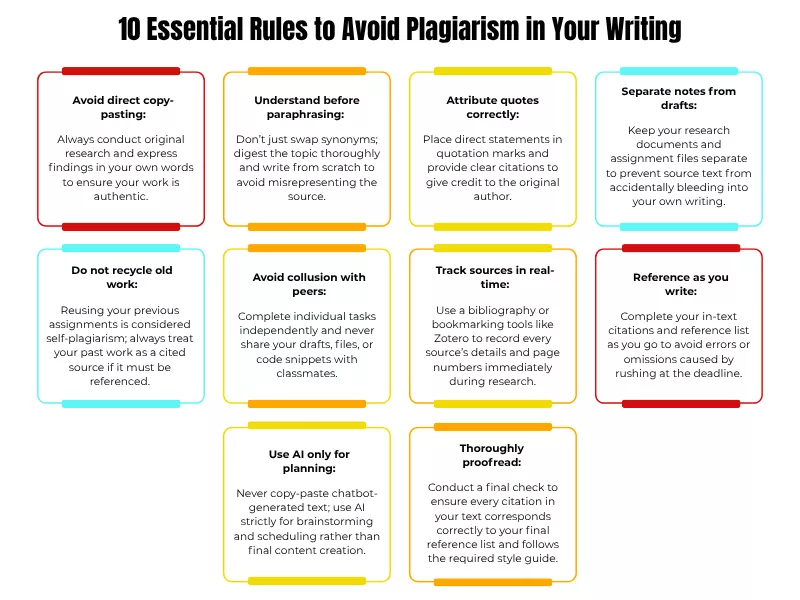
1. Avoid Direct Copy and Paste
Copying content from a source and pasting it word-for-word in your assignment is direct plagiarism. Whether it’s the whole content, a block, a paragraph, or a single line, it all counts as plagiarism. Academic papers that contain such copied content get flagged easily by plagiarism-detection tools.
What to do instead:
- Bring your original ideas and creativity into work.
- Conduct your own research to gather information.
- Restate ideas in your own words.
2. Do Not Paraphrase Blindly
Many students assume they can copy content from sources, paraphrase it, and avoid plagiarism. This is far from reality.
Here’s why:
- Manually rewriting the source content without having proper knowledge of the topic can change the actual meaning, leading to wrong work.
- Using free paraphrasing tools may help, but they often rewrite the real quotes, which are supposed to be mentioned exactly with the author’s name.
- Text-matching tools often flag reworded passages lightly — and even when they don’t, lightly paraphrased text still counts as plagiarism. Either way, the effort is wasted.
The solution:
- Take references from the sources, but write in your own words from scratch.
- Take time to understand the topic.
- Take assignment help from experts to avoid making paraphrasing mistakes.
3. Always Give Credit When Quoting Someone Else’s Words, Observations, or Findings
While researching, you will find sources where a point is so perfectly elaborated in a passage that it is hard to rephrase. In that case, you can copy such statements to use in your writing by following these rules:
- Mention the exact statement in proper quotation marks.
- Give credit to the actual speaker of the statement by mentioning their name.
Students sometimes rephrase such statements to avoid using quotation marks. This simply means not giving credit to the original author.
Therefore, always cite the source for the paraphrased section to let readers know that you are using someone else’s insight or observation in your writing. This has two benefits:
- Your work looks credible and research-backed.
- It reduces the risk of academic misconduct findings.
Citation credits the source — it does not grant permission to reproduce substantial portions of copyrighted material.
4. Keep Your Own Writing Separate From Source Content
Use a hard copy or saved version of your source documents rather than the live website. This helps you take notes and avoid unintentional plagiarism.
Also, make sure your research notes are in a separate document from your draft. This way, you will not plagiarize text without proper quotation, and you will be able to distinguish the source’s ideas from your own.
5. Do Not Repurpose Your Old Assignments
If you are wondering, is reusing my own old paper considered plagiarism? The answer is yes! This is called self-plagiarism or a duplicate submission.
Self-plagiarism is most commonly detected through the use of text-matching software such as Turnitin, which compares submissions against web content, published works, and stored student papers. If you try to recycle your own text, these platforms can flag passages that match your earlier submissions stored in the institution’s repository.
Here’s how to avoid self-plagiarism:
- Use a new file and new outline rather than copying and pasting text from older files.
- Check with your teacher or professor if it is okay to build upon your prior submissions.
- When you quote from or paraphrase your own previous publications or assignments, give a formal reference and a citation.
- Make sure that your new text provides a different perspective, new information, or new analysis, not simply repeating the same conclusions.
6. Keep Track of Your Sources and Use Them Contextually
During extensive research, it is common to lose track of where ideas came from. Correctly using textual evidence also requires knowing the context of the original text to avoid misrepresenting the author’s purpose. If you find a great quote but forget the source, do not include it in your paper anyway; either find the source or omit the information.
Keep a current bibliography, use a reference manager such as Zotero or Mendeley, or save sources with a bookmarking tool such as Raindrop.io. Note the page numbers immediately for any information you plan to use.
7. Don’t Save Your Citation for Later, Complete Referencing as You Go
Many students wait until the end of their paper to write an annotated bibliography. This is a mistake. As you rush to finish work on time, it is common to forget an in-text citation or misplace a URL for a primary source. This results in inadvertent plagiarism.
How to cite sources correctly?
- As soon as you begin your draft, create a References page and add to it as you go.
- When choosing between MLA, APA, and Chicago, be sure to check your department’s style guide because each style has its own rules for headers and punctuation.
- If using a citation generator, always double-check the output against an official manual.
8. Do Not Share Drafts or Written Work with Classmates
Submitting an assignment that closely resembles a classmate’s work falls under two distinct categories of academic dishonesty: Collusion and Plagiarism.
Collusion refers to unauthorized collaboration. It occurs when an assignment is meant to be completed individually, but two or more students work together so closely that their final outputs are substantially the same.
On the other hand, copying a peer’s text directly, changing just a few words, or adopting their unique math formulas/code structures are all direct forms of plagiarism.
Sometimes, many students get caught up in these situations without malicious intent. Common scenarios include:
- Sharing drafts: Sending a complete or partial file to a struggling classmate so they can “see an example.” That classmate may copy chunks of your phrasing or structure out of panic.
- Close group study: Solving prompts line-by-line. While discussing concepts is fine, writing answers together creates matching logic, code, or sentences.
- Poor paraphrasing: Looking directly at a friend’s paper while writing your own and simply swapping out words with synonyms instead of restructuring the thoughts completely.
If drafts are nearly identical, both students usually face consequences. Schools rarely try to determine who copied whom. Upon detection, an academic board will interview each student individually and penalize both for unauthorized sharing or copying.
How to avoid accidental plagiarism through collusion:
- Do not share your drafts, text files, assignment sentences, or code snippets with classmates.
- Do not work in shared Google Docs where peers can view your active writing.
- Never use an unapproved structure or bullet-point breakdown provided by a peer.
- Discuss concepts with classmates, but write alone.
- Use your own bullet points from group discussions rather than shared documents to keep it independent.
- Read a source, look away, explain it aloud in your own voice, and then write it down.
- If you use a classmate’s specific data or unique concept (and group work is permitted), always cite them formally.
9. Avoid Using AI-Generated Content
A common question among modern students is: Is using AI to write considered plagiarism? The answer is yes.
Most institutions categorize AI-generated text as a form of academic dishonesty for two reasons:
- The work is not your own.
- The “thoughts” are synthesized from existing data without attribution.
How to avoid AI plagiarism:
- Don’t use AI to write sentences; just brainstorm and plan a schedule.
- Never copy-paste text from a chatbot into your assignment.
- Be ready to share your “version history” or “rough drafts” to demonstrate your own writing process.
10. Proofread Thoroughly
The final step in preventing plagiarism is a careful final review. Read your paper again specifically to ensure all footnotes and endnotes correspond to the correct number in the text and that all sources cited in the text are included in the reference list.
Try Our Free Plagiarism Checker
It is always a better idea to run your assignment through an online similarity checker to identify unattributed matches, then add the missing citations. Assignments4u’s free plagiarism checker helps you check your assignments for free.
Just paste your content and run the diagnosis; the tool will offer accurate results on match found and originality score.
Try Our Free Plagiarism Checker NowConclusion
Academic honesty is not just about avoiding copy-paste mistakes; it’s about giving credit to others’ work and creating your own. With a structured process for research, prompt citations of sources, and a conscious effort to avoid plagiarizing others and artificial intelligence, students can confidently hand in their assignments. By adhering to these ten rules, your academic reputation will be safeguarded, and your final grade will be the result of your hard work and honest effort.
Frequently Asked Questions
How much plagiarism is acceptable?
Most institutional policies apply zero tolerance to actual plagiarism. However, software detectors measure text “similarity,” not plagiarism. A similarity score of less than 15% is acceptable in the majority of institutions, as long as it includes proper citations, references, or common phrases.
Does citing sources avoid plagiarism?
Correct citation is the basic defense against plagiarism, but it only works when combined with your own original work and proper attribution.
What's the difference between paraphrasing and plagiarizing?
Plagiarizing means presenting somebody else’s words or ideas as your own. On the other hand, paraphrasing means reading a source, understanding it, and restating the idea in your own sentence structure and vocabulary. Adding a citation for the original author is still recommended.
Where can I get 100% plagiarism-free assignments?
At Assignments4u, you can get 100% original work written from scratch for all assignment types, including research papers, dissertations, case studies, PhD theses, etc. Our US-based subject matter experts ensure high-quality assignments with proper referencing and citations. Each work is tailored to students’ needs and meets specific institutions’ guidelines. Plus, you will get a Turnitin plagiarism report attached to every assignment.
- 15 Logical Fallacies Examples You Need to Know (With Real-Life Cases) - August 19, 2026
- How to Avoid Plagiarism? Top 10 Rules for Students - August 18, 2026
- A List of 100+ Policy Speech Topics for College Students - July 6, 2026
