
In the US, a thesis is written for a master’s degree and a dissertation for a PhD. In the UK, the terms are reversed: students write a dissertation for a bachelor’s or master’s degree and a thesis for a PhD. At the doctoral level, both involve original research.
Are you staring at a significant research paper or chunk of coursework, unsure if it’s a thesis or dissertation you are supposed to write? Maybe you are applying to a foreign university and are torn between applying to a UK or a US program?
Crossing the ocean or advancing from a Master’s degree to a PhD can change the meaning of a simple word. One term can have multiple meanings depending on the education system you are in. What one person knows as a thesis is, for another, a dissertation.
Confusing a thesis and a dissertation can lead to a misunderstanding of the requirements, page count, structure, and even the defense! This guide aims to discuss dissertation vs thesis in the US and UK, what degree each one is given for, and much more.
Key Takeaways: Understanding the Main Differences for Academic Success
- In the US, a thesis is for a Master’s degree, and a dissertation is for a PhD. In the UK, these terms are reversed.
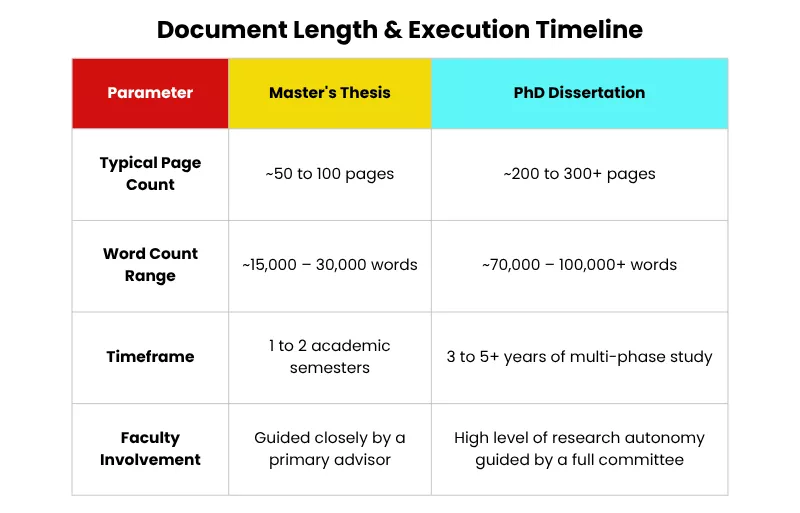
- Master’s theses focus on synthesizing existing literature and applying established methods (~50–100 pages).
- Doctoral dissertations require original research and novel contributions to knowledge (~200–300+ pages).
- Both share a 5-chapter framework, but dissertations span multiple years of fieldwork, while theses take 1-2 semesters.
What Is a Thesis?
In general, a thesis is a document prepared as a final project for a degree, either a master’s thesis in the US or a PhD thesis in the UK. A thesis typically requires the candidate to demonstrate their knowledge of the particular research topic through in-depth analysis of existing research and literature.
A thesis differs from a regular term paper because it is longer and more extensive, and it can take a full semester to write under a professor’s supervision. If you need assistance with your thesis, our professional online assignment help service provides writing support.
The central objective of a thesis is to assess the candidate’s ability to formulate a research question, apply appropriate methodology, participate in scientific debates, and effectively summarize the collected information to support the initial thesis statement.
What Is a Dissertation?
On the other hand, a dissertation is a piece of original research you complete as a requirement for a PhD in the United States, or for an undergraduate or master’s degree in the United Kingdom.
In the US academic system, a dissertation represents the culmination of a PhD program. Unlike a thesis, a dissertation is a body of work that requires you to make an original contribution to knowledge in a particular area of study.
While a thesis often builds upon the literature and scholarly research, a dissertation often takes an original angle and scope.
A dissertation involves a long piece of work that requires you to write a detailed, formal research proposal, conduct field or lab research, analyze data, and defend your findings and methodology before a board of faculty members.
Dissertation vs Thesis: Key Differences Explained
Understanding the key difference between a dissertation and a thesis is essential: both are lengthy, complex scholarly projects, but they differ in purpose, scope, originality, and thesis and dissertation length.
Perhaps the most distinguishing features that set these papers apart are the expectation of originality and scope of exploration:
| Aspect | Thesis | Dissertation |
| Primary Academic Level (US) | Master’s Degree | Doctoral Degree (PhD) |
| Primary Academic Level (UK) | Doctoral Degree (PhD) | Undergraduate / Master’s Degree |
| Main Objective(US) | Demonstrates mastery and synthesis of existing scholarly knowledge | Generates novel, original research and new theoretical contributions |
| Typical Length | ~50 – 100 pages (15,000 – 30,000 words) | ~200 – 300+ pages (70,000 – 100,000+ words), varies widely by field and institution. |
| Duration | 1 to 2 semesters | Typically developed across the 3 to 5+ years of a full PhD program, including research, data collection, and manuscript drafting. |
| Research Approach(US) | Applying existing methodologies and frameworks | Developing original hypotheses, field research, or new methodologies |
| Defense Requirement | Varies by program (oral presentation or written sign-off) | Required by nearly all doctoral programs (Defense / Viva Voce) |
The US vs UK Naming Flip: Main Differences Explained
The transatlantic terminology inversion, often summed up in the classic thesis vs dissertation US vs UK debate, causes considerable confusion among postgraduate students and international applicants.
The Linguistic Flip Breakdown
To understand why this trips up applicants, one must examine the correspondence between the terms across academic degrees:
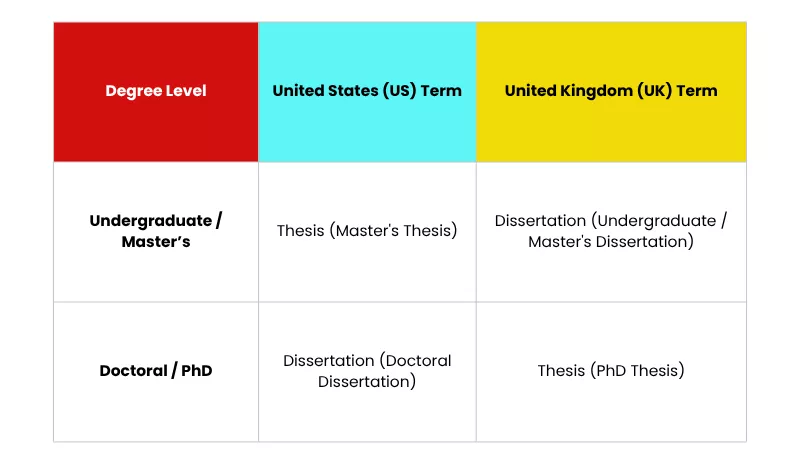
In the US: You write a thesis as part of obtaining your Master’s to demonstrate your ability to synthesize the literature, and you write a dissertation as part of obtaining your PhD to demonstrate your ability to create new knowledge.
In the UK: It’s the other way around. You write a dissertation as part of your Bachelor’s or Master’s degree, and the huge PhD project is called a thesis.
Where the Words Come From
The difference has its roots in Greek and Latin etymology and in the way different university systems adopted the two words. Both terms trace back to the idea of presenting an argument for evaluation.
The Historical Root of “Thesis”:
The Greek tithemi means ‘to place or put’ and the related noun thesis was used to indicate propositions put forth for argument. In both systems, a thesis originally meant a position that was put forth for debate.
The Historical Root of “Dissertation”:
The Latin dissertare means ‘to debate or examine’. The word was adopted differently in the US and UK, with the former using it for the doctoral research document and the latter for undergraduate and master’s research projects.
How Do You Know Whether Your Project Should Be a Thesis or Dissertation?
Depending on the degree, university, and academic system, a project should be referred to as a thesis or dissertation. It is vital to distinguish between the two terms when comparing US and UK educational systems since the project’s type does not necessarily differ in size.
Use these questions to identify the appropriate project:
1. What Degree Are You Pursuing and What Is the Difference Between a Thesis and a Dissertation?
US academic programs use different terms to differentiate projects for master’s and doctoral students. For example, a research project for a master’s degree is referred to as a thesis, while doctoral studies require a dissertation. Meanwhile, the UK system often sees these terms used interchangeably depending on the department but leans toward using a dissertation for a bachelor’s or master’s thesis and a thesis for a doctoral project.
2. What Does Your University Call the Project?
The project’s name may vary depending on the university, department, and research field. Therefore, it is essential to rely on the guidelines provided by the academic institution. The handbook, research, or graduate school’s regulations may offer more information about the project’s name and requirements.
3. What Are the Program Requirements?
The university’s program requirements for research projects should highlight the necessary type of work and its particular format. The students should determine if their project is a thesis, dissertation, capstone, or another type of work required for graduation.
4. What Does Your Advisor or Department Require?
It may be necessary to ask for the advisor’s assistance to discover if the project should be called a thesis or dissertation after conducting research on the assignment. The department or graduate school may provide the specific terminology and guidelines for completing and approving the project. Hence, it is critical to rely on the regulations suggested by the academic institution.
The safest approach is to follow the terminology and requirements specified by your institution. The same research project may be described as a thesis in one academic system and a dissertation in another, even when the underlying research expectations are similar.
I’m Applying to a UK University — Is Their “Thesis” the Same as a US Dissertation?

Yes, a UK PhD thesis is broadly equivalent to a US dissertation in academic scope and research rigor.
The reason there is confusion about which document is which comes from the fact that the US and UK higher-education systems use the two terms in reverse.
In the US system, you write a thesis for a Master’s degree and defend a dissertation for a Doctorate.
In the UK system, you write a dissertation at the level of a Master’s or Bachelor’s degree and defend a thesis for a PhD.
So, if you are a student looking to apply for a degree in the UK, it is important to understand that your university will typically call it a thesis rather than a dissertation, but it involves the same level of original research as a US PhD dissertation.
A doctoral thesis will also require you to conduct a thorough review of the existing literature to identify a gap in the research and defend your thesis in an oral examination (viva voce).
Does a Master’s Degree in the US Require a Thesis or a Dissertation?
In the United States higher education system, a thesis is required for a Master’s degree, not a dissertation.Dissertations in American universities are generally reserved for doctoral programs, such as PhD, EdD, or DBA degrees.
While a masters thesis is the traditional research milestone for Master’s candidates, whether you actually have to write one depends on your specific university, field of study, and chosen program track. If your track involves heavy coursework and mid-term assessments rather than a final research manuscript, students can opt for take my exam help to stay on track.
How Does a PhD Dissertation Differ from a Master’s Thesis in Length and Scope?
When comparing a master’s thesis vs doctoral dissertation, you’ll find that although both are significant academic undertakings, they differ considerably in terms of expected scope, length, and research goals.
Scope & Primary Research Goal
Master’s Thesis (Scholarship & Synthesis): A Master’s thesis shows you understand why academic research is important and can evaluate current literature, apply established methodologies, and synthesize complex findings to answer a specific research question.
PhD Dissertation (Originality & Innovation): The primary research goal of a PhD dissertation is to create new knowledge and make a tangible contribution to the understanding of the subject area. Unlike a thesis, a dissertation requires students to pursue uncharted territories and propose novel theoretical models, approaches, and methodologies or conduct unprecedented research that would fill the gaps in the existing knowledge.
Document Length & Execution Timeline
What Chapters Go in a Dissertation, and How Is That Different from a Thesis?
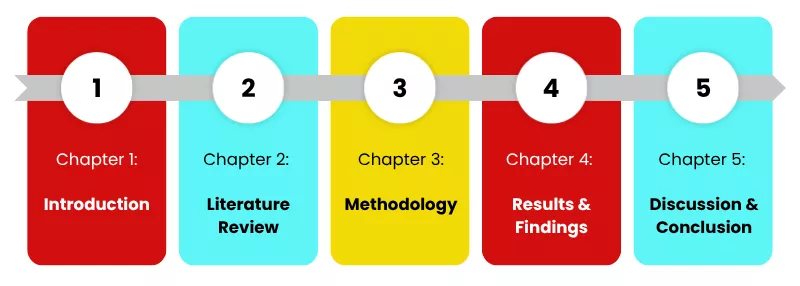
Many a dissertation and thesis share a basic five-chapter backbone, but analyzing the thesis vs dissertation structure reveals distinct differences in empirical complexity, chapter depth, and execution.
Many programs, especially in the social sciences, organize both around five core chapters:
Chapter 1: Introduction
Establishes the research problem, hypotheses, significance, and primary objectives of the project, whether you are framing dissertation topics in education, healthcare, or the physical sciences.
Chapter 2: Literature Review
Provides a comprehensive critical evaluation of existing scholarly work, making it essential to know how to write a literature review that clearly frames the research gap.
Chapter 3: Methodology
Details the research design, data collection instruments, sampling strategies, and analytical procedures used.
Chapter 4: Results & Findings
Presents the empirical data, statistical outputs, or qualitative themes directly addressing the research questions.
Chapter 5: Discussion & Conclusion
Interprets the findings, evaluates their real-world applications, acknowledges study limitations, and outlines future research directions.
Key Structural Differences Between a Dissertation and a Thesis
Beyond this shared framework, a dissertation differs from a thesis in several significant ways:
Defining a Knowledge Gap:
A thesis literature review mainly shows command of the literature, while a dissertation’s must establish the gap the study will fill.
Methodological Depth:
A thesis’s methodology chapter applies established research methods, while a dissertation’s methodology chapter provides much more detailed explanations of the research designs used in the study. A dissertation may use multiple phases of data collection, or it may describe new tools developed for data collection.
Multi-Study & Three-Paper Formats:
A thesis is usually organized around a single line of reasoning that leads to a single chapter of findings. However, a dissertation often involves multiple studies that are used to generate more than one chapter of findings, or it may take the form of a three-paper dissertation, consisting of three journal articles with a combined introduction and conclusion.
Theoretical Contribution:
The thesis’s conclusion discusses what the findings of the study mean. Meanwhile, a dissertation’s conclusion describes what new theory, model, or knowledge was created by the doctoral candidate.
My Program Lists a Thesis Track and a Non-Thesis Track — What’s the Difference?
Choosing between a thesis and non-thesis track comes down to your long-term career goals, your preferred learning style, and whether you plan to pursue further graduate study. Both options usually lead to the same Master’s degree title, but they structure your final academic requirements in very different ways.
1. Thesis Track (Research-Focused)
- What it entails: You establish that a thesis is a project of independent research that you design and execute under the supervision of a faculty advisor or committee.
- Primary Goal: Proves that you know how to write a thesis statement, formulate a focused research question, critically analyze scholarly literature, apply proper research methodologies, and draw evidence-based conclusions.
- Output & Length: A formal research manuscript ranging from 50 to 100 pages, though an extended thesis might require an oral defense before a faculty panel.
- Who it’s for: Students planning to apply to PhD programs, enter academic or corporate research, or publish scholarly work.
2. Non-Thesis Track (Professional & Coursework-Focused)
- What it entails: Replaces the long-form research manuscript with additional upper-level elective courses, practical internships, written comprehensive exams, or a smaller applied capstone project.
- Primary Goal: Focuses on real-world application, advanced skill acquisition, and industry mastery rather than academic research synthesis.
- Output & Length: Industry-oriented deliverables such as a professional portfolio, capstone report, or consulting proposal, or a comprehensive examination in place of a written project.
- Who it’s for: Working professionals, career changers, students seeking direct entry into specialized industry roles, and students in applied fields such as education, business (MBAs), or social work (MSWs). If you need extra academic support or flexibility, or want to pay someone to take my online class to balance demanding workloads, you can reach out to professional online class helpers.
What Are the Research Requirements for a Thesis vs Dissertation?
When examining the thesis vs dissertation research requirements, when examining the difference between the two, you’ll see that both demand systematic investigation and rigorous academic inquiry, but their underlying objectives differ substantially.
| Research Element | Master’s Thesis | PhD Dissertation |
| Primary Requirement | Knowledge Synthesis: Evaluates existing literature, applies established frameworks, and draws evidence-based conclusions on a bounded topic. | Extensive original research: Generates brand-new knowledge, novel theoretical models, or unique empirical findings that fill a clear gap in scholarship. |
| Research Scope & Depth | Bounded in scale, focusing on demonstrating mastery of research design and critical thinking within a single academic year. | Comprehensive, multi-year investigation addressing broad, complex questions with high research autonomy. |
| Data Collection | Relies on small-scale primary research, existing secondary datasets, systematic literature reviews, or archival data. | Multi-phase primary empirical research, extensive fieldwork, large-scale quantitative surveys, or multi-site qualitative studies. |
| Methodological Rigor | Focuses on correctly executing standard, established research methodologies under close advisor supervision. | Demands advanced methodological mastery, custom protocol development, or extensive defense of complex research designs. |
| Faculty Guidance | High level of ongoing supervision from a primary faculty advisor. | Largely independent work, overseen by a faculty committee. |
How Do You Choose a Thesis or Dissertation Topic?
To choose a thesis or dissertation topic, a student needs to develop a certain understanding of the subject. The topic for the research work of the student must be specific enough to explore but broad enough to provide useful information. The student also needs to consider their degree level, academic field, sources, and program requirements.
Consider these factors when selecting a topic:
1. Start With Your Research Interests
First, select a topic that interests you; an exciting topic can keep you motivated to do the research. To get started, students need to find a topic that will keep them engaged for at least several weeks or months. For a master’s thesis, students typically spend one semester, and for a doctoral thesis, up to a year.
2. Identify a Clear Research Problem
Students need to narrow the topic and identify a research question rather than a broad area of study. To get started, you should review the current research literature to identify and formulate a question, challenge, or opportunity, utilizing academic resources like the Purdue OWL research writing guide to refine your research strategy.
3. Check the Scope and Feasibility
You need to choose a question that can be explored within a certain timeframe, with a certain level of resources, money, and equipment. If the topic is too broad, it can be challenging to find the necessary resources. Another challenge may be the lack of time due to the large volume of work.
4. Consider Your Degree Requirements
Students need to ensure that the chosen subject matches their degree level. Different Universities have different requirements for the format and content of the thesis or dissertation.
Moreover, the level of mastery for a research topic must be appropriate for the degree program. For example, the master’s thesis should have a narrower scope, and the dissertation should demonstrate a broader range of research topics.
5. Discuss the Topic with Your Advisor
Students need to consult their faculty or advisor. Students should discuss the topic and initial ideas with a supervisor, advisor, or faculty member to get feedback, suggestions, and approval.
Therefore, the student will choose a topic they are interested in within the program and degree-level framework, allowing them to explore a narrow topic in more detail and motivating them to complete the work promptly.
Can I Reuse My Master’s Thesis Research in My Doctoral Dissertation?

Yes. While it is possible to use your master’s thesis as the basis for your doctoral dissertation, you are required to follow ethical guidelines and policies of your institution to ensure that your work does not constitute self-plagiarism.
Key Guidelines for Reusing Your Master’s Research
Expansion, Not Copy-Pasting:
You may expand on the findings, conclusions, and notes generated during your research for your master’s thesis, but your doctoral dissertation must contain significantly more information and represent an original project. If your program does not allow you to reuse your master’s thesis directly, ask your advisor which aspects of it could be extended through new doctoral research. Often, your master’s thesis can provide a solid framework that you can build upon by conducting new research and publishing additional documents.
Explicit Citation Requirements:
Any material that your master’s thesis provides for your doctoral dissertation, including research results and ideas, should be cited accordingly. You should not present a previously submitted work as your original discovery, and a thesis from your previous degree should not be used as is for your doctoral degree.
Prior Committee Approval:
Before building on your master’s research, get approval from your doctoral advisor and, where your program requires it, your dissertation committee to use the findings, conclusions, and notes from your previous study.
Do I Have to Defend a Master’s Thesis the Same Way As a PhD Dissertation?
When evaluating a dissertation defense vs thesis defense, you’ll notice the process differs significantly in formal structure, examination intensity, committee composition, and stakes. In US higher education, a Master’s degree culmination may require an oral thesis defense, though some programs opt for a written sign-off or capstone project instead.
| Defense Feature | Master’s Thesis Defense | PhD Dissertation / Viva Voce |
| Primary Goal | Proves literature mastery and research competence. | Defends original theoretical & empirical contributions. |
| Duration | Typically 45 to 90 minutes. | Often 1 to 3 hours, depending on the institution. |
| Committee | Typically 2–3 faculty members. | A full committee (US) or internal and external examiners (UK). |
| Requirement | Program-dependent (not required in all programs; some use a project or exam instead) | A dissertation is required by nearly all doctoral programs. |
Is a Research Proposal Required for Both a Thesis and a Dissertation?
In most cases, preparing a formal research proposal is a necessary step before a candidate can begin work on a master’s thesis or doctoral dissertation. A document that serves to outline a candidate’s argumentative focus and methodology is reviewed by faculty members to ensure that the scope of the research problem is viable and appropriate for their degree level.
While the thesis and dissertation proposals have similar objectives, they significantly differ in terms of the required length, research scope, and approval process.
Primary Purpose:
A Master’s thesis proposal usually entails a research question, literature review, and methodology for a project that is feasible within a short timeframe. A PhD dissertation proposal (also known as a prospectus) should demonstrate the potential to make a significant contribution to the existing body of knowledge and the research gap that will be filled by completing the study.
Length and Depth:
Thesis proposals tend to be shorter and less detailed (10-20 pages) than dissertation proposals (30-50+ pages depending on program requirements). Doctoral-level research proposals may contain initial pilot study results, methodology, and analysis.
Approval and Defense:
In many programs, the thesis proposal is approved by the thesis advisor and a second reader without a formal defense. The doctoral dissertation proposal in the US typically requires students to defend their proposal orally, often as a step toward advancing to candidacy.
Institutional Ethics Review:
Both thesis and dissertation proposals require Institutional Review Board (IRB) approval for research involving human subjects (or Institutional Animal Care and Use Committee for animal studies).
How Is a Thesis or Dissertation Graded?
Thesis and dissertation grading is based on the academic and research standards established by the university and program. The exact grading system varies by institution and discipline, but evaluators generally consider the quality of the research, analysis, methodology, academic writing, and the work’s overall contribution.
Common assessment areas include:
Research question:
Whether the project presents a clear, focused, and relevant research problem.
Literature review:
How effectively the work engages with relevant academic sources and establishes the research context.
Methodology:
Whether the selected research methods are appropriate and applied correctly.
Analysis and findings:
The quality of the analysis and how clearly the evidence addresses the research questions.
Critical thinking:
Whether the student evaluates evidence, recognizes limitations, and develops reasoned academic arguments.
Originality and contribution:
Particularly at the doctoral level, evaluators consider whether the research provides a meaningful original contribution to the field.
Academic presentation:
Organization, clarity, referencing, formatting, and adherence to institutional requirements.
Defense or oral examination:
Where required, the student’s ability to explain, justify, and respond to questions about their research may also form part of the assessment.
The weighting of these criteria can differ considerably between programs. Some universities use letter grades or percentages, while others use classifications such as pass, merit, distinction, or satisfactory/unsatisfactory. Always check your program’s assessment rubric rather than assuming that every thesis or dissertation is graded using the same criteria.
Dissertation vs Thesis: Navigating Your Path to Success
Whether you are writing a Master’s thesis or embarking on a multi-year PhD dissertation, taking time to understand the differences in scope, structure, and regional terminology is essential for graduate success. While a thesis focuses on demonstrating literature mastery and synthesis, a dissertation demands novel, original contributions that push the boundaries of your discipline.
Overwhelmed by complex methodologies, literature reviews, or formatting guidelines? Get tailored guidance from verified experts to refine your manuscript, structure your chapters, and help your work meet high academic standards.
Frequently Asked Questions
Can You Get a Master's Without Writing a Thesis?
Yes. Many universities grant non-thesis Master’s degrees, which tend to be more skills and career-oriented, in contrast to thesis-based Master’s degrees. Some schools require additional coursework, comprehensive exams, an industry internship, or a capstone project as an alternative to a thesis.
Is a Thesis Published Like a Dissertation?
Doctoral dissertations are usually deposited in the university’s repository and often in databases such as ProQuest, sometimes after an embargo period, whereas master’s theses are less consistently made public. In addition, it’s worth noting that dissertations are frequently converted into books or scholarly articles.
How Long Does It Take to Write a Dissertation vs a Thesis?
The length of time it takes to finish a thesis or dissertation depends on the degree. A master’s thesis usually takes between 1 and 2 semesters to complete, whereas a doctoral dissertation is typically developed over several years of a PhD program.
What Is a Thesis Statement in a Dissertation?
A thesis statement is a claim or an argument about the topic you want to explore further. If you’re writing a PhD dissertation, you’ll typically present your thesis statement in Chapter 1.
Can an Undergraduate Student Write a Thesis or Dissertation?
Students at the undergraduate level are sometimes required to write a thesis as part of their degree requirements. A thesis is most commonly referred to as an undergraduate thesis or senior thesis when it is presented as part of an honors program at the end of an undergraduate degree.
Undergraduate students in the United States do not typically write dissertations, since the term “dissertation” refers to a doctoral-level thesis; however, in the United Kingdom, it is standard practice for most undergraduate degrees to have a dissertation component, making it helpful for students to clearly grasp the undergraduate dissertation meaning before starting their final year project.
Can a Thesis or Dissertation Be Written as a Collection of Published Papers?
Yes. This is called a manuscript-style (or three-paper) dissertation. The manuscript typically consists of three separate articles with a common theme, bound together by an introduction and a concluding chapter that synthesizes the findings. In the US, a master’s thesis is rarely written this way because there isn’t enough time for students to complete the process of submitting and publishing articles before graduation.
Are Theses and Dissertations Available to the Public After Submission?
Yes, most dissertations are made public through the university repository, often after an optional embargo. Master’s theses are deposited less consistently, depending on the institution.
Can I get a master's degree without writing a thesis?
Yes, many universities grant non-thesis Master’s degrees, which tend to be more skills- and career-oriented, in contrast to thesis-based Master’s degrees. Some schools require additional coursework, comprehensive exams, an industry internship, or a capstone project as an alternative to a thesis.
Is a capstone the same as a thesis?
While a thesis is a formal long-form research manuscript (typically 50 to 100 pages) focusing on academic synthesis or original investigation, a capstone project is an industry-oriented or professional deliverable (such as a professional portfolio, consulting proposal, or capstone report) typically chosen in non-thesis tracks to emphasize real-world application and practical skill acquisition.
Which is harder, a thesis or dissertation?
A doctoral dissertation is generally considered a much larger and more rigorous undertaking than a master’s thesis. While a thesis takes 1 to 2 semesters and focuses on evaluating existing literature and applying established methods (~50–100 pages), a dissertation requires multi-year primary empirical research, extensive fieldwork, and novel contributions to knowledge (~200–300+ pages).

Want To See My Profile — Check Now
- Dissertation vs Thesis: Key Differences Explained (US and UK) - October 1, 2026
- How to Write a Book Title in an Essay: Citation Rules and Mistakes to Avoid - September 28, 2026
- Transition Words for Essays: 100+ Examples by Function - September 10, 2026


