

Taking the ALEKS placement test for the first time? Whether this is your first time or your final attempt, ALEKS PPL is no less challenging. Many students complain that ALEKS PPL is challenging because they barely know the format, questions, grading system, and, most importantly, how to study for the ALEKS placement test. We created this ALEKS PPL test guide to help you understand the test and score well.
Key Takeaways: ALEKS Placement Test
- ALEKS adjusts questions based on your answers to evaluate your mathematical knowledge.
- Expect approximately 25–30 open-response questions covering arithmetic, algebra, geometry, functions, and trigonometry.
- Most students take around 60–90 minutes to complete the assessment.
- Scores range from 0–100 and reflect the percentage of mathematical topics you have mastered.
- ALEKS Prep and Learning Modules help identify knowledge gaps and strengthen weak areas.
- Multiple attempts may be available, depending on your college’s policies.
- A structured seven-day revision plan can help you prepare through focused practice and mock assessments.
- Calculator permissions, proctoring arrangements, time limits, and placement score requirements vary by institution.
What Is an ALEKS Placement Test?
An ALEKS Placement Test is an online, adaptive assessment colleges use to determine the right starting course for you. It is not a pass/fail exam and usually does not affect admission; it measures your current skills so you and your advisor can choose an appropriate course.
If you are willing to take an ALEKS placement assessment, you need to know the system well. ALEKS stands for Assessment and Learning in Knowledge Spaces. ALEKS PPL is an adaptive assessment, so it adjusts questions based on your answers and identifies what you already know, what you need to review, and what you are ready to learn next.
What Is on the ALEKS Placement Test?
The ALEKS PPL (Placement, Preparation and Learning) math test covers topics ranging from basic arithmetic to pre-calculus and trigonometry. It is typically an open-response assessment, not multiple-choice: you work out problems and enter accurate ALEKS answers.
It usually has about 25 questions and takes roughly 60–90 minutes, though some schools allow up to 2.5–3 hours. Your result is generally a score from 0 to 100, representing the percentage of math topics ALEKS estimates you have mastered.
Have questions about preparing for your ALEKS assessment? Chat with our academic support team to explore your study support options.
What Should I Expect When Taking the ALEKS Placement Test for College?

Understanding the assessment format beforehand can help you feel more confident and avoid unnecessary surprises.
Question Type: The assessment generally contains up to 30 open-ended or free-response questions. It is not primarily a multiple-choice examination.
Adaptive Nature: ALEKS adjusts the difficulty and subject matter of subsequent questions based on your previous answers. As a result, two students may receive different questions.
Length: Most students take approximately 60–90 minutes to complete the assessment. However, the actual duration depends on your mathematical knowledge and your college’s testing arrangements.
Calculators: You generally cannot use an external calculator unless your institution explicitly permits one. ALEKS provides an on-screen calculator for specific questions where it’s allowed.
Scoring: Your placement result is reported on a scale of 0–100. It represents the percentage of mathematical topics ALEKS estimates you have mastered.
Test Environment: Depending on your institution, you may take the assessment remotely or through a designated testing center. Proctoring requirements also vary.
How Does the Adaptive Question System Work?
The adaptive format is one of the ALEKS placement test’s most important features.
For example:
- If you correctly solve questions involving fractions and basic equations, the system may move towards more advanced algebra.
- If you struggle with polynomial expressions, ALEKS may use additional questions to assess your understanding of related concepts.
- If you demonstrate proficiency in several mathematical areas, the system can evaluate your readiness for more advanced topics.
This means you cannot prepare by memorizing a fixed set of questions. You need to understand the underlying mathematical concepts and practice solving different types of problems.
What Topics Are on the ALEKS Placement Test?
Although the assessment covers several areas of mathematics, some topics require more attention because they form the foundation for advanced concepts.
Here is a breakdown of what you should revise to improve your academic performance:
| Topic | Concepts to Practice |
| Arithmetic | Fractions, decimals, percentages, integers and ratios |
| Algebra | Linear equations, inequalities and systems of equations |
| Functions | Function notation, graphs and quadratic functions |
| Exponents | Exponent rules, polynomials and factoring |
| Expressions | Rational expressions, radicals and logarithms |
| Geometry | Angles, area, perimeter, volume and coordinate geometry |
| Trigonometry | Trigonometric ratios, functions and identities |
Start with the topics you find difficult, rather than spending equal time on every chapter. This approach makes your preparation more focused and productive.
How Long Is the ALEKS Placement Test?
Most students complete the ALEKS placement assessment in approximately 60–90 minutes. However, no single time limit applies to every college.
Some institutions offer an untimed assessment or allow students a longer completion window. Others establish specific testing limits or require students to complete the assessment during a scheduled session.
For example, Purdue University gives students a 48-hour window to complete an assessment once it begins, while recommending they set aside about two hours.
Therefore, check your university’s instructions before starting the test. Allow enough uninterrupted time to work through the questions carefully without rushing.
Need help managing your academic workload while preparing for your placement assessment? Connect with our team on WhatsApp.
Is the ALEKS Placement Test Proctored?

Not always. Whether or not the ALEKS placement test will be proctored depends on your specific university’s policies. Some schools allow initial attempts to be taken unproctored from home (often as practice or on an honor system). In contrast, official or final placement attempts require remote or in-person proctoring. Other colleges require proctoring for every single official attempt.
This may involve:
- In-person testing at a college testing center.
- Remote proctoring through an approved online service.
- Identity verification before starting the assessment.
- Webcam monitoring and restrictions on external resources.
How Many Questions Are on the ALEKS Placement Test?
The ALEKS PPL placement assessment can contain up to 30 questions, although the exact number may vary depending on the institution and assessment setup.
You may encounter questions involving:
- Quantitative reasoning
- Basic arithmetic and fractions.
- Algebraic expressions and equations.
- Functions and graphs.
- Polynomials and factoring.
- Geometry and trigonometry.
- Exponential and logarithmic concepts.
Since the system adapts to your answers, focus on solving each question accurately rather than predicting what will appear next.
How Do the ALEKS Prep and Learning Modules Help Raise My Placement Score?
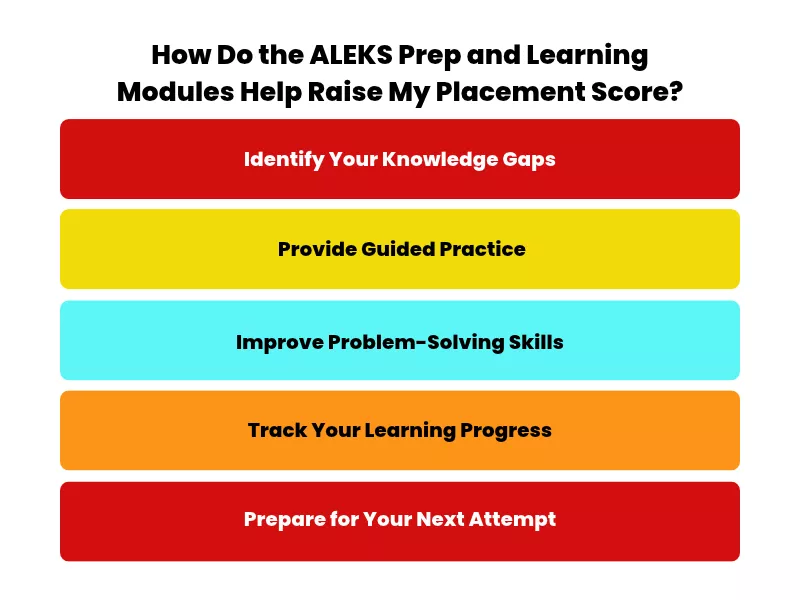
The ALEKS Prep and Learning Modules are personalized study resources designed to help students improve their mathematical knowledge before taking another placement assessment.
After your initial assessment, ALEKS identifies the topics you have mastered and the concepts that require further practice. It then provides a learning path based on your performance.
These modules can help you improve your placement score in several ways and stop you from procrastinating.
- Identify Your Knowledge Gaps
The learning modules highlight topics where you need additional practice. Instead of revising the entire mathematics syllabus, you can concentrate on specific areas that affect your readiness for the next course level.
- Provide Guided Practice
Each module includes explanations, examples, and practice questions to help you understand mathematical concepts. You can work through the material at your own pace.
- Improve Problem-Solving Skills
Regular practice helps you become more comfortable with different question formats. You can learn how to approach unfamiliar problems, apply mathematical rules, and avoid common calculation errors.
- Track Your Learning Progress
ALEKS provides progress information to help you understand which topics you have completed and where you need more work.
- Prepare for Your Next Attempt
Once you have reviewed the required topics, you can take another placement assessment if your institution permits it. The additional preparation can help you demonstrate improved mathematical knowledge.
Remember, completing the modules does not automatically guarantee a higher score. Your next result depends on how well you understand and apply the concepts during the assessment.
How Many Times Can You Take the ALEKS Placement Test?
The number of times you can take the ALEKS placement test depends on your institution’s ALEKS placement test retake policy.
Many colleges allow multiple attempts, with some permitting up to four or five placement assessments within a specified period. However, the number of attempts, waiting periods, and preparation requirements vary.
If you are not confident about the upcoming exam, you can outsource your classes and prepare without hindrance. Take my online class service is designed to handle your classes while you focus on learning outcomes.
What Is the Best Way to Study for the ALEKS Math Placement Test in a Week?
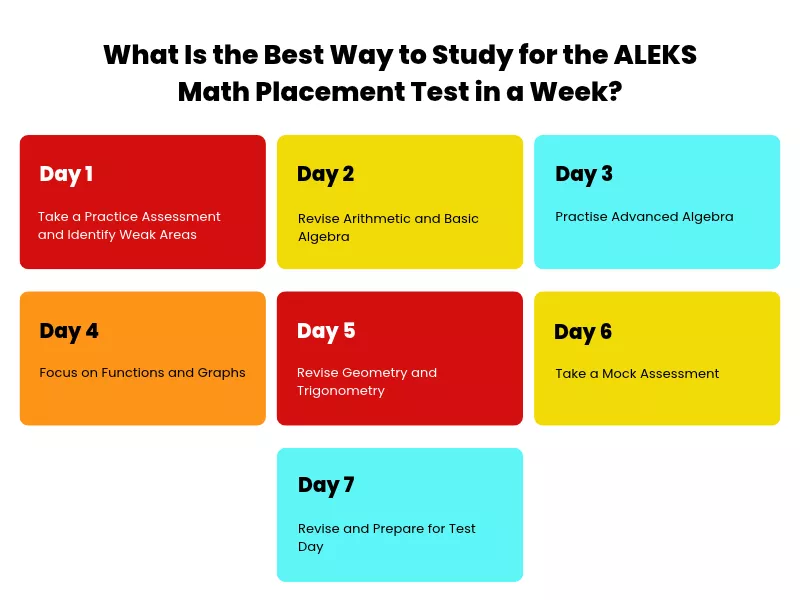
Preparing for the ALEKS math placement test in seven days requires a structured approach. You may not have enough time to revise every mathematical concept in depth, but you can improve your readiness by prioritizing important topics and practicing consistently.
Here is a practical seven-day study plan.
Day 1: Take a Practice Assessment and Identify Weak Areas
Start with an ALEKS placement test practice assessment, if available through your institution, on the first day of college.
Review your performance and identify topics that require additional attention.
Make a list of concepts you find difficult, such as fractions, equations, functions, or trigonometry. Use this list to organize the remaining six days.
Day 2: Revise Arithmetic and Basic Algebra
Focus on mathematical foundations, including:
- Fractions, decimals, and percentages.
- Integers and real numbers.
- Ratios and proportions.
- Linear equations and inequalities.
- Basic algebraic expressions.
Practice solving problems without depending on a calculator.
Day 3: Practice Advanced Algebra
Move on to more challenging algebraic concepts, including:
- Systems of equations.
- Quadratic equations.
- Exponents and polynomials.
- Factoring and polynomial operations.
- Rational expressions.
Work through different problem formats rather than repeatedly solving identical questions.
Day 4: Focus on Functions and Graphs
Review the relationship between mathematical equations and their graphical representations.
Practise:
- Function notation.
- Linear and quadratic functions.
- Coordinate geometry.
- Graph interpretation.
- Function operations and compositions.
Pay particular attention to understanding how changes in equations affect their graphs.
Day 5: Revise Geometry and Trigonometry
Review important formulas and practice applying them to different problems.
Focus on:
- Angles and geometric relationships.
- Perimeter, area, and volume.
- Coordinate geometry.
- Trigonometric ratios.
- Trigonometric functions and identities.
Do not just memorize formulas. Understand when and how to use them.
Day 6: Take a Mock Assessment
Attempt another practice assessment under conditions similar to your actual test.
Avoid unnecessary interruptions and practice solving questions independently.
After completing the assessment, review your mistakes. Identify whether you struggled because of a conceptual misunderstanding, calculation error, or difficulty interpreting the question.
Day 7: Revise and Prepare for Test Day
Use your final preparation day to revisit difficult topics and review important formulas.
Avoid learning too many new concepts at the last minute. Instead:
- Revise your weakest mathematical areas.
- Solve a few mixed-topic questions.
- Review common calculation mistakes.
- Check your computer and internet connection.
- Confirm your institution’s testing and proctoring instructions.
- Get sufficient rest before the assessment.
A focused study schedule can help you prepare more effectively than last-minute cramming. If you tend to delay academic preparation, learning how to [stop procrastinating] can also help you maintain a consistent revision routine.
Looking for reliable academic assistance? Get expert support with your coursework and manage your study commitments more effectively.
Frequently Asked Questions
Can you use a calculator on the ALEKS placement test?
No. Most institutions do not allow calculators on the ALEKS placement test. That being said, you can use the built-in calculator in the ALEKS portal to work out math problems.
Can I retake the ALEKS placement test if I get a low score?
What happens if you do bad on the ALEKS placement test?
Poor grades on the ALEKS math placement test do not mean you failed it. It simply places you into a mathematics course that matches your current skill level. For instance, if your scores do not reflect your knowledge to be placed in advanced calculus, but in intermediate calculus, you will be placed in the latter.
Is the ALEKS placement test hard if I haven’t taken math in years?
The ALEKS PPL test is an adaptive assessment; therefore, if you haven’t taken math in years, it might seem challenging. Practicing math every day gives you an advantage you might lack if you haven’t done it in years.
How is the ALEKS placement test scored, and what score do I need for calculus?
The ALEKS PPL (Placement, Preparation, and Learning) test is scored on a 0-100 scale. The score represents the percentage of math topics you have mastered out of the curriculum evaluated by the adaptive assessment. Because it is an adaptive test, it adjusts ALEKS placement test questions based on your responses and tests your readiness across arithmetic, algebra, precalculus, and trigonometry. Many universities allow multiple attempts in ALEKS PPL. The calculus score is dynamic; it varies by institution.
- General / Standard Calculus I: Typically requires a score of 76 to 85+ (for example, 76+ at the University of South Carolina or University of Rhode Island, 80+ at Baylor University or UT Dallas, and 85+ for honors/specific calc tracks).
- Applied Calculus / Business Calculus: Often has a lower threshold, typically ranging from 61 to 75 depending on the program.
- Precalculus (Prerequisite for Calculus): Usually requires a score between 51 and 75 if you need to take precalculus before moving on to calculus.

Want To See My Profile — Check Now
- ALEKS Placement Test: What to Expect, Scoring, and How to Study for It - November 2, 2026
- Learn How to Get ALEKS Solutions Before You Buy ALEKS Answer Keys - December 19, 2025


